
共通テスト(英語) 過去問
令和4年度(2022年度)追・再試験
問31 (<旧課程>英語リーディング(第5問) 問2)
問題文
各問いの英文や図表を読み、解答番号にあてはまるものとして最も適当な選択肢を選びなさい。
You are applying for a scholarship to attend an international summer program.As part of the application process, you need to make a presentation about a famous person from another country.Complete your presentation slides based on the article below.
During his 87 years of life, both above and below the waves, Jacques Cousteau did many great things.He was an officer in the French navy, an explorer, an environmentalist, a filmmaker, a scientist, an author, and a researcher who studied all forms of underwater life.
Born in France in 1910, he went to school in Paris and then entered the French naval academy in 1930.After graduating in 1933, he was training to become a pilot, when he was involved in a car accident and was badly injured.This put an end to his flying career.To help recover from his injuries, Cousteau began swimming in the Mediterranean, which increased his interest in life underwater.Around this time, he carried out his first underwater research.Cousteau remained in the navy until 1949, even though he could no longer follow his dream of becoming a pilot.
In the 1940s, Cousteau became friends with Marcel Ichac, who lived in the same village.Both men shared a desire to explore unknown and difficult-to-reach places.For Ichac this was mountain peaks, and for Cousteau it was the mysterious world under the sea.In 1943, these two neighbors became widely recognized when they won a prize for the first French underwater documentary.
Their documentary, 18 Meters Deep, had been filmed the previous year without breathing equipment.After their success they went on to make another film, Shipwrecks, using one of the very first underwater breathing devices, known as the Aqua-Lung.While filming Shipwrecks, Cousteau was not satisfied with how long he could breathe underwater, and made improvements to its design.His improved equipment enabled him to explore the wreck of the Roman ship, the Mahdia, in 1948.
Cousteau was always watching the ocean, even from age four when he first learned how to swim.In his book, The Silent World, published in 1953, he describes a group of dolphins following his boat.He had long suspected that dolphins used echolocation(navigating with sound waves)、 so he decided to try an experiment.Cousteau changed direction by a few degrees so that the boat wasn’t following the best course, according to his underwater maps.The dolphins followed for a few minutes, but then changed back to their original course.Seeing this, Cousteau confirmed his prediction about their ability, even though human use of echolocation was still relatively new.
Throughout his life, Cousteau’s work would continue to be recognized internationally.He had the ability to capture the beauty of the world below the surface of the ocean with cameras, and he shared the images with ordinary people through his many publications.For this he was awarded the Special Gold Medal by National Geographic in 1961.Later, his lifelong passion for environmental work would help educate people on the necessity of protecting the ocean and aquatic life.For this he was honored in 1977 with the United Nations International Environment Prize.
Jacques Cousteau’s life has inspired writers, filmmakers, and even musicians.In 2010, Brad Matsen published Jacques Cousteau: The Sea King.This was followed by the film The Odyssey in 2016, which shows his time as the captain of the research boat Calypso.When Cousteau was at the peak of his career, the American musician John Denver used the research boat as the title for a piece on his album Windsong.
Cousteau himself produced more than 50 books and 120 television documentaries.His first documentary series, The Undersea World of Jacques Cousteau, ran for ten years.His style of presentation made these programs very popular, and a second documentary series, The Cousteau Odyssey, was aired for another five years.Thanks to the life and work of Jacques Cousteau, we have a better understanding of what is going on under the waves.
Choose the best option to complete the Early Career(before 1940)slide.( 31 )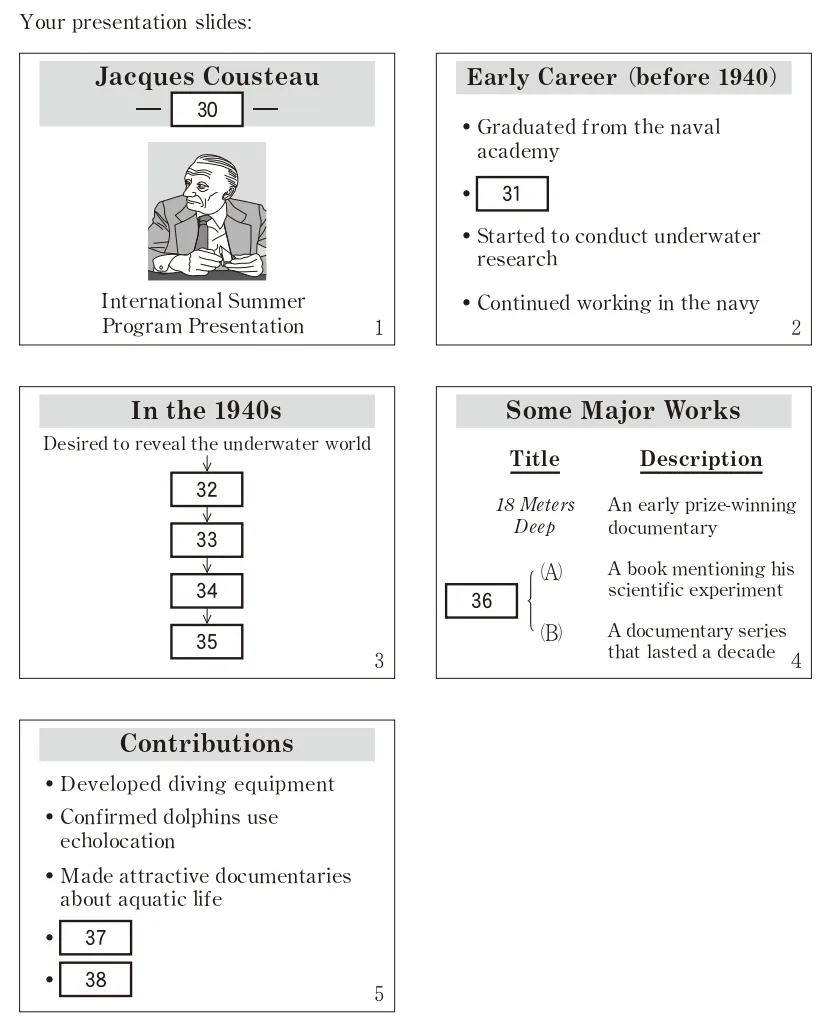
You are applying for a scholarship to attend an international summer program.As part of the application process, you need to make a presentation about a famous person from another country.Complete your presentation slides based on the article below.
During his 87 years of life, both above and below the waves, Jacques Cousteau did many great things.He was an officer in the French navy, an explorer, an environmentalist, a filmmaker, a scientist, an author, and a researcher who studied all forms of underwater life.
Born in France in 1910, he went to school in Paris and then entered the French naval academy in 1930.After graduating in 1933, he was training to become a pilot, when he was involved in a car accident and was badly injured.This put an end to his flying career.To help recover from his injuries, Cousteau began swimming in the Mediterranean, which increased his interest in life underwater.Around this time, he carried out his first underwater research.Cousteau remained in the navy until 1949, even though he could no longer follow his dream of becoming a pilot.
In the 1940s, Cousteau became friends with Marcel Ichac, who lived in the same village.Both men shared a desire to explore unknown and difficult-to-reach places.For Ichac this was mountain peaks, and for Cousteau it was the mysterious world under the sea.In 1943, these two neighbors became widely recognized when they won a prize for the first French underwater documentary.
Their documentary, 18 Meters Deep, had been filmed the previous year without breathing equipment.After their success they went on to make another film, Shipwrecks, using one of the very first underwater breathing devices, known as the Aqua-Lung.While filming Shipwrecks, Cousteau was not satisfied with how long he could breathe underwater, and made improvements to its design.His improved equipment enabled him to explore the wreck of the Roman ship, the Mahdia, in 1948.
Cousteau was always watching the ocean, even from age four when he first learned how to swim.In his book, The Silent World, published in 1953, he describes a group of dolphins following his boat.He had long suspected that dolphins used echolocation(navigating with sound waves)、 so he decided to try an experiment.Cousteau changed direction by a few degrees so that the boat wasn’t following the best course, according to his underwater maps.The dolphins followed for a few minutes, but then changed back to their original course.Seeing this, Cousteau confirmed his prediction about their ability, even though human use of echolocation was still relatively new.
Throughout his life, Cousteau’s work would continue to be recognized internationally.He had the ability to capture the beauty of the world below the surface of the ocean with cameras, and he shared the images with ordinary people through his many publications.For this he was awarded the Special Gold Medal by National Geographic in 1961.Later, his lifelong passion for environmental work would help educate people on the necessity of protecting the ocean and aquatic life.For this he was honored in 1977 with the United Nations International Environment Prize.
Jacques Cousteau’s life has inspired writers, filmmakers, and even musicians.In 2010, Brad Matsen published Jacques Cousteau: The Sea King.This was followed by the film The Odyssey in 2016, which shows his time as the captain of the research boat Calypso.When Cousteau was at the peak of his career, the American musician John Denver used the research boat as the title for a piece on his album Windsong.
Cousteau himself produced more than 50 books and 120 television documentaries.His first documentary series, The Undersea World of Jacques Cousteau, ran for ten years.His style of presentation made these programs very popular, and a second documentary series, The Cousteau Odyssey, was aired for another five years.Thanks to the life and work of Jacques Cousteau, we have a better understanding of what is going on under the waves.
Choose the best option to complete the Early Career(before 1940)slide.( 31 )
このページは閲覧用ページです。
履歴を残すには、 「新しく出題する(ここをクリック)」 をご利用ください。
問題
反映中…
共通テスト(英語)試験 令和4年度(2022年度)追・再試験 問31(<旧課程>英語リーディング(第5問) 問2) (訂正依頼・報告はこちら)
各問いの英文や図表を読み、解答番号にあてはまるものとして最も適当な選択肢を選びなさい。
You are applying for a scholarship to attend an international summer program.As part of the application process, you need to make a presentation about a famous person from another country.Complete your presentation slides based on the article below.
During his 87 years of life, both above and below the waves, Jacques Cousteau did many great things.He was an officer in the French navy, an explorer, an environmentalist, a filmmaker, a scientist, an author, and a researcher who studied all forms of underwater life.
Born in France in 1910, he went to school in Paris and then entered the French naval academy in 1930.After graduating in 1933, he was training to become a pilot, when he was involved in a car accident and was badly injured.This put an end to his flying career.To help recover from his injuries, Cousteau began swimming in the Mediterranean, which increased his interest in life underwater.Around this time, he carried out his first underwater research.Cousteau remained in the navy until 1949, even though he could no longer follow his dream of becoming a pilot.
In the 1940s, Cousteau became friends with Marcel Ichac, who lived in the same village.Both men shared a desire to explore unknown and difficult-to-reach places.For Ichac this was mountain peaks, and for Cousteau it was the mysterious world under the sea.In 1943, these two neighbors became widely recognized when they won a prize for the first French underwater documentary.
Their documentary, 18 Meters Deep, had been filmed the previous year without breathing equipment.After their success they went on to make another film, Shipwrecks, using one of the very first underwater breathing devices, known as the Aqua-Lung.While filming Shipwrecks, Cousteau was not satisfied with how long he could breathe underwater, and made improvements to its design.His improved equipment enabled him to explore the wreck of the Roman ship, the Mahdia, in 1948.
Cousteau was always watching the ocean, even from age four when he first learned how to swim.In his book, The Silent World, published in 1953, he describes a group of dolphins following his boat.He had long suspected that dolphins used echolocation(navigating with sound waves)、 so he decided to try an experiment.Cousteau changed direction by a few degrees so that the boat wasn’t following the best course, according to his underwater maps.The dolphins followed for a few minutes, but then changed back to their original course.Seeing this, Cousteau confirmed his prediction about their ability, even though human use of echolocation was still relatively new.
Throughout his life, Cousteau’s work would continue to be recognized internationally.He had the ability to capture the beauty of the world below the surface of the ocean with cameras, and he shared the images with ordinary people through his many publications.For this he was awarded the Special Gold Medal by National Geographic in 1961.Later, his lifelong passion for environmental work would help educate people on the necessity of protecting the ocean and aquatic life.For this he was honored in 1977 with the United Nations International Environment Prize.
Jacques Cousteau’s life has inspired writers, filmmakers, and even musicians.In 2010, Brad Matsen published Jacques Cousteau: The Sea King.This was followed by the film The Odyssey in 2016, which shows his time as the captain of the research boat Calypso.When Cousteau was at the peak of his career, the American musician John Denver used the research boat as the title for a piece on his album Windsong.
Cousteau himself produced more than 50 books and 120 television documentaries.His first documentary series, The Undersea World of Jacques Cousteau, ran for ten years.His style of presentation made these programs very popular, and a second documentary series, The Cousteau Odyssey, was aired for another five years.Thanks to the life and work of Jacques Cousteau, we have a better understanding of what is going on under the waves.
Choose the best option to complete the Early Career(before 1940)slide.( 31 )
You are applying for a scholarship to attend an international summer program.As part of the application process, you need to make a presentation about a famous person from another country.Complete your presentation slides based on the article below.
During his 87 years of life, both above and below the waves, Jacques Cousteau did many great things.He was an officer in the French navy, an explorer, an environmentalist, a filmmaker, a scientist, an author, and a researcher who studied all forms of underwater life.
Born in France in 1910, he went to school in Paris and then entered the French naval academy in 1930.After graduating in 1933, he was training to become a pilot, when he was involved in a car accident and was badly injured.This put an end to his flying career.To help recover from his injuries, Cousteau began swimming in the Mediterranean, which increased his interest in life underwater.Around this time, he carried out his first underwater research.Cousteau remained in the navy until 1949, even though he could no longer follow his dream of becoming a pilot.
In the 1940s, Cousteau became friends with Marcel Ichac, who lived in the same village.Both men shared a desire to explore unknown and difficult-to-reach places.For Ichac this was mountain peaks, and for Cousteau it was the mysterious world under the sea.In 1943, these two neighbors became widely recognized when they won a prize for the first French underwater documentary.
Their documentary, 18 Meters Deep, had been filmed the previous year without breathing equipment.After their success they went on to make another film, Shipwrecks, using one of the very first underwater breathing devices, known as the Aqua-Lung.While filming Shipwrecks, Cousteau was not satisfied with how long he could breathe underwater, and made improvements to its design.His improved equipment enabled him to explore the wreck of the Roman ship, the Mahdia, in 1948.
Cousteau was always watching the ocean, even from age four when he first learned how to swim.In his book, The Silent World, published in 1953, he describes a group of dolphins following his boat.He had long suspected that dolphins used echolocation(navigating with sound waves)、 so he decided to try an experiment.Cousteau changed direction by a few degrees so that the boat wasn’t following the best course, according to his underwater maps.The dolphins followed for a few minutes, but then changed back to their original course.Seeing this, Cousteau confirmed his prediction about their ability, even though human use of echolocation was still relatively new.
Throughout his life, Cousteau’s work would continue to be recognized internationally.He had the ability to capture the beauty of the world below the surface of the ocean with cameras, and he shared the images with ordinary people through his many publications.For this he was awarded the Special Gold Medal by National Geographic in 1961.Later, his lifelong passion for environmental work would help educate people on the necessity of protecting the ocean and aquatic life.For this he was honored in 1977 with the United Nations International Environment Prize.
Jacques Cousteau’s life has inspired writers, filmmakers, and even musicians.In 2010, Brad Matsen published Jacques Cousteau: The Sea King.This was followed by the film The Odyssey in 2016, which shows his time as the captain of the research boat Calypso.When Cousteau was at the peak of his career, the American musician John Denver used the research boat as the title for a piece on his album Windsong.
Cousteau himself produced more than 50 books and 120 television documentaries.His first documentary series, The Undersea World of Jacques Cousteau, ran for ten years.His style of presentation made these programs very popular, and a second documentary series, The Cousteau Odyssey, was aired for another five years.Thanks to the life and work of Jacques Cousteau, we have a better understanding of what is going on under the waves.
Choose the best option to complete the Early Career(before 1940)slide.( 31 )
- Developed underwater breathing equipment
- Forced to give up his dream of becoming a pilot
- Shifted his focus from the ocean to the air
- Suffered severe injuries while underwater
正解!素晴らしいです
残念...
画像拡大
この過去問の解説 (3件)
01
問の訳は以下の通りです。
初期キャリア(1940年以前)のスライドを完成させるのに最適な選択肢を選んでください。( 31 )
スライドを見ると、以下のように記載があります。
・Graduated from naval school(海軍学校を卒業)
・(31)
・Started to conduct underwater research(水中調査を始めた)
・Continued working in the navy (海軍で働き続けた)
本文第二段階を確認すると、
Born in France in 1910, he went to school in Paris and then entered the French naval academy in 1930.After graduating in 1933, he was training to become a pilot, when he was involved in a car accident and was badly injured.This put an end to his flying career.To help recover from his injuries, Cousteau began swimming in the Mediterranean, which increased his interest in life underwater.Around this time, he carried out his first underwater research.Cousteau remained in the navy until 1949, even though he could no longer follow his dream of becoming a pilot.
1910年、フランス生まれ。パリで学校に通い、1930年にフランス海軍兵学校に入学。1933年に卒業後、パイロットの訓練を受けていたが、自動車事故に遭い重傷を負った。これにより、彼の飛行士としてのキャリアは終わりを告げた。怪我の回復のため、クストーは地中海で泳ぎ始め、水中生物への関心を深めていった。この頃、彼は初めて水中調査を行った。パイロットになるという夢は叶わなくなったものの、クストーは1949年まで海軍に在籍し続けた。
これを踏まえて、各選択肢を確認しましょう。
訳:水中呼吸装置を開発
本文にて言及されていないため、不正解です。
訳:パイロットになる夢を諦めざるを得なかった
本文の内容と一致します。よってこの選択肢が正解です。
訳:海から空へと関心を移した
海に関心を移したため、不正解です。
訳:水中で重傷を負った
自動車事故により重傷を負ったため、不正解です。
参考になった数0
この解説の修正を提案する
02
問題文は
「1940年以前の初期の経歴のスライドを完成させなさい。」
です。
該当のスライドは
・Graduated from naval school(海軍の学校を卒業した)
・(31)
・Started to conduct underwater research(海面下の調査を始めた)
となっており、「学校卒業」と「調査開始」の間に起ったことを選ぶことになります。
この間に関する記述は
After graduating in 1933, he was training to become a pilot, when he was involved in a car accident and was badly injured.This put an end to his flying career.To help recover from his injuries, Cousteau began swimming in the Mediterranean, which increased his interest in life underwater.
(1933年卒業後、彼はパイロットになる訓練をしていたが、そのときに車の事故に巻き込まれ、ひどくケガした。これが、パイロットのキャリアの終わりとなった。ケガからの回復を助けるため、 CousteauはMediterraneanで泳ぎ始めた。それが、海面下への興味を増加させた。)
となっています。
この内容と合うものを選びます。
「水中で呼吸する装置を開発した」
内容と一致しません。
正解「パイロットになる夢を諦めるよう強いられた。」
内容と一致します。
「意識を海から空に移した」
「海中にいるときにひどいケガに苦しんだ」
参考になった数0
この解説の修正を提案する
03
ジャック・クストーの初期の経歴(1940年以前)のスライドを完成させるために、もっとも適切な選択肢を選ぶ問題です。
訳)
あなたは国際サマープログラムに参加するための奨学金に応募しています。その応募プロセスの一環として、他国の有名人についてのプレゼンテーションを作成しなければなりません。以下の記事に基づいて、プレゼンテーションのスライドを完成させてください。
彼の87年間の人生の中で、海上でも海中でも、ジャック・クストーは多くの偉大なことを成し遂げました。彼はフランス海軍の士官、探検家、環境保護活動家、映画の脚本家、科学者、作家、そしてあらゆる海中生物の研究者でした。
・officer(名詞) : 士官という意味です。
・environmentalist(名詞) : 環境保護活動家という意味です。
・underwater life : 海中生物という意味です。
1910年にフランスで生まれ、パリの学校に通い、1930年にフランス海軍学校に入りました。1933年に卒業後、パイロットになる訓練を受けていましたが、交通事故で大けがを負い、その夢は断たれました。けがの回復のため、クストーは地中海で泳ぎ始め、海中への関心が深まりました。この頃、彼は初めての海中研究を行いました。パイロットにはなれませんでしたが、クストーは1949年まで海軍に所属し続けました。
・involve(動詞) : 巻き込むという意味です。
・Mediterranean(名詞) : 地中海という意味です。
・carry out : 行う、実行するという意味です。
1940年代、クストーは同じ村に住むマルセル・イシャックと友人になりました。2人とも、未知で困難な場所を探検したいという思いを共有していました。イシャックにとっては山の頂上、クストーにとっては海の深い世界です。1943年、2人はフランス初の海中ドキュメンタリーで賞を受け、有名になりました。
・unknown(形容詞) : 未知、知られていないという意味です。
・difficult-to-reach places : 到達、たどり着くのに難しい場所という意味です。
・peak(名詞) : 頂上、てっぺんという意味です。
・recognize(動詞) : 表彰する、称える、認めるという意味です。
その作品「18メートルの深み」は、前年に呼吸装置なしで撮影されたものでした。その成功後、彼らはアクアラング(初期の海中呼吸装置)を使って難破船を撮影しました。撮影中クストーは水中で呼吸できる時間に満足できず、装置を改良しました。改良した装置で、彼は1948年にローマ時代の船アフディア号の残骸の調査をしました。
・breathing equipment : 呼吸装置という意味です。
・is satisfied with : ~に満足するという意味です。
・improvement(名詞) : 改良という意味です。
・enable 人 to : 人に~できるようにするという意味です。
・wreck(残骸) : 残骸という意味です。
クストーは4歳のころ水泳を覚えて以来、常に海を見つめてきました。1953年出版の「沈黙の世界」で、イルカが船についてくる様子を書いています。クストーは以前から、イルカが「反響定位(音で周囲を把握する能力)」を使うと考えており、ある実験を行うことを決めました。クストーは水中地図の最適な航路を進まないように、船の進む方向を数度だけ変えました。するとイルカはしばらくついてきましたが、やがて元の正しい進路へ戻りました。これを見て、人による反響定位の利用は比較的新しかったにもかかわらず、クストーは自分の考えが正しいことを確信しました。
・describe(動詞): 描く、記述するという意味です。
・suspect(動詞) : 疑うという意味です。
・confirm(動詞): 確認する、裏付けるという意味です。
・prediction(名詞) : 予言、予報という意味です。
・relatively(副詞) : 比較的という意味です。
彼の生涯の仕事は世界的に高く評価されました。クストーは海中の美しさをカメラで見事に捉え、出版物を通して多くの人々に共有しました。これにより、1961年にはナショナルジオグラフィック協会の特別金賞を授与されました。その後彼の生涯にわたる環境保護への情熱は、人々に海や水生生物を守る必要性を教える助けとなりました。この功績により、1977年に国連国際環境賞を受賞しました。
・publication(名詞) : 出版物という意味です。
・necessity(名詞) : 必要なこと、不可欠なものという意味です。
・aquatic life : 水生生物、海洋生物という意味です。
クストーの生涯は作家、映画監督、音楽家にも影響を与えました。2010年にはブラッド・マツセンは「海の王 ジャック・クストー」を出版しました。2016年には彼の研究船カリプソ号時代を描いた映画「オデッセイ」が公開されました。また、クストーがキャリアの絶頂期にあったころ、アメリカの音楽家ジョン・デンバーは、研究船の名を自身のアルバム「ウィンドソング」の収録曲のタイトルに使いました。
クストー自身も50冊以上の本と120のTVドキュメンタリーを制作しました。最初のシリーズ「クストーの海底世界」は10年続き、彼独自のプレゼンテーションスタイルにより非常に人気を集めました。続く第2シリーズ「クストーのオデッセイ」は5年放送されました。ジャック・クストーのおかげで、私たちは海の中で何が起きているかをより深く理解できるようになりました。
・air(動詞) : 放送するという意味です。
初期の経歴(1940年以前)
・海軍学校を卒業
・_____
・海中研究を始めた
・そのまま海軍勤務を続けた
不正解
水中呼吸装置を開発したという意味です。
アクアラングの開発は1943年以降のため不適切です。
正解
パイロットになる夢をあきらめざるを得なかったという意味です。
2段落目に、After graduating in 1933, he was training to become a pilot, when he was involved in a car accident and was badly injured.This put an end to his flying career(1933年に卒業後、パイロットになる訓練を受けていましたが、交通事故で大けがを負い、その夢は断たれました).と述べられているため正解です。
不正解
関心を海から空へ移したという意味です。
空から海に興味が移ったため不正解です。
・shift(動詞) : 移すという意味です。
不正解
水中で重傷を負ったという意味です。
けがをしたのは交通事故のため不正解です。
海軍学校卒業後、パイロットを目指す→事故で断念→海中研究の道に進む流れなので、「Forced to give up his dream of becoming a pilot」が正解です。
参考になった数0
この解説の修正を提案する
前の問題(問30)へ
令和4年度(2022年度)追・再試験 問題一覧
次の問題(問32)へ