
共通テスト(英語) 過去問
令和5年度(2023年度)本試験
問117 (<旧課程>英語リーディング(第5問) 問3)
問題文
各問いの英文や図表を読み、解答番号にあてはまるものとして最も適当な選択肢を選びなさい。
Your English teacher has told everyone in your class to find an inspirational story and present it to a discussion group, using notes. You have found a story written by a high school student in the UK.
Lessons from Table Tennis
Ben Carter
The ball flew at lightning speed to my backhand. It was completely unexpected and I had no time to react. I lost the point and the match. Defeat... Again! This is how it was in the first few months when I started playing table tennis. It was frustrating, but I now know that the sport taught me more than simply how to be a better athlete.
In middle school, I loved football. I was one of the top scorers, but I didn’t get along with my teammates. The coach often said that I should be more of a team player. I knew I should work on the problem, but communication was just not my strong point.
I had to leave the football club when my family moved to a new town. I wasn’t upset as I had decided to stop playing football anyway. My new school had a table tennis club, coached by the PE teacher, Mr Trent, and I joined that. To be honest, I chose table tennis because I thought it would be easier for me to play individually.
At first, I lost more games than I won. I was frustrated and often went straight home after practice, not speaking to anyone. One day, however, Mr Trent said to me, ”You could be a good player, Ben, but you need to think more about your game. What do you think you need to do?” ”I don’t know,” I replied, ”focus on the ball more?” ”Yes,” Mr Trent continued, ”but you also need to study your opponent’s moves and adjust your play accordingly. Remember, your opponent is a person, not a ball.” This made a deep impression on me.
I deliberately modified my style of play, paying closer attention to my opponent’s moves. It was not easy, and took a lot of concentration. My efforts paid off, however, and my play improved. My confidence grew and I started staying behind more after practice. I was turning into a star player and my classmates tried to talk to me more than before. I thought that I was becoming popular, but our conversations seemed to end before they really got started. Although my play might have improved, my communication skills obviously hadn’t.
My older brother Patrick was one of the few people I could communicate with well. One day, I tried to explain my problems with communication to him, but couldn’t make him understand. We switched to talking about table tennis. ”What do you actually enjoy about it?” he asked me curiously. I said I loved analysing my opponent’s movements and making instant decisions about the next move. Patrick looked thoughtful. ”That sounds like the kind of skill we use when we communicate,” he said.
At that time, I didn’t understand, but soon after our conversation, I won a silver medal in a table tennis tournament. My classmates seemed really pleased. One of them, George, came running over. ”Hey, Ben!” he said, ”Let’s have a party to celebrate!” Without thinking, I replied, ”I can’t. I’ve got practice.” He looked a bit hurt and walked off without saying anything else.
Why was he upset? I thought about this incident for a long time. Why did he suggest a party? Should I have said something different? A lot of questions came to my mind, but then I realised that he was just being kind. If I’d said, ”Great idea. Thank you! Let me talk to Mr Trent and see if I can get some time off practice,” then maybe the outcome would have been better. At that moment Patrick’s words made sense. Without attempting to grasp someone’s intention, I wouldn’t know how to respond.
I’m still not the best communicator in the world, but I definitely feel more confident in my communication skills now than before. Next year, my friends and I are going to co−ordinate the table tennis league with other schools.
Choose four out of the five options(a〜e)and rearrange them in the order they happened.
a Became a table tennis champion
b Discussed with his teacher how to play well
c Refused a party in his honour
d Started to study his opponents
e Talked to his brother about table tennis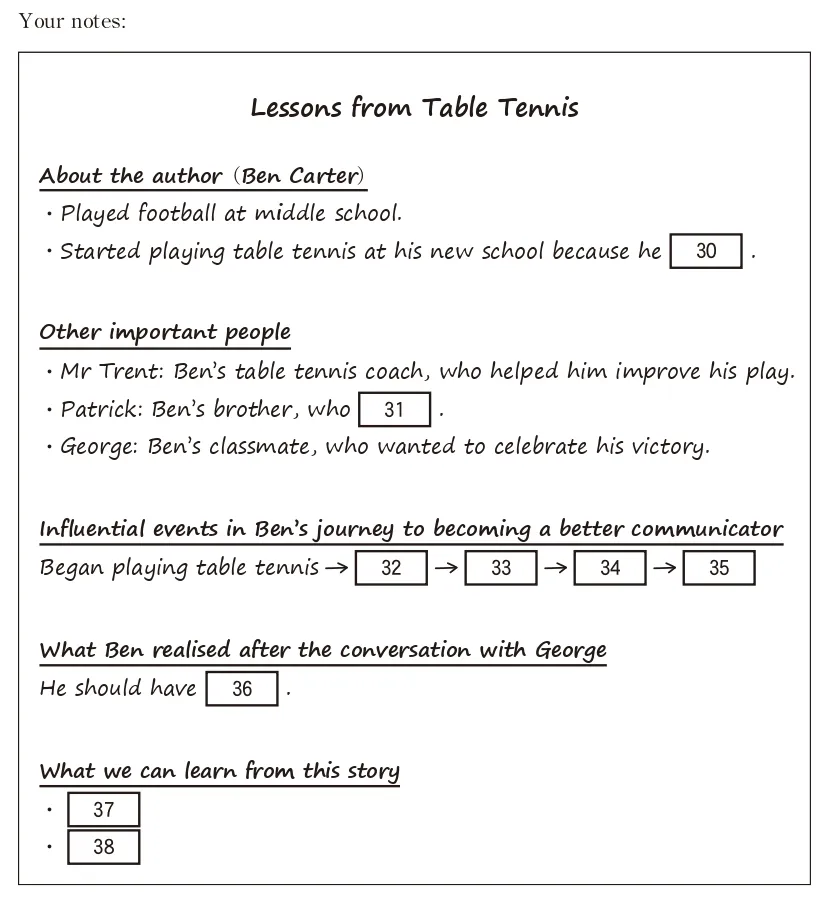
Your English teacher has told everyone in your class to find an inspirational story and present it to a discussion group, using notes. You have found a story written by a high school student in the UK.
Lessons from Table Tennis
Ben Carter
The ball flew at lightning speed to my backhand. It was completely unexpected and I had no time to react. I lost the point and the match. Defeat... Again! This is how it was in the first few months when I started playing table tennis. It was frustrating, but I now know that the sport taught me more than simply how to be a better athlete.
In middle school, I loved football. I was one of the top scorers, but I didn’t get along with my teammates. The coach often said that I should be more of a team player. I knew I should work on the problem, but communication was just not my strong point.
I had to leave the football club when my family moved to a new town. I wasn’t upset as I had decided to stop playing football anyway. My new school had a table tennis club, coached by the PE teacher, Mr Trent, and I joined that. To be honest, I chose table tennis because I thought it would be easier for me to play individually.
At first, I lost more games than I won. I was frustrated and often went straight home after practice, not speaking to anyone. One day, however, Mr Trent said to me, ”You could be a good player, Ben, but you need to think more about your game. What do you think you need to do?” ”I don’t know,” I replied, ”focus on the ball more?” ”Yes,” Mr Trent continued, ”but you also need to study your opponent’s moves and adjust your play accordingly. Remember, your opponent is a person, not a ball.” This made a deep impression on me.
I deliberately modified my style of play, paying closer attention to my opponent’s moves. It was not easy, and took a lot of concentration. My efforts paid off, however, and my play improved. My confidence grew and I started staying behind more after practice. I was turning into a star player and my classmates tried to talk to me more than before. I thought that I was becoming popular, but our conversations seemed to end before they really got started. Although my play might have improved, my communication skills obviously hadn’t.
My older brother Patrick was one of the few people I could communicate with well. One day, I tried to explain my problems with communication to him, but couldn’t make him understand. We switched to talking about table tennis. ”What do you actually enjoy about it?” he asked me curiously. I said I loved analysing my opponent’s movements and making instant decisions about the next move. Patrick looked thoughtful. ”That sounds like the kind of skill we use when we communicate,” he said.
At that time, I didn’t understand, but soon after our conversation, I won a silver medal in a table tennis tournament. My classmates seemed really pleased. One of them, George, came running over. ”Hey, Ben!” he said, ”Let’s have a party to celebrate!” Without thinking, I replied, ”I can’t. I’ve got practice.” He looked a bit hurt and walked off without saying anything else.
Why was he upset? I thought about this incident for a long time. Why did he suggest a party? Should I have said something different? A lot of questions came to my mind, but then I realised that he was just being kind. If I’d said, ”Great idea. Thank you! Let me talk to Mr Trent and see if I can get some time off practice,” then maybe the outcome would have been better. At that moment Patrick’s words made sense. Without attempting to grasp someone’s intention, I wouldn’t know how to respond.
I’m still not the best communicator in the world, but I definitely feel more confident in my communication skills now than before. Next year, my friends and I are going to co−ordinate the table tennis league with other schools.
Choose four out of the five options(a〜e)and rearrange them in the order they happened.
a Became a table tennis champion
b Discussed with his teacher how to play well
c Refused a party in his honour
d Started to study his opponents
e Talked to his brother about table tennis
このページは閲覧用ページです。
履歴を残すには、 「新しく出題する(ここをクリック)」 をご利用ください。
問題
反映中…
共通テスト(英語)試験 令和5年度(2023年度)本試験 問117(<旧課程>英語リーディング(第5問) 問3) (訂正依頼・報告はこちら)
各問いの英文や図表を読み、解答番号にあてはまるものとして最も適当な選択肢を選びなさい。
Your English teacher has told everyone in your class to find an inspirational story and present it to a discussion group, using notes. You have found a story written by a high school student in the UK.
Lessons from Table Tennis
Ben Carter
The ball flew at lightning speed to my backhand. It was completely unexpected and I had no time to react. I lost the point and the match. Defeat... Again! This is how it was in the first few months when I started playing table tennis. It was frustrating, but I now know that the sport taught me more than simply how to be a better athlete.
In middle school, I loved football. I was one of the top scorers, but I didn’t get along with my teammates. The coach often said that I should be more of a team player. I knew I should work on the problem, but communication was just not my strong point.
I had to leave the football club when my family moved to a new town. I wasn’t upset as I had decided to stop playing football anyway. My new school had a table tennis club, coached by the PE teacher, Mr Trent, and I joined that. To be honest, I chose table tennis because I thought it would be easier for me to play individually.
At first, I lost more games than I won. I was frustrated and often went straight home after practice, not speaking to anyone. One day, however, Mr Trent said to me, ”You could be a good player, Ben, but you need to think more about your game. What do you think you need to do?” ”I don’t know,” I replied, ”focus on the ball more?” ”Yes,” Mr Trent continued, ”but you also need to study your opponent’s moves and adjust your play accordingly. Remember, your opponent is a person, not a ball.” This made a deep impression on me.
I deliberately modified my style of play, paying closer attention to my opponent’s moves. It was not easy, and took a lot of concentration. My efforts paid off, however, and my play improved. My confidence grew and I started staying behind more after practice. I was turning into a star player and my classmates tried to talk to me more than before. I thought that I was becoming popular, but our conversations seemed to end before they really got started. Although my play might have improved, my communication skills obviously hadn’t.
My older brother Patrick was one of the few people I could communicate with well. One day, I tried to explain my problems with communication to him, but couldn’t make him understand. We switched to talking about table tennis. ”What do you actually enjoy about it?” he asked me curiously. I said I loved analysing my opponent’s movements and making instant decisions about the next move. Patrick looked thoughtful. ”That sounds like the kind of skill we use when we communicate,” he said.
At that time, I didn’t understand, but soon after our conversation, I won a silver medal in a table tennis tournament. My classmates seemed really pleased. One of them, George, came running over. ”Hey, Ben!” he said, ”Let’s have a party to celebrate!” Without thinking, I replied, ”I can’t. I’ve got practice.” He looked a bit hurt and walked off without saying anything else.
Why was he upset? I thought about this incident for a long time. Why did he suggest a party? Should I have said something different? A lot of questions came to my mind, but then I realised that he was just being kind. If I’d said, ”Great idea. Thank you! Let me talk to Mr Trent and see if I can get some time off practice,” then maybe the outcome would have been better. At that moment Patrick’s words made sense. Without attempting to grasp someone’s intention, I wouldn’t know how to respond.
I’m still not the best communicator in the world, but I definitely feel more confident in my communication skills now than before. Next year, my friends and I are going to co−ordinate the table tennis league with other schools.
Choose four out of the five options(a〜e)and rearrange them in the order they happened.
a Became a table tennis champion
b Discussed with his teacher how to play well
c Refused a party in his honour
d Started to study his opponents
e Talked to his brother about table tennis
Your English teacher has told everyone in your class to find an inspirational story and present it to a discussion group, using notes. You have found a story written by a high school student in the UK.
Lessons from Table Tennis
Ben Carter
The ball flew at lightning speed to my backhand. It was completely unexpected and I had no time to react. I lost the point and the match. Defeat... Again! This is how it was in the first few months when I started playing table tennis. It was frustrating, but I now know that the sport taught me more than simply how to be a better athlete.
In middle school, I loved football. I was one of the top scorers, but I didn’t get along with my teammates. The coach often said that I should be more of a team player. I knew I should work on the problem, but communication was just not my strong point.
I had to leave the football club when my family moved to a new town. I wasn’t upset as I had decided to stop playing football anyway. My new school had a table tennis club, coached by the PE teacher, Mr Trent, and I joined that. To be honest, I chose table tennis because I thought it would be easier for me to play individually.
At first, I lost more games than I won. I was frustrated and often went straight home after practice, not speaking to anyone. One day, however, Mr Trent said to me, ”You could be a good player, Ben, but you need to think more about your game. What do you think you need to do?” ”I don’t know,” I replied, ”focus on the ball more?” ”Yes,” Mr Trent continued, ”but you also need to study your opponent’s moves and adjust your play accordingly. Remember, your opponent is a person, not a ball.” This made a deep impression on me.
I deliberately modified my style of play, paying closer attention to my opponent’s moves. It was not easy, and took a lot of concentration. My efforts paid off, however, and my play improved. My confidence grew and I started staying behind more after practice. I was turning into a star player and my classmates tried to talk to me more than before. I thought that I was becoming popular, but our conversations seemed to end before they really got started. Although my play might have improved, my communication skills obviously hadn’t.
My older brother Patrick was one of the few people I could communicate with well. One day, I tried to explain my problems with communication to him, but couldn’t make him understand. We switched to talking about table tennis. ”What do you actually enjoy about it?” he asked me curiously. I said I loved analysing my opponent’s movements and making instant decisions about the next move. Patrick looked thoughtful. ”That sounds like the kind of skill we use when we communicate,” he said.
At that time, I didn’t understand, but soon after our conversation, I won a silver medal in a table tennis tournament. My classmates seemed really pleased. One of them, George, came running over. ”Hey, Ben!” he said, ”Let’s have a party to celebrate!” Without thinking, I replied, ”I can’t. I’ve got practice.” He looked a bit hurt and walked off without saying anything else.
Why was he upset? I thought about this incident for a long time. Why did he suggest a party? Should I have said something different? A lot of questions came to my mind, but then I realised that he was just being kind. If I’d said, ”Great idea. Thank you! Let me talk to Mr Trent and see if I can get some time off practice,” then maybe the outcome would have been better. At that moment Patrick’s words made sense. Without attempting to grasp someone’s intention, I wouldn’t know how to respond.
I’m still not the best communicator in the world, but I definitely feel more confident in my communication skills now than before. Next year, my friends and I are going to co−ordinate the table tennis league with other schools.
Choose four out of the five options(a〜e)and rearrange them in the order they happened.
a Became a table tennis champion
b Discussed with his teacher how to play well
c Refused a party in his honour
d Started to study his opponents
e Talked to his brother about table tennis
- b → d → e → c
- c → b → d → a
- d → b → e → c
- e → d → b → a
正解!素晴らしいです
残念...
画像拡大
この過去問の解説 (3件)
01
問題文は
「次の5つから4つを選び、起こった順序に並べなさい。」
です。
選択肢に関する英文を本文より探していきます。
a Became a table tennis champion→本文になし
(卓球のチャンピオンになった)
I won a silver medal in a table tennis tournament.
(私は卓球の大会で銀メダル【2位】を獲った)
とはありますが、優勝とは書かれていないため、この選択肢は使いません。
b Discussed with his teacher how to play well→第4段落
(先生と上手にプレイする方法を話した)
→ Mr Trent said to me, ”You could be a good player, Ben, but you need to think more about your game.
(トレント先生は、「君は良い選手になれるが、もっと試合について考える必要がある。」と言った。)
とあり、プレイについて話しています。
c Refused a party in his honor→第7段落
(彼を称えるパーティーを断った)
→ One of them, George, came running over. ”Hey, Ben!” he said, ”Let’s have a party to celebrate!” Without thinking, I replied, ”I can’t. I’ve got practice.”
(私のクラスメイトはの1人のジョージが走ってきた。「やあ、ベン!お祝いのパーティーしよう!」と言った。考えずに、答えた。「できない。練習しなきゃ。」)
とあり、断っています。
d Started to study his opponents→第5段落
(彼の敵を研究し始めた)
I deliberately modified my style of play, paying closer attention to my opponent’s moves.
(私は意図的にプレイのスタイルを修正し、敵の動きにもっと注意するようにした。)
とあり、敵を研究していると言えます。
e Talked to his brother about table tennis→第6段落
(お兄さんと卓球について話した)
→ We switched to talking about table tennis.
(卓球の話に変えた。)
したがって、b → d → e → c となります。
参考になった数0
この解説の修正を提案する
02
設問:5つの出来事(a~b)の中から4つ選び、起こった順番に並べなさい。
a 卓球のチャンピョンになった。
b 先生とどうすれば上手くプレーできるか話し合った。
c 自分を祝うパーティーを断った。
d 相手選手を研究し始めた。
e 兄と卓球について話した。
!問題のポイント!
①本文のストーリーの時系列系問題です。ストーリーを順に追いましょう。
訳)
あなたの英語の先生は、クラスの全員に感動的な話を見つけ、メモを使ってディスカッショングループで発表するように言いました。そしてイギリスの高校生が書いた物語を見つけました。
卓球から学んだこと
Ben Carter
ボールが稲妻のような速さで私のバックハンド側に飛んできました。それは全く予想外で、反応する時間もありませんでした。私はそのポイントも試合も落としました。敗北・・・・またか!卓球を始めた最初の数ヵ月は、いつもこんな感じでした。とても悔しかったですが、今ではこのスポーツが単に良いアスリートになる方法以上のことを私に教えてくれたと分かっています。
・completely unexpected : 完全に予想外だった
・frustrating : 悔しい、イライラする
中学生の頃、私はサッカーが大好きでした。私は得点力の高い選手の1人でしたが、チームメイトとうまくやれませんでした。コーチはよく、もっとチームプレーをするべきだと言っていました。その問題を改善するべきだと分かっていましたが、コミュニケーションは私の得意分野ではありませんでした。
・get along with ~ : ~とうまくやる、仲良くする
家族が新しい街へ引っ越したとき、サッカー部を退部しなければなりませんでした。どうせサッカーは辞めるつもりだったので、それほど悲しくありませんでした。新しい学校には体育教師のTrent先生が指導する卓球部があり、そこに入部しました。正直に言うと、私は個人プレーできて楽だと思ったので卓球を選びました。
・PE teacher : 体育教師
・individually : 個人で
最初は、勝つより負ける試合の方が多かったです。悔しくて練習後は誰とも話さずにすぐに家に帰ることが多かったです。しかしある日、Trenr先生がこう言いました。「Ben、君は良い選手になれる可能性がある。だが、自分のプレーについてもっと考える必要がある。何をすべきだと思う?」「分かりません。ボールにもっと集中することですか?」と答えました。「そうだ。」Trent先生は続けました。「しかし、相手の動きを観察し、それに合わせてプレーを調整する必要もある。」「覚えておきなさい。相手はボールではなく、人間なんだ。」この言葉は私に強い印象を残しました。
・opponent(名詞) : 対戦相手、敵
・accordingly(副詞) : それに応じて
・impression(名詞) : 印象
私は相手の動きにより注意を払うようにして、意識的にプレースタイルを変えました。それは簡単ではなく、多くの集中力が必要でした。しかし努力は実り、プレーは上達しました。自信が付き、練習後も残るようになりました。私は有名になりつつあり、クラスメートも以前より話しかけてくるようになりました。自分は人気者になってきたのだと思いましたが、会話は本格的に始まる前に終わってしまうことが多かったです。プレーは上達したかもしれませんが、コミュニケーション能力は明らかに上達していませんでした。
・deliberately(副詞): 故意に
・modify(動詞) : 変える、調整する
・concentration(名詞) : 集中
・pay off : 報われる
兄のPatrickは、私がうまくコミュニケーションできる数少ない1人でした。ある日、自分のコミュニケーションの問題を説明しようとしましたが、うまく理解してもらえませんでした。そこで話題を卓球に変えました。「卓球のどこが好きなの?」彼は興味深そうに聞きました。私は相手の動きを分析し、次のプレーを瞬時に決めることが好きだと答えました。Patrickは考え込んだ様子でした。「それは人とコミュニケーションするときに使う能力と同じだね。」と彼は言いました。
・curiously(副詞) : 興味深そうに、好奇心旺盛な
・analyse(動詞) : 分析する
・instant decisions : 瞬時に決める
・thoughtful(形容詞) : 思慮深い
そのときは意味が分かりませんでしたが、その会話の後まもなく、卓球大会で銀メダルを取りました。クラスメートはとても喜んでいるようでした。そのうちの1人、Georgeが走ってきました。「Ben!お祝いのパーティーをしよう!と彼は言いました。私は何も考えず「無理だよ。練習があるんだ」と答えました。彼は少し傷ついたような表情をして、何も言わずに立ち去りました。
なぜ彼は悲しんだのだろう?私はこの出来事について長い間考えました。なぜ彼はパーティーを提案したのだろう?違う言い方をすべきだったのだろうか?多くの疑問が頭に浮かびましたが、彼はただ親切にしてくれただけだと気付きました。もし私が「いいね!ありがとう。Trent先生に話して練習を休めるか聞いてみるよ。」と言っていたら、結果はもっと良かったかもしれません※1。そのときPatrickの言葉の意味が分かりました。相手の意図を理解しようとしなければ、どう返事をすればよいか分からないのです。
・incident(名詞) : 出来事、事件
・outcome(名詞) : 結果
・grasp(動詞) : 理解する、捉える、掴む
※1
「If i'd said ~, the outcome would have been better」は「もし私が~と言っていたら、結果はもっと良かったかもしれない」という意味で、過去の事実と反対のことを仮定する表現ですs。
仮定法過去完了と呼ばれ、形は「If 主語 had 過去分詞,主語 would have 過去分詞」です。
例)
If I had said the truth, she would have been angry.
もし本当のことを言っていたら、彼女は怒っていただろう。
参考にしてください。
私はまだ世界一のコミュニケーターではないが、以前よりコミュニケーション能力に自信を持てるようになりました。来年、私は友達と一緒に他校と卓球リーグを運営する予定です。
卓球から学んだこと
作者について(Ben Carter)
・中学校ではサッカーをしていた。
・新しい学校で卓球を始めた。なぜなら彼は( 30 )だったから。
その他の重要な人物
Mr Trent:Benの卓球コーチで、彼のプレーを上達させるのを助けた。
Patrick:Benの兄で、( 31 )。
George:Benのクラスメートで、彼の勝利を祝おうとした。
Benがより良いコミュニケーターになるまでの重要な出来事
卓球を始めた→( 32 )→( 33 )→( 34 )→( 35 )
Georgeとの会話のあとでBenが気づいたこと
彼は( 36 )するべきだった。
この物語から学べること
・( 37 )
・( 38 )
正解
ストーリーの流れを確認しましょう。
①b→4段落目の、Mr Trent said to me, ”You could be a good player, Ben, but you need to think more about your game. What do you think you need to do?” ”I don’t know,” I replied, ”focus on the ball more?” ”Yes,” Mr Trent continued, ”but you also need to study your opponent’s moves and adjust your play accordingly. Remember, your opponent is a person, not a ball.”(Trenr先生がこう言いました。「Ben、君は良い選手になれる可能性がある。だが、自分のプレーについてもっと考える必要がある。何をすべきだと思う?」「分かりません。ボールにもっと集中することですか?」と答えました。「そうだ。」Trent先生は続けました。「しかし、相手の動きを観察し、それに合わせてプレーを調整する必要もある。」「覚えておきなさい。相手はボールではなく、人間なんだ。」)
②d→5段落目の文頭、I deliberately modified my style of play, paying closer attention to my opponent’s moves(私は相手の動きにより注意を払うようにして、意識的にプレースタイルを変えました。).
③e→6段落目の中盤、We switched to talking about table tennis. ”What do you actually enjoy about it?” he asked me curiously. I said I loved analysing my opponent’s movements and making instant decisions about the next move(そこで話題を卓球に変えました。「卓球のどこが好きなの?」彼は興味深そうに聞きました。私は相手の動きを分析し、次のプレーを瞬時に決めることが好きだと答えました).
④c→7段落目の中盤、My classmates seemed really pleased. One of them, George, came running over. ”Hey, Ben!” he said, ”Let’s have a party to celebrate!” Without thinking, I replied, ”I can’t. I’ve got practice.”(クラスメートはとても喜んでいるようでした。そのうちの1人、Georgeが走ってきました。「Ben!お祝いのパーティーをしよう!と彼は言いました。私は何も考えず「無理だよ。練習があるんだ」と答えました。)
以上の流れが本文の流れになるため正解です。
なぜa(卓球のチャンピョンになった)が入らないのか?
本文には、I won a silver medal.と記載があります。つまりチャンピョンではなく、銀メダルを獲得したとういうことが分かるので本文にはない出来事です。
参考になった数0
この解説の修正を提案する
03
筆者が卓球を始める第3段落以降の要旨は次のようになっています。
3 卓球を始める
4 卓球が上手くなるための方法についてTrent先生と話をする (bに対応)
5 相手をよく見て試合をするようになり、自信がつく (dに対応)
6 卓球とコミュニケーションについて兄と話をする (eに対応)
7 大会で銀メダルをとるが、それをお祝いするパーティーへの出席を断ってしまう (cに対応)
8 断るべきでなかったと気が付く
9 まとめ
以上を踏まえて選択肢を見ていきましょう
上述の解説より、これが正解です
参考になった数0
この解説の修正を提案する
前の問題(問116)へ
令和5年度(2023年度)本試験 問題一覧
次の問題(問121)へ