
共通テスト(英語) 過去問
令和5年度(2023年度)本試験
問130 (<旧課程>英語リーディング(第6問) 問7)
問題文
各問いの英文や図表を読み、解答番号にあてはまるものとして最も適当な選択肢を選びなさい。
You are in a student group preparing for an international science presentation contest. You are using the following passage to create your part of the presentation on extraordinary creatures.
Ask someone to name the world’s toughest animal, and they might say the Bactrian camel as it can survive in temperatures as high as 50℃、 or the Arctic fox which can survive in temperatures lower than −58℃. However, both answers would be wrong as it is widely believed that the tardigrade is the toughest creature on earth.
Tardigrades, also known as water bears, are microscopic creatures, which are between 0.1 mm to 1.5 mm in length. They live almost everywhere, from 6,000−meter−high mountains to 4,600 meters below the ocean’s surface. They can even be found under thick ice and in hot springs. Most live in water, but some tardigrades can be found in some of the driest places on earth. One researcher reported finding tardigrades living under rocks in a desert without any recorded rainfall for 25 years. All they need are a few drops or a thin layer of water to live in. When the water dries up, so do they. They lose all but three percent of their body’s water and their metabolism slows down to 0.01% of its normal speed. The dried−out tardigrade is now in a state called ”tun,” a kind of deep sleep. It will continue in this state until it is once again soaked in water. Then, like a sponge, it absorbs the water and springs back to life again as if nothing had happened. Whether the tardigrade is in tun for 1 week or 10 years does not really matter. The moment it is surrounded by water, it comes alive again. When tardigrades are in a state of tun, they are so tough that they can survive in temperatures as low as −272℃ and as high as 151℃. Exactly how they achieve this is still not fully understood.
Perhaps even more amazing than their ability to survive on earth ― they have been on earth for some 540 million years ― is their ability to survive in space. In 2007, a team of European researchers sent a number of living tardigrades into space on the outside of a rocket for 10 days. On their return to earth, the researchers were surprised to see that 68% were still alive. This means that for 10 days most were able to survive X−rays and ultraviolet radiation 1,000 times more intense than here on earth. Later, in 2019, an Israeli spacecraft crashed onto the moon and thousands of tardigrades in a state of tun were spilled onto its surface. Whether these are still alive or not is unknown as no one has gone to collect them ― which is a pity.
Tardigrades are shaped like a short cucumber. They have four short legs on each side of their bodies. Some species have sticky pads at the end of each leg, while others have claws. There are 16 known claw variations, which help identify those species with claws. All tardigrades have a place for eyes, but not all species have eyes. Their eyes are primitive, only having five cells in total ― just one of which is light sensitive.
Basically, tardigrades can be divided into those that eat plant matter, and those that eat other creatures. Those that eat vegetation have a ventral mouth ― a mouth located in the lower part of the head, like a shark. The type that eats other creatures has a terminal mouth, which means the mouth is at the very front of the head, like a tuna. The mouths of tardigrades do not have teeth. They do, however, have two sharp needles, called stylets, that they use to pierce plant cells or the bodies of smaller creatures so the contents can be sucked out.
Both types of tardigrade have rather simple digestive systems. The mouth leads to the pharynx(throat)、 where digestive juices and food are mixed. Located above the pharynx is a salivary gland. This produces the juices that flow into the mouth and help with digestion. After the pharynx, there is a tube which transports food toward the gut. This tube is called the esophagus. The middle gut, a simple stomach/intestine type of organ, digests the food and absorbs the nutrients. The leftovers then eventually move through to the anus.
For the Secrets to Survival slide, select two features of the tardigrade which best help it survive. (The order does not matter.) ( 45 )・( 46 )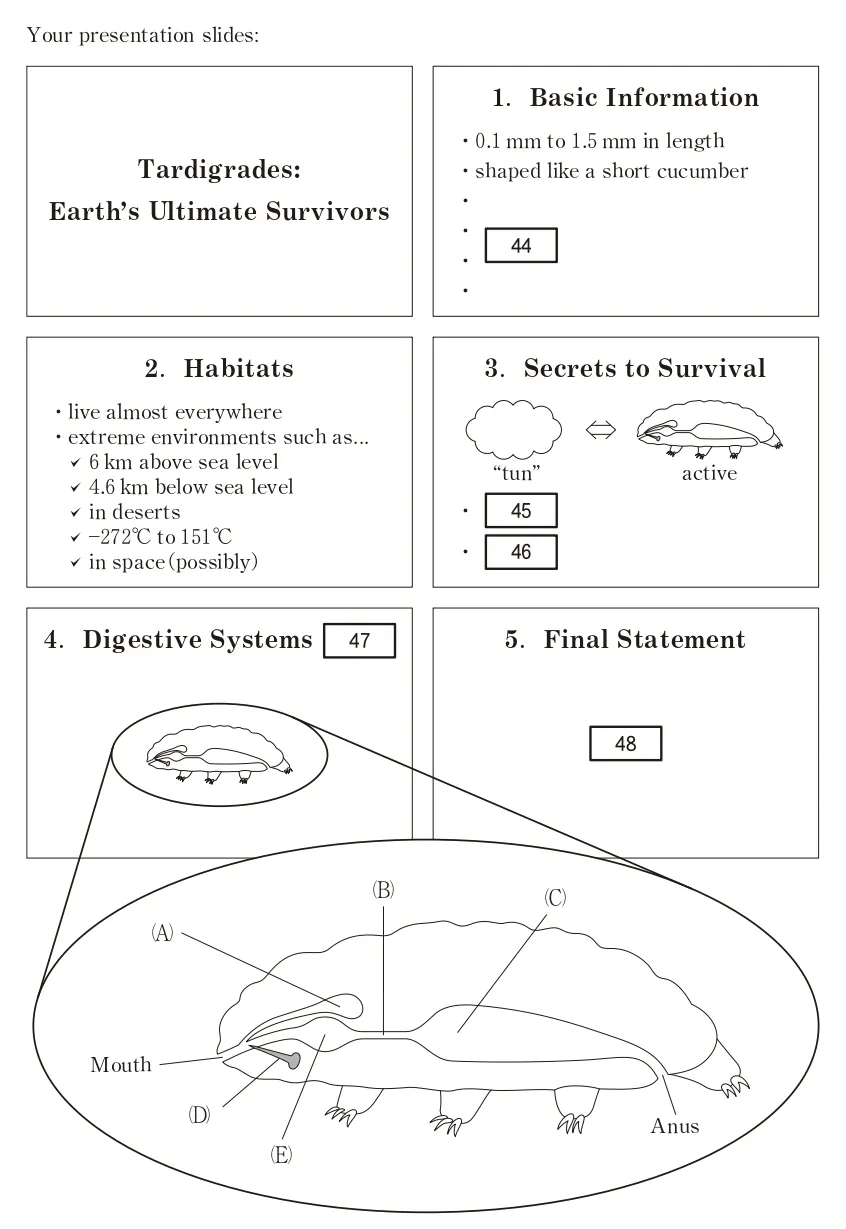
You are in a student group preparing for an international science presentation contest. You are using the following passage to create your part of the presentation on extraordinary creatures.
Ask someone to name the world’s toughest animal, and they might say the Bactrian camel as it can survive in temperatures as high as 50℃、 or the Arctic fox which can survive in temperatures lower than −58℃. However, both answers would be wrong as it is widely believed that the tardigrade is the toughest creature on earth.
Tardigrades, also known as water bears, are microscopic creatures, which are between 0.1 mm to 1.5 mm in length. They live almost everywhere, from 6,000−meter−high mountains to 4,600 meters below the ocean’s surface. They can even be found under thick ice and in hot springs. Most live in water, but some tardigrades can be found in some of the driest places on earth. One researcher reported finding tardigrades living under rocks in a desert without any recorded rainfall for 25 years. All they need are a few drops or a thin layer of water to live in. When the water dries up, so do they. They lose all but three percent of their body’s water and their metabolism slows down to 0.01% of its normal speed. The dried−out tardigrade is now in a state called ”tun,” a kind of deep sleep. It will continue in this state until it is once again soaked in water. Then, like a sponge, it absorbs the water and springs back to life again as if nothing had happened. Whether the tardigrade is in tun for 1 week or 10 years does not really matter. The moment it is surrounded by water, it comes alive again. When tardigrades are in a state of tun, they are so tough that they can survive in temperatures as low as −272℃ and as high as 151℃. Exactly how they achieve this is still not fully understood.
Perhaps even more amazing than their ability to survive on earth ― they have been on earth for some 540 million years ― is their ability to survive in space. In 2007, a team of European researchers sent a number of living tardigrades into space on the outside of a rocket for 10 days. On their return to earth, the researchers were surprised to see that 68% were still alive. This means that for 10 days most were able to survive X−rays and ultraviolet radiation 1,000 times more intense than here on earth. Later, in 2019, an Israeli spacecraft crashed onto the moon and thousands of tardigrades in a state of tun were spilled onto its surface. Whether these are still alive or not is unknown as no one has gone to collect them ― which is a pity.
Tardigrades are shaped like a short cucumber. They have four short legs on each side of their bodies. Some species have sticky pads at the end of each leg, while others have claws. There are 16 known claw variations, which help identify those species with claws. All tardigrades have a place for eyes, but not all species have eyes. Their eyes are primitive, only having five cells in total ― just one of which is light sensitive.
Basically, tardigrades can be divided into those that eat plant matter, and those that eat other creatures. Those that eat vegetation have a ventral mouth ― a mouth located in the lower part of the head, like a shark. The type that eats other creatures has a terminal mouth, which means the mouth is at the very front of the head, like a tuna. The mouths of tardigrades do not have teeth. They do, however, have two sharp needles, called stylets, that they use to pierce plant cells or the bodies of smaller creatures so the contents can be sucked out.
Both types of tardigrade have rather simple digestive systems. The mouth leads to the pharynx(throat)、 where digestive juices and food are mixed. Located above the pharynx is a salivary gland. This produces the juices that flow into the mouth and help with digestion. After the pharynx, there is a tube which transports food toward the gut. This tube is called the esophagus. The middle gut, a simple stomach/intestine type of organ, digests the food and absorbs the nutrients. The leftovers then eventually move through to the anus.
For the Secrets to Survival slide, select two features of the tardigrade which best help it survive. (The order does not matter.) ( 45 )・( 46 )
このページは閲覧用ページです。
履歴を残すには、 「新しく出題する(ここをクリック)」 をご利用ください。
問題
反映中…
共通テスト(英語)試験 令和5年度(2023年度)本試験 問130(<旧課程>英語リーディング(第6問) 問7) (訂正依頼・報告はこちら)
各問いの英文や図表を読み、解答番号にあてはまるものとして最も適当な選択肢を選びなさい。
You are in a student group preparing for an international science presentation contest. You are using the following passage to create your part of the presentation on extraordinary creatures.
Ask someone to name the world’s toughest animal, and they might say the Bactrian camel as it can survive in temperatures as high as 50℃、 or the Arctic fox which can survive in temperatures lower than −58℃. However, both answers would be wrong as it is widely believed that the tardigrade is the toughest creature on earth.
Tardigrades, also known as water bears, are microscopic creatures, which are between 0.1 mm to 1.5 mm in length. They live almost everywhere, from 6,000−meter−high mountains to 4,600 meters below the ocean’s surface. They can even be found under thick ice and in hot springs. Most live in water, but some tardigrades can be found in some of the driest places on earth. One researcher reported finding tardigrades living under rocks in a desert without any recorded rainfall for 25 years. All they need are a few drops or a thin layer of water to live in. When the water dries up, so do they. They lose all but three percent of their body’s water and their metabolism slows down to 0.01% of its normal speed. The dried−out tardigrade is now in a state called ”tun,” a kind of deep sleep. It will continue in this state until it is once again soaked in water. Then, like a sponge, it absorbs the water and springs back to life again as if nothing had happened. Whether the tardigrade is in tun for 1 week or 10 years does not really matter. The moment it is surrounded by water, it comes alive again. When tardigrades are in a state of tun, they are so tough that they can survive in temperatures as low as −272℃ and as high as 151℃. Exactly how they achieve this is still not fully understood.
Perhaps even more amazing than their ability to survive on earth ― they have been on earth for some 540 million years ― is their ability to survive in space. In 2007, a team of European researchers sent a number of living tardigrades into space on the outside of a rocket for 10 days. On their return to earth, the researchers were surprised to see that 68% were still alive. This means that for 10 days most were able to survive X−rays and ultraviolet radiation 1,000 times more intense than here on earth. Later, in 2019, an Israeli spacecraft crashed onto the moon and thousands of tardigrades in a state of tun were spilled onto its surface. Whether these are still alive or not is unknown as no one has gone to collect them ― which is a pity.
Tardigrades are shaped like a short cucumber. They have four short legs on each side of their bodies. Some species have sticky pads at the end of each leg, while others have claws. There are 16 known claw variations, which help identify those species with claws. All tardigrades have a place for eyes, but not all species have eyes. Their eyes are primitive, only having five cells in total ― just one of which is light sensitive.
Basically, tardigrades can be divided into those that eat plant matter, and those that eat other creatures. Those that eat vegetation have a ventral mouth ― a mouth located in the lower part of the head, like a shark. The type that eats other creatures has a terminal mouth, which means the mouth is at the very front of the head, like a tuna. The mouths of tardigrades do not have teeth. They do, however, have two sharp needles, called stylets, that they use to pierce plant cells or the bodies of smaller creatures so the contents can be sucked out.
Both types of tardigrade have rather simple digestive systems. The mouth leads to the pharynx(throat)、 where digestive juices and food are mixed. Located above the pharynx is a salivary gland. This produces the juices that flow into the mouth and help with digestion. After the pharynx, there is a tube which transports food toward the gut. This tube is called the esophagus. The middle gut, a simple stomach/intestine type of organ, digests the food and absorbs the nutrients. The leftovers then eventually move through to the anus.
For the Secrets to Survival slide, select two features of the tardigrade which best help it survive. (The order does not matter.) ( 45 )・( 46 )
You are in a student group preparing for an international science presentation contest. You are using the following passage to create your part of the presentation on extraordinary creatures.
Ask someone to name the world’s toughest animal, and they might say the Bactrian camel as it can survive in temperatures as high as 50℃、 or the Arctic fox which can survive in temperatures lower than −58℃. However, both answers would be wrong as it is widely believed that the tardigrade is the toughest creature on earth.
Tardigrades, also known as water bears, are microscopic creatures, which are between 0.1 mm to 1.5 mm in length. They live almost everywhere, from 6,000−meter−high mountains to 4,600 meters below the ocean’s surface. They can even be found under thick ice and in hot springs. Most live in water, but some tardigrades can be found in some of the driest places on earth. One researcher reported finding tardigrades living under rocks in a desert without any recorded rainfall for 25 years. All they need are a few drops or a thin layer of water to live in. When the water dries up, so do they. They lose all but three percent of their body’s water and their metabolism slows down to 0.01% of its normal speed. The dried−out tardigrade is now in a state called ”tun,” a kind of deep sleep. It will continue in this state until it is once again soaked in water. Then, like a sponge, it absorbs the water and springs back to life again as if nothing had happened. Whether the tardigrade is in tun for 1 week or 10 years does not really matter. The moment it is surrounded by water, it comes alive again. When tardigrades are in a state of tun, they are so tough that they can survive in temperatures as low as −272℃ and as high as 151℃. Exactly how they achieve this is still not fully understood.
Perhaps even more amazing than their ability to survive on earth ― they have been on earth for some 540 million years ― is their ability to survive in space. In 2007, a team of European researchers sent a number of living tardigrades into space on the outside of a rocket for 10 days. On their return to earth, the researchers were surprised to see that 68% were still alive. This means that for 10 days most were able to survive X−rays and ultraviolet radiation 1,000 times more intense than here on earth. Later, in 2019, an Israeli spacecraft crashed onto the moon and thousands of tardigrades in a state of tun were spilled onto its surface. Whether these are still alive or not is unknown as no one has gone to collect them ― which is a pity.
Tardigrades are shaped like a short cucumber. They have four short legs on each side of their bodies. Some species have sticky pads at the end of each leg, while others have claws. There are 16 known claw variations, which help identify those species with claws. All tardigrades have a place for eyes, but not all species have eyes. Their eyes are primitive, only having five cells in total ― just one of which is light sensitive.
Basically, tardigrades can be divided into those that eat plant matter, and those that eat other creatures. Those that eat vegetation have a ventral mouth ― a mouth located in the lower part of the head, like a shark. The type that eats other creatures has a terminal mouth, which means the mouth is at the very front of the head, like a tuna. The mouths of tardigrades do not have teeth. They do, however, have two sharp needles, called stylets, that they use to pierce plant cells or the bodies of smaller creatures so the contents can be sucked out.
Both types of tardigrade have rather simple digestive systems. The mouth leads to the pharynx(throat)、 where digestive juices and food are mixed. Located above the pharynx is a salivary gland. This produces the juices that flow into the mouth and help with digestion. After the pharynx, there is a tube which transports food toward the gut. This tube is called the esophagus. The middle gut, a simple stomach/intestine type of organ, digests the food and absorbs the nutrients. The leftovers then eventually move through to the anus.
For the Secrets to Survival slide, select two features of the tardigrade which best help it survive. (The order does not matter.) ( 45 )・( 46 )
- In dry conditions, their metabolism drops to less than one percent of normal.
- Tardigrades in a state of tun are able to survive in temperatures exceeding 151℃.
- The state of tun will cease when the water in a tardigrade’s body is above 0.01%.
- Their shark−like mouths allow them to more easily eat other creatures.
- They have an ability to withstand extreme levels of radiation.
正解!素晴らしいです
残念...
画像拡大
この過去問の解説 (3件)
01
この問題では、クマムシが生き残るために特に役立つ特徴を選びます。本文では、クマムシは乾燥するとtunという休眠状態になり、代謝を大きく下げること、また宇宙で強い放射線にも耐えたことが説明されています。
これは正しいです。
本文では、クマムシは水がなくなると体の水分をほとんど失い、代謝が通常の0.01%まで下がると説明されています。
0.01%は1%よりも小さいので、「通常の1%未満まで代謝が下がる」という内容は本文と合っています。乾燥した環境でも生き残れる大きな理由です。
これは適切ではありません。
本文では、tunの状態のクマムシは151℃まで耐えられると書かれています。
しかし、この選択肢の「exceeding 151℃」は「151℃を超える」という意味です。本文は「151℃まで」と言っているだけで、「151℃を超えても耐えられる」とは書かれていません。
これは適切ではありません。
本文では、0.01%は代謝の速さについての数字です。体内の水分量ではありません。
また、tunの状態が終わるのは、クマムシが再び水に浸され、水を吸収したときです。そのため、この選択肢は本文の内容と合いません。
これは適切ではありません。
本文では、サメのような口は、頭の下側にある口のことです。この口をもつクマムシは、主に植物を食べるタイプです。
一方、ほかの生き物を食べるタイプは、マグロのように頭の前に口があります。したがって、「サメのような口でほかの生き物を食べやすい」という説明は本文と反対です。
これは正しいです。
本文では、クマムシが宇宙に10日間出されても、多くが生き残ったことが説明されています。
その間、地球上よりも1,000倍強い紫外線やX線に耐えたと書かれています。これは、クマムシがとても強い放射線にも耐えられることを示しています。
クマムシが「最もタフな生き物」と考えられている理由は、乾燥するとtunという休眠状態になって代謝を極端に下げられることと、宇宙のような厳しい環境で強い放射線にも耐えられることです。
したがって、「乾燥時に代謝が通常の1%未満に下がること」と「極めて強い放射線に耐えられること」が、この問題で選ぶべき特徴です。
参考になった数0
この解説の修正を提案する
02
問題文は
「Secrets to Survival のスライドで、クマムシが生き残るのを助けている特徴を2つ選びなさい(順不同)。」
です。
広範囲に及ぶので、選択肢から問題に戻って、正誤を確かめていきます。
正解 「乾燥状態では、その代謝は、通常の1%未満に低下する。」
their metabolism slows down to 0.01% of its normal speed.
(代謝は、普通のスピードの0.01%に低下する)
1%未満は、0.01%を含むため、一致します。
「タンの状態のクマムシは、151℃を超える温度の中で生き延びることができる。」
they are so tough that they can survive in temperatures as low as −272℃ and as high as 151℃.
(クマムシはとても頑丈なので、-272度の低さや、151度もの暑さの中で生きることができる。)
とあり、最高151度と考えられるため、誤りです。
「タンの状態は、クマムシの体内の水分が0.01%より高くなると終わる。」
このような具体的な記述はありません。
「サメのような口は、クマムシに、他の生物より簡単に食べさせている。」
Those that eat vegetation have a ventral mouth ― a mouth located in the lower part of the head, like a shark.
(植物を食べるクマムシは、腹口、つまり、サメのように頭の下部にある口を持っている。)
という中で、サメに関する記述はありますが、食べやすさには言及していません。
正解 「極度の放射線に耐える能力をクマムシは持っている。」
most were able to survive X−rays and ultraviolet radiation 1,000 times more intense
(クマムシの大半は、1000倍強いX線や紫外線で生き残ることができた)
とあり、内容と一致します。
参考になった数0
この解説の修正を提案する
03
設問:「生存の秘密」のスライドに、クマムシが生き延びるのに最も役立つ特徴を2つ選びなさい。(順不同)( 45 )・( 46 )
!問題のポイント!
①「生存の秘密」なので極限環境でも生き残れる理由を本文から探しましょう。
②数字を変えていたり、対象をすり替えていないか注意して読みましょう。
訳)
あなたは、国際的な科学プレゼンテーションコンテストに向けて準備している学生グループの一員です。驚くべき生き物についての発表担当部分を作るために、次の文章を使っています。
世界で最もタフな動物の名前を誰かに尋ねれば、気温50℃の環境でも生きられるフタコブラクダや、ー58℃より低い気温でも生きられるホッキョクギツネを挙げるかもしれない。しかし、そのどちらも間違いである。というのも、地球上で最も強靭な生物はクマムシであると広く信じられているからだ。
・tardigrade(名詞) : クマムシ
クマムシはウォーターベアとも呼ばれる微小な生物で、体長は0.1mmから1.5mmほどである。彼らはほとんどあらゆる場所に生息しており、標高6,000mの山から海面下4,600mの深海まで存在する。厚い氷の下や温泉の中でも見つかる。多くは水中で生活しているが、地球上でも最も乾燥した場所で見つかる種類もいる。ある研究者は、25年間一度も雨が記録されていない砂漠の岩の下で生きるクマムシを発見したとして報告している。クマムシが生きるために必要なのは、ほんの数滴、あるいは薄い水の膜だけである。水が干しあがると、クマムシ自身も乾燥する。体内の水分のうち97%を失い、代謝は通常の0.01%まで低下する。乾燥したクマムシはTunと呼ばれる状態、つまり深い眠りのような状態に入る。そして再び水に浸されるまで、その状態を保ち続ける。その後、スポンジのように水を吸収し、何事もなかったかのように再び活動を始める。Tunの状態が1週間続こうと10年間続こうと、実際には大きな問題ではない。水に囲まれた瞬間、彼らは再び生き返るのだ。クマムシがTun状態にあるときは非常に強靭で、ー272℃という低温から151℃の高温まで耐えることができる。彼らがどのようにしてそれを可能にしているのかは、まだ完全には解明されていない。
・microscopic creature : 微小な生物、生き物
・in length : 長さ
・hot spring : 温泉
・rainfall(名詞) : 雨量
・metabolism(名詞) : 雨量
・soak(動詞) : 浸す
・absorb(動詞) : 吸収する
・is surrounded by ~ : ~に囲まれると
さらに驚くべきことに、クマムシは地球上で生き延びる能力だけでなく(彼らは約5億4千万年前から地球に存在している)、宇宙空間でも生き延びられる能力を持っている。2007年、ヨーロッパの研究チームは生きたクマムシを多数ロケットの外側に取り付けた状態で、10日間宇宙に送り出した。地球に帰還後、研究者たちはそのうちの68%がまだ生きていることに驚いた。つまりクマムシの多くは10日間、地球上の1,000倍強いX線や紫外線に耐えることができたということになる。その後2019年には、イスラエルの宇宙船が月面に墜落し、Tun状態にあった何千ものクマムシが月面に散乱した。これがまだ生きているかどうかは、回収した者がいないため分かっていない。それは残念なことである。
・spacecraft(名詞) : 宇宙船
・crash onto ~ : ~に墜落する
・spill onto ~ : ~に散らばる
・pity(名詞) : 残念、哀れ
クマムシの形は短いキュウリのようである。体の左右にそれぞれ4本ずつ、短い脚がついている。脚の先に粘着性のパッドを持つ種もいれば、爪を持つ種もいる。爪には16種類の既知のバリエーションがあり、爪を持つ種の識別に役立っている。すべてのクマムシには目があるわけではない。目は原始的で、全部で5つの細胞しかなく、そのうち光を感じる細胞は1つだけである。
・cucumber(名詞) : キュウリ
・sticky(形容詞) : 粘着性のある、ネバネバした
・claw(名詞) : 爪
・primitive(形容詞) : 原始的な
基本的にはクマムシは、植物を食べるタイプと他の生物を食べるタイプに分けられる。植物を食べるタイプは腹側口を持ち、口が頭部の下側にあり、サメのような位置にある。他の生物を食べるタイプは終端口を持ち、口が頭部の最前部にあり、マグロのような位置にある。クマムシの口には歯がないが、代わりにスタイレットと呼ばれる2本の鋭い針を持っており、それを使って植物細胞や小さな生物の体に穴を開け、中身を吸い出す。
・divide into ~ : ~に分ける
・ventral(形容詞) : 腹側の
・terminal(形容詞) : 末端の
・pierce(動詞) : 穴を開ける
どちらのタイプのクマムシも消化器官はかなり単純である。口は咽頭につながっており、そこでは消化液と食物が混ざり合う。咽頭の上には唾液腺があり、ここで作られた液体が口へ流れ込み、消化を助ける。咽頭の後には食道と呼ばれる管があり、食べ物を腸へ運ぶ。中腸は単純な胃・腸のような器官で、食物を消化し、栄養を吸収する。残りかすは最終的に肛門へと運ばれ排出される。
・digestive system : 消化器官
・pharynx(名詞) : 咽頭
・salivary gland : 唾液腺
・gut(名詞) : 腸
・esophagus(名詞) : 食道
・digest(動詞) : 消化する
・nutrient(名詞) : 栄養
・anus(名詞) : 肛門
クマムシ:
地球究極の生存者
1.基本情報
・体長は0.1mm~1.5mm
・短いキュウリのような形
・(44)
・(44)
・(44)
・(44)
2.生息地
・ほぼどこにでもいる
・過酷な環境
・標高6km
・深海4.6km
・砂漠
・ー272℃~151℃
・宇宙(可能性あり)
3.生存の秘密
・(45)
・(46)
4.消化器官
(47)
5.結論
(48)
正解
訳)乾燥状態では、代謝が通常の1%未満にまで低下する。
根拠となる文は2段落目の中盤、but some tardigrades can be found in some of the driest places on earth.~.their metabolism slows down to 0.01% of its normal speed(地球上でも最も乾燥した場所で見つかる種類もいる。~。代謝は通常の0.01%まで低下する).です。
これは、乾燥すると代謝を極端に落とすというクマムシの特徴を述べています。less than one percentは正しい要約のため正解です。
不正解
訳)Tun状態のクマムシは、151℃を超える温度でも生き延びられる。
本文では、「最高151℃まで」と記載があるため不正解です。
・exceeding : ~を超えて
不正解
訳)体内の水分が0.01%を超えると、Tun状態が終わる。
本文では、水分量ではなく「代謝」の話しをしているため不正解です。また、「再び水に浸されるまで、その状態を保ち続ける」と記載がありますが、体内水分が0.01%超えると解除になるとは述べられていません。
・cease(動詞) : 終わる
不正解
訳)サメのような口のおかげで、他の生物より簡単に食べられる。
本文には、サメのような口だから捕食しやすいという因果関係は述べられていないため不正解です。
正解
訳)非常に強い放射線に耐える能力がある。
根拠となる文は3段落目の、In 2007, a team of European researchers sent a number of living tardigrades into space ~. the researchers were surprised to see that 68% were still alive. ~ most were able to survive X−rays and ultraviolet radiation 1,000 times more intense(2007年、ヨーロッパの研究チームは生きたクマムシを宇宙に送り出した。研究者たちはそのうちの68%がまだ生きていることに驚いた。つまりクマムシの多くは、1,000倍強いX線や紫外線に耐えることができたということになる).です。
これは「生存の秘密」の中でもインパクトが強く、スライドに載せるべき特徴として非常に重要です。
・withstand(動詞) : 耐える
・radiation(名詞) : 放射線
参考になった数0
この解説の修正を提案する
前の問題(問129)へ
令和5年度(2023年度)本試験 問題一覧
次の問題(問132)へ