
共通テスト(英語) 過去問
令和5年度(2023年度)本試験
問167 (<旧課程>英語リスニング(第5問) 問7)
問題文
最初に講義を聞き、問いに答えなさい。
<状況>
あなたは大学で、アジアゾウに関する講義を、ワークシートにメモを取りながら聞いています。
Today, our topic is the Asian elephant, the largest land animal in Asia. They are found across South and Southeast Asia. Asian elephants are sociable animals that usually live in groups and are known for helping each other. They are also intelligent and have the ability to use tools.
The Asian elephant’s population has dropped greatly over the last 75 years, even though this animal is listed as endangered. Why has this happened? One reason for this decline is illegal human activities. Wild elephants have long been killed for ivory. But now, there is a developing market for other body parts, including skin and tail hair. These body parts are used for accessories, skin care products, and even medicine. Also, the number of wild elephants caught illegally is increasing because performing elephants are popular as tourist attractions.
Housing developments and farming create other problems for elephants. Asian elephants need large areas to live in, but these human activities have reduced their natural habitats and created barriers between elephant groups. As a result, there is less contact between elephant groups and their numbers are declining. Also, many elephants are forced to live close to humans, resulting in deadly incidents for both humans and elephants.
What actions have been taken to improve the Asian elephant’s future? People are forming patrol units and other groups that watch for illegal activities. People are also making new routes to connect elephant habitats, and are constructing fences around local living areas to protect both people and elephants.
Next, let’s look at the current situation for elephants in different Asian countries. Each group will give its report to the class.
グループの発表を聞き、次の図から読み取れる情報と講義全体の内容からどのようなことが言えるか、最も適切なものを、四つの選択肢のうちから一つ選びなさい。
Our group studied deadly encounters between humans and elephants in Sri Lanka. In other countries, like India, many more people than elephants die in these encounters. By contrast, similar efforts in Sri Lanka show a different trend. Let’s take a look at the graph and the data we found.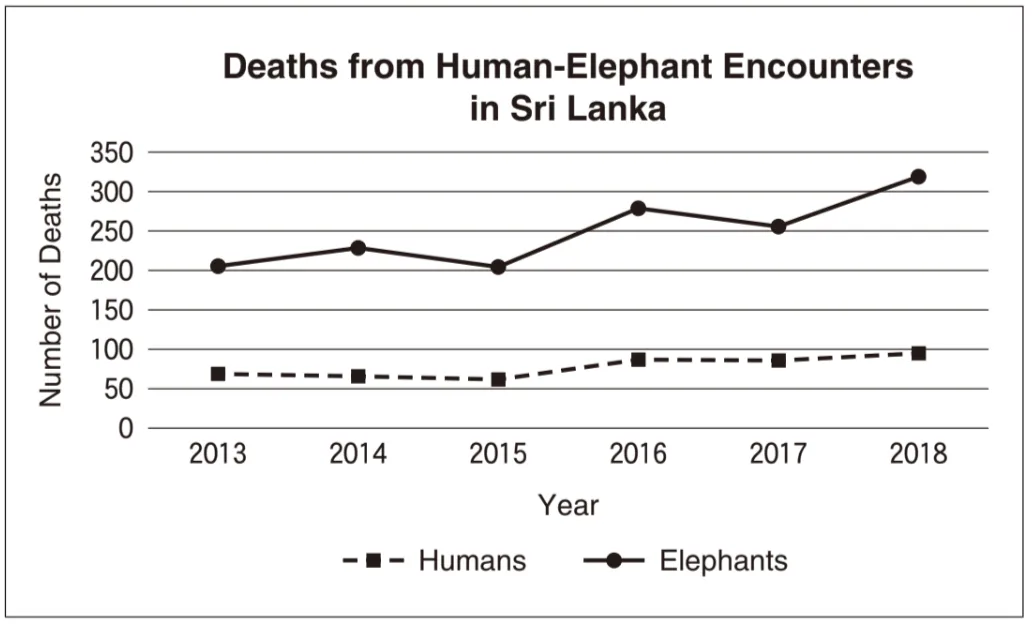
<状況>
あなたは大学で、アジアゾウに関する講義を、ワークシートにメモを取りながら聞いています。
Today, our topic is the Asian elephant, the largest land animal in Asia. They are found across South and Southeast Asia. Asian elephants are sociable animals that usually live in groups and are known for helping each other. They are also intelligent and have the ability to use tools.
The Asian elephant’s population has dropped greatly over the last 75 years, even though this animal is listed as endangered. Why has this happened? One reason for this decline is illegal human activities. Wild elephants have long been killed for ivory. But now, there is a developing market for other body parts, including skin and tail hair. These body parts are used for accessories, skin care products, and even medicine. Also, the number of wild elephants caught illegally is increasing because performing elephants are popular as tourist attractions.
Housing developments and farming create other problems for elephants. Asian elephants need large areas to live in, but these human activities have reduced their natural habitats and created barriers between elephant groups. As a result, there is less contact between elephant groups and their numbers are declining. Also, many elephants are forced to live close to humans, resulting in deadly incidents for both humans and elephants.
What actions have been taken to improve the Asian elephant’s future? People are forming patrol units and other groups that watch for illegal activities. People are also making new routes to connect elephant habitats, and are constructing fences around local living areas to protect both people and elephants.
Next, let’s look at the current situation for elephants in different Asian countries. Each group will give its report to the class.
グループの発表を聞き、次の図から読み取れる情報と講義全体の内容からどのようなことが言えるか、最も適切なものを、四つの選択肢のうちから一つ選びなさい。
Our group studied deadly encounters between humans and elephants in Sri Lanka. In other countries, like India, many more people than elephants die in these encounters. By contrast, similar efforts in Sri Lanka show a different trend. Let’s take a look at the graph and the data we found.
このページは閲覧用ページです。
履歴を残すには、 「新しく出題する(ここをクリック)」 をご利用ください。
問題
反映中…
共通テスト(英語)試験 令和5年度(2023年度)本試験 問167(<旧課程>英語リスニング(第5問) 問7) (訂正依頼・報告はこちら)
最初に講義を聞き、問いに答えなさい。
<状況>
あなたは大学で、アジアゾウに関する講義を、ワークシートにメモを取りながら聞いています。
Today, our topic is the Asian elephant, the largest land animal in Asia. They are found across South and Southeast Asia. Asian elephants are sociable animals that usually live in groups and are known for helping each other. They are also intelligent and have the ability to use tools.
The Asian elephant’s population has dropped greatly over the last 75 years, even though this animal is listed as endangered. Why has this happened? One reason for this decline is illegal human activities. Wild elephants have long been killed for ivory. But now, there is a developing market for other body parts, including skin and tail hair. These body parts are used for accessories, skin care products, and even medicine. Also, the number of wild elephants caught illegally is increasing because performing elephants are popular as tourist attractions.
Housing developments and farming create other problems for elephants. Asian elephants need large areas to live in, but these human activities have reduced their natural habitats and created barriers between elephant groups. As a result, there is less contact between elephant groups and their numbers are declining. Also, many elephants are forced to live close to humans, resulting in deadly incidents for both humans and elephants.
What actions have been taken to improve the Asian elephant’s future? People are forming patrol units and other groups that watch for illegal activities. People are also making new routes to connect elephant habitats, and are constructing fences around local living areas to protect both people and elephants.
Next, let’s look at the current situation for elephants in different Asian countries. Each group will give its report to the class.
グループの発表を聞き、次の図から読み取れる情報と講義全体の内容からどのようなことが言えるか、最も適切なものを、四つの選択肢のうちから一つ選びなさい。
Our group studied deadly encounters between humans and elephants in Sri Lanka. In other countries, like India, many more people than elephants die in these encounters. By contrast, similar efforts in Sri Lanka show a different trend. Let’s take a look at the graph and the data we found.
<状況>
あなたは大学で、アジアゾウに関する講義を、ワークシートにメモを取りながら聞いています。
Today, our topic is the Asian elephant, the largest land animal in Asia. They are found across South and Southeast Asia. Asian elephants are sociable animals that usually live in groups and are known for helping each other. They are also intelligent and have the ability to use tools.
The Asian elephant’s population has dropped greatly over the last 75 years, even though this animal is listed as endangered. Why has this happened? One reason for this decline is illegal human activities. Wild elephants have long been killed for ivory. But now, there is a developing market for other body parts, including skin and tail hair. These body parts are used for accessories, skin care products, and even medicine. Also, the number of wild elephants caught illegally is increasing because performing elephants are popular as tourist attractions.
Housing developments and farming create other problems for elephants. Asian elephants need large areas to live in, but these human activities have reduced their natural habitats and created barriers between elephant groups. As a result, there is less contact between elephant groups and their numbers are declining. Also, many elephants are forced to live close to humans, resulting in deadly incidents for both humans and elephants.
What actions have been taken to improve the Asian elephant’s future? People are forming patrol units and other groups that watch for illegal activities. People are also making new routes to connect elephant habitats, and are constructing fences around local living areas to protect both people and elephants.
Next, let’s look at the current situation for elephants in different Asian countries. Each group will give its report to the class.
グループの発表を聞き、次の図から読み取れる情報と講義全体の内容からどのようなことが言えるか、最も適切なものを、四つの選択肢のうちから一つ選びなさい。
Our group studied deadly encounters between humans and elephants in Sri Lanka. In other countries, like India, many more people than elephants die in these encounters. By contrast, similar efforts in Sri Lanka show a different trend. Let’s take a look at the graph and the data we found.
- Efforts to protect endangered animals have increased the number of elephants in Sri Lanka.
- Monitoring illegal activities in Sri Lanka has been effective in eliminating elephant deaths.
-
Sri Lanka has not seen an increase in the number of elephants that have died due to human−elephant encounters.
- Steps taken to protect elephants have not produced the desired results in Sri Lanka yet.
正解!素晴らしいです
残念...
画像拡大
この過去問の解説 (3件)
01
講義と図の内容から最も適切なのは、「Steps taken to protect elephants have not produced the desired results in Sri Lanka yet.」です。
これは「ゾウを守るために取られた対策は、スリランカではまだ望ましい結果を生み出していない」という意味です。
講義では、人間とゾウの衝突を減らすため、生息地をつなぐ道を作ったり、人間の生活地域の周りに柵を作ったりする対策が紹介されています。しかし、図からは、スリランカでは人間とゾウの衝突によって死亡するゾウの数が増えていることが読み取れます。したがって、ゾウを守るための対策は行われているものの、まだ十分な成果が出ていないと考えられます。
「絶滅危惧動物を守るための取り組みによって、スリランカのゾウの数が増えた」という意味です。
しかし、図が示しているのはスリランカにいるゾウ全体の個体数ではなく、人間とゾウの衝突による死亡数です。そのため、この図から「ゾウの個体数が増えた」と判断することはできません。
したがって、図から読み取れる情報とは一致しません。
「スリランカで違法行為を監視することは、ゾウの死亡をなくすのに効果があった」という意味です。
講義では、違法行為を監視するためにパトロール隊などを作る取り組みが紹介されています。
しかし、図では人間とゾウの衝突によるゾウの死亡数はなくなっておらず、むしろ増えています。そのため、「ゾウの死亡をなくすことに成功した」という内容にはなりません。
また、この図は人間とゾウの衝突についてのものであり、違法行為だけが死亡の原因だと示しているわけでもありません。
Sri Lanka has not seen an increase in the number of elephants that have died due to human−elephant encounters.
「スリランカでは、人間とゾウの衝突によって死亡したゾウの数は増えていない」という意味です。
しかし、図からはゾウの死亡数が増加していることが読み取れます。
したがって、「増加していない」という部分が図と反対になっています。
「ゾウを守るために取られた対策は、スリランカではまだ望ましい結果を生み出していない」という意味です。
講義では、ゾウを守るために、生息地をつなぐ道を作ることや、人間の生活地域を柵で囲むことなどが行われていると説明されています。
一方、図からは、スリランカでは人間とゾウの衝突によって死亡するゾウの数が増えていることが分かります。
つまり、ゾウを守るための取り組みは行われていますが、死亡するゾウが増えているため、まだ期待した結果にはつながっていないと考えられます。
講義全体の内容と図の情報の両方を結び付けた文になっています。
この問題では、グループ発表と図だけでなく、最初の講義で説明されたゾウを守るための対策も合わせて考えることがポイントです。
講義では、ゾウと人間を守るための対策が行われていると説明されています。一方、図では、スリランカで人間とゾウの衝突によるゾウの死亡数が増えていることが示されています。
そのため、
保護対策は行われている
↓
しかし、ゾウの死亡は増えている
↓
まだ望ましい結果は得られていない
と考えます。
したがって、講義全体と図の内容を最もよく表しているのは、「Steps taken to protect elephants have not produced the desired results in Sri Lanka yet.」です。
参考になった数0
この解説の修正を提案する
02
設問:グループの発表を聞き、次の図から読み取れる情報と講義全体の内容からどのようなことが言えるか、最も適切なものを、四つの選択肢のうちから一つ選びなさい。
問題のポイント
①グラフはスリランカでの人間とゾウの致命的な遭遇を表しています。
②スリランカではインドとは対照的に、人間よりもゾウの方が死んでいることが読み取れます。
訳)
私たちのグループは、スリランカにおける人間とゾウの致命的な遭遇(衝突)について調査しました。インドのような他の国々では、こうした遭遇で死亡するのはゾウよりも人間のほうがはるかに多いです。それに対して、スリランカでの同様の取り組みでは、異なる傾向が見られます。では、グラフと私たちが見つけたデータを見てみましょう。
・by contrast:それに対して、比較して
不正解
訳)絶滅危惧動物を守るための取り組みによって、スリランカのゾウの数は増加した。
グラフはゾウの数ではなく、死亡者数(頭数)を表しているため不正解です。
・endangered animal:絶滅危惧動物
不正解
訳)スリランカで違法行為を監視することは、ゾウの死亡をなくすのに効果的だった。
グラフは、ゾウの死亡頭数が増えていることを表しているため不正解です。
・illegal activity:違法行為
Sri Lanka has not seen an increase in the number of elephants that have died due to human−elephant encounters.
不正解
訳)スリランカでは、人間とゾウの遭遇によって死亡したゾウの数が増加していない。
グラフは、ゾウの死亡頭数が増えていることを表しているため不正解です。
正解
訳)ゾウを守るために取られた対策は、スリランカではまだ望ましい結果を生み出していない。
グラフは、ゾウの死亡頭数が増えていることを表しています。つまり、ゾウの保護対策が依然として効果的ではないということが分かるため正解です。
参考になった数0
この解説の修正を提案する
03
グループの発表では、
In other countries, like India, many more people than elephants die in these encounters. By contrast, similar efforts in Sri Lanka show a different trend.
(インドのような他の国では、遭遇により、ゾウより人間が死んでいます。対象的に、スリランカでの同様の努力は、違う傾向を示している。)
とあります。
スリランカのこの傾向は、グラフより読み取ることができます。
グラフを見ると、スリランカでは、人間よりゾウの死が多いことが分かります。
以上のようなグループ発表内容やグラフの内容に一致するものを選びましょう。
「危機に瀕した動物を守る努力は、スリランカのゾウの数を増加させた。」
スリランカのゾウの死亡数は増えています。
「スリランカで違法な活動を巡視することは、ゾウの死を排除するのに効果的だ。」
スリランカのゾウの死亡数は増えています。
Sri Lanka has not seen an increase in the number of elephants that have died due to human−elephant encounters.
「スリランカでは、人間とゾウの遭遇によって死亡するゾウの数は増加していない。」
スリランカのゾウの死亡数は増えています。
正解
「スリランカでは、ゾウを守るために取られている対策で、まだ望む結果を得ることができていない。」
依然として、人間よりゾウの死亡数が多く、他国のように、ゾウの死亡数を減らすことができていないので、一致します。
参考になった数0
この解説の修正を提案する
前の問題(問166)へ
令和5年度(2023年度)本試験 問題一覧
次の問題(問168)へ