
共通テスト(英語) 過去問
令和6年度(2024年度)本試験
問43 (<旧課程>英語リーディング(第6問) 問5)
問題文
各問の英文や図表を読み、最も適当な選択肢を選びなさい。
Your English teacher has assigned this article to you.You need to prepare notes to give a short talk.
Perceptions of Time
When you hear the word “time,” it is probably hours,minutes,and seconds that immediately come to mind.In the late 19th century,however,philosopher Henri Bergson described how people usually do not experience time as it is measured by clocks(clock time).Humans do not have a known biological mechanism to measure clock time,so they use mental processes instead.This is called psychological time,which everyone perceives differently.
If you were asked how long it had taken to finish your homework,you probably would not know exactly.You would think back and make an estimate.In a 1975 experiment,participants were shown either simple or complex shapes for a fixed amount of time and asked to memorize them.Afterwards,they were asked how long they had looked at the shapes.To answer,they used a mental process called retrospective timing,which is estimating time based on the information retrieved from memory.Participants who were shown the complex shapes felt the time was longer,while the people who saw the simple shapes experienced the opposite.
Another process to measure psychological time is called prospective timing.It is used when you are actively keeping track of time while doing something.Instead of using the amount of information recalled,the level of attention given to time while doing the activity is used.In several studies,the participants performed tasks while estimating the time needed to complete them. Time seemed shorter for the people doing more challenging mental activities which required them to place more focus on the task than on time. Time felt longer for the participants who did simpler tasks and the longest for those who were waiting or doing nothing.
Your emotional state can influence your awareness of time,too.For example,you can be enjoying a concert so much that you forget about time.Afterwards,you are shocked that hours have passed by in what seemed to be the blink of an eye.To explain this,we often say,“Time flies when you’re having fun.” The opposite occurs when you are bored.Instead of being focused on an activity,you notice the time.It seems to go very slowly as you cannot wait for your boredom to end.Fear also affects our perception of time.In a 2006 study,more than 60 people experienced skydiving for the first time.Participants with high levels of unpleasant emotions perceived the time spent skydiving to be much longer than it was in reality.
Psychological time also seems to move differently during life stages.Children constantly encounter new information and have new experiences,which makes each day memorable and seem longer when recalled.Also,time creeps by for them as they anticipate upcoming events such as birthdays and trips.For most adults,unknown information is rarely encountered and new experiences become less frequent,so less mental focus is required and each day becomes less memorable. However,this is not always the case.Daily routines are shaken up when drastic changes occur,such as changing jobs or relocating to a new city.In such cases,the passage of time for those people is similar to that for children.But generally speaking,time seems to accelerate as we mature.
Knowledge of psychological time can be helpful in our daily lives,as it may help us deal with boredom.Because time passes slowly when we are not mentally focused and thinking about time,changing to a more engaging activity,such as reading a book,will help ease our boredom and speed up the time.The next occasion that you hear “Time flies when you’re having fun,” you will be reminded of this.
Choose the best option for( 43 ).
Your notes: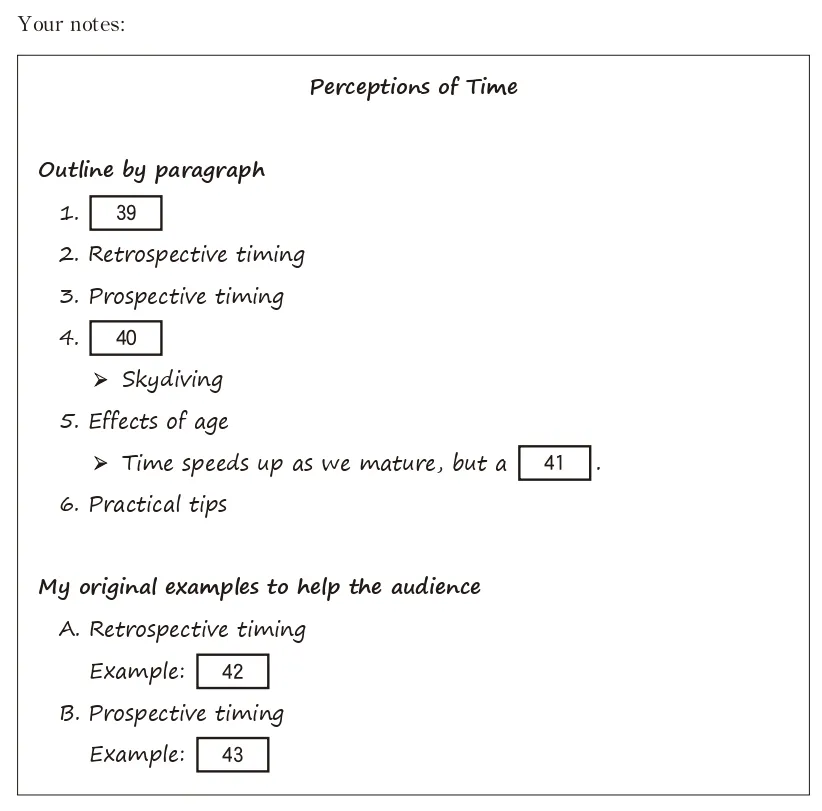
Your English teacher has assigned this article to you.You need to prepare notes to give a short talk.
Perceptions of Time
When you hear the word “time,” it is probably hours,minutes,and seconds that immediately come to mind.In the late 19th century,however,philosopher Henri Bergson described how people usually do not experience time as it is measured by clocks(clock time).Humans do not have a known biological mechanism to measure clock time,so they use mental processes instead.This is called psychological time,which everyone perceives differently.
If you were asked how long it had taken to finish your homework,you probably would not know exactly.You would think back and make an estimate.In a 1975 experiment,participants were shown either simple or complex shapes for a fixed amount of time and asked to memorize them.Afterwards,they were asked how long they had looked at the shapes.To answer,they used a mental process called retrospective timing,which is estimating time based on the information retrieved from memory.Participants who were shown the complex shapes felt the time was longer,while the people who saw the simple shapes experienced the opposite.
Another process to measure psychological time is called prospective timing.It is used when you are actively keeping track of time while doing something.Instead of using the amount of information recalled,the level of attention given to time while doing the activity is used.In several studies,the participants performed tasks while estimating the time needed to complete them. Time seemed shorter for the people doing more challenging mental activities which required them to place more focus on the task than on time. Time felt longer for the participants who did simpler tasks and the longest for those who were waiting or doing nothing.
Your emotional state can influence your awareness of time,too.For example,you can be enjoying a concert so much that you forget about time.Afterwards,you are shocked that hours have passed by in what seemed to be the blink of an eye.To explain this,we often say,“Time flies when you’re having fun.” The opposite occurs when you are bored.Instead of being focused on an activity,you notice the time.It seems to go very slowly as you cannot wait for your boredom to end.Fear also affects our perception of time.In a 2006 study,more than 60 people experienced skydiving for the first time.Participants with high levels of unpleasant emotions perceived the time spent skydiving to be much longer than it was in reality.
Psychological time also seems to move differently during life stages.Children constantly encounter new information and have new experiences,which makes each day memorable and seem longer when recalled.Also,time creeps by for them as they anticipate upcoming events such as birthdays and trips.For most adults,unknown information is rarely encountered and new experiences become less frequent,so less mental focus is required and each day becomes less memorable. However,this is not always the case.Daily routines are shaken up when drastic changes occur,such as changing jobs or relocating to a new city.In such cases,the passage of time for those people is similar to that for children.But generally speaking,time seems to accelerate as we mature.
Knowledge of psychological time can be helpful in our daily lives,as it may help us deal with boredom.Because time passes slowly when we are not mentally focused and thinking about time,changing to a more engaging activity,such as reading a book,will help ease our boredom and speed up the time.The next occasion that you hear “Time flies when you’re having fun,” you will be reminded of this.
Choose the best option for( 43 ).
Your notes:
このページは閲覧用ページです。
履歴を残すには、 「新しく出題する(ここをクリック)」 をご利用ください。
問題
反映中…
共通テスト(英語)試験 令和6年度(2024年度)本試験 問43(<旧課程>英語リーディング(第6問) 問5) (訂正依頼・報告はこちら)
各問の英文や図表を読み、最も適当な選択肢を選びなさい。
Your English teacher has assigned this article to you.You need to prepare notes to give a short talk.
Perceptions of Time
When you hear the word “time,” it is probably hours,minutes,and seconds that immediately come to mind.In the late 19th century,however,philosopher Henri Bergson described how people usually do not experience time as it is measured by clocks(clock time).Humans do not have a known biological mechanism to measure clock time,so they use mental processes instead.This is called psychological time,which everyone perceives differently.
If you were asked how long it had taken to finish your homework,you probably would not know exactly.You would think back and make an estimate.In a 1975 experiment,participants were shown either simple or complex shapes for a fixed amount of time and asked to memorize them.Afterwards,they were asked how long they had looked at the shapes.To answer,they used a mental process called retrospective timing,which is estimating time based on the information retrieved from memory.Participants who were shown the complex shapes felt the time was longer,while the people who saw the simple shapes experienced the opposite.
Another process to measure psychological time is called prospective timing.It is used when you are actively keeping track of time while doing something.Instead of using the amount of information recalled,the level of attention given to time while doing the activity is used.In several studies,the participants performed tasks while estimating the time needed to complete them. Time seemed shorter for the people doing more challenging mental activities which required them to place more focus on the task than on time. Time felt longer for the participants who did simpler tasks and the longest for those who were waiting or doing nothing.
Your emotional state can influence your awareness of time,too.For example,you can be enjoying a concert so much that you forget about time.Afterwards,you are shocked that hours have passed by in what seemed to be the blink of an eye.To explain this,we often say,“Time flies when you’re having fun.” The opposite occurs when you are bored.Instead of being focused on an activity,you notice the time.It seems to go very slowly as you cannot wait for your boredom to end.Fear also affects our perception of time.In a 2006 study,more than 60 people experienced skydiving for the first time.Participants with high levels of unpleasant emotions perceived the time spent skydiving to be much longer than it was in reality.
Psychological time also seems to move differently during life stages.Children constantly encounter new information and have new experiences,which makes each day memorable and seem longer when recalled.Also,time creeps by for them as they anticipate upcoming events such as birthdays and trips.For most adults,unknown information is rarely encountered and new experiences become less frequent,so less mental focus is required and each day becomes less memorable. However,this is not always the case.Daily routines are shaken up when drastic changes occur,such as changing jobs or relocating to a new city.In such cases,the passage of time for those people is similar to that for children.But generally speaking,time seems to accelerate as we mature.
Knowledge of psychological time can be helpful in our daily lives,as it may help us deal with boredom.Because time passes slowly when we are not mentally focused and thinking about time,changing to a more engaging activity,such as reading a book,will help ease our boredom and speed up the time.The next occasion that you hear “Time flies when you’re having fun,” you will be reminded of this.
Choose the best option for( 43 ).
Your notes:
Your English teacher has assigned this article to you.You need to prepare notes to give a short talk.
Perceptions of Time
When you hear the word “time,” it is probably hours,minutes,and seconds that immediately come to mind.In the late 19th century,however,philosopher Henri Bergson described how people usually do not experience time as it is measured by clocks(clock time).Humans do not have a known biological mechanism to measure clock time,so they use mental processes instead.This is called psychological time,which everyone perceives differently.
If you were asked how long it had taken to finish your homework,you probably would not know exactly.You would think back and make an estimate.In a 1975 experiment,participants were shown either simple or complex shapes for a fixed amount of time and asked to memorize them.Afterwards,they were asked how long they had looked at the shapes.To answer,they used a mental process called retrospective timing,which is estimating time based on the information retrieved from memory.Participants who were shown the complex shapes felt the time was longer,while the people who saw the simple shapes experienced the opposite.
Another process to measure psychological time is called prospective timing.It is used when you are actively keeping track of time while doing something.Instead of using the amount of information recalled,the level of attention given to time while doing the activity is used.In several studies,the participants performed tasks while estimating the time needed to complete them. Time seemed shorter for the people doing more challenging mental activities which required them to place more focus on the task than on time. Time felt longer for the participants who did simpler tasks and the longest for those who were waiting or doing nothing.
Your emotional state can influence your awareness of time,too.For example,you can be enjoying a concert so much that you forget about time.Afterwards,you are shocked that hours have passed by in what seemed to be the blink of an eye.To explain this,we often say,“Time flies when you’re having fun.” The opposite occurs when you are bored.Instead of being focused on an activity,you notice the time.It seems to go very slowly as you cannot wait for your boredom to end.Fear also affects our perception of time.In a 2006 study,more than 60 people experienced skydiving for the first time.Participants with high levels of unpleasant emotions perceived the time spent skydiving to be much longer than it was in reality.
Psychological time also seems to move differently during life stages.Children constantly encounter new information and have new experiences,which makes each day memorable and seem longer when recalled.Also,time creeps by for them as they anticipate upcoming events such as birthdays and trips.For most adults,unknown information is rarely encountered and new experiences become less frequent,so less mental focus is required and each day becomes less memorable. However,this is not always the case.Daily routines are shaken up when drastic changes occur,such as changing jobs or relocating to a new city.In such cases,the passage of time for those people is similar to that for children.But generally speaking,time seems to accelerate as we mature.
Knowledge of psychological time can be helpful in our daily lives,as it may help us deal with boredom.Because time passes slowly when we are not mentally focused and thinking about time,changing to a more engaging activity,such as reading a book,will help ease our boredom and speed up the time.The next occasion that you hear “Time flies when you’re having fun,” you will be reminded of this.
Choose the best option for( 43 ).
Your notes:
- guessing how long you’ve been jogging so far
- making a schedule for the basketball team summer camp
- running into your tennis coach at the railway station
- thinking about your last family vacation to a hot spring
正解!素晴らしいです
残念...
画像拡大
この過去問の解説 (3件)
01
問題文は
「(43)に適するものを選びなさい。」
です。
空所は、My original examples to help the audience(聴衆を助ける私の個人的な例)の項目で、prospective timing(展望的計時)の例を選ぶ問題です。
該当箇所は
It is used when you are actively keeping track of time while doing something.
(何かをしている間、積極的に時間を記録しているときに使われる。)
です。
つまり、展望的計時とは、進行中の行動にかかる時間を計測することです。
この内容に該当するものを選びます。
正解「これまでで、どのくらいの時間ジョギングしているかを推測すること」
so far(これまでで)とあるため、まだジョギング中であると考えられます。
したがって、進行中の行動にかかる時間を考えていると言え、正解となります。
「バスケットボールの夏キャンプのスケジュールを作ること」
内容と一致しません。
「鉄道駅でテニスのコーチに偶然出会うこと」
内容と一致しません。
「最後に行った温泉への家族旅行のことを考えること」
内容と一致しません。
参考になった数0
この解説の修正を提案する
02
(43)は Prospective timing(前向き時間判断) の例を選ぶ問題です。
これについて書かれているのは、第3段落。
下記本文参照
It is used when you are actively keeping track of time while doing something.
(何かをしながら積極的に時間を記録しているときに使用されます。)
つまり、今活動中・進行中であり、その行動がどれくらいの時間が経ったのかと考えているというものです。
訳)これまでどれくらいジョギングをしてきたか推測する
→正しい
走っている最中に「どれくらい走ったのかな」と考えることは例として相応しいです。
訳)バスケットボールチームのサマーキャンプのスケジュールを立てる
→間違い
予定を立てるというのは未来の話であり、時間間隔とは関係のない話です。
訳)駅でテニスコーチにばったり会う
→間違い
偶然会うことは、時間測定ではありません。
訳)前回の家族旅行の温泉旅行を思い出す
→間違い
過去を振り返るというのはretrospective に近いです。
参考になった数0
この解説の修正を提案する
03
Prospective timingとは、パラグラフ3より、以下のように説明されています。
It is used when you are actively keeping track of time while doing something.
(訳:何かを行う際に時間を積極的に記録する際に使用されます。)
これを踏まえると、何かをするときに、タイムを計測する必要のある事柄を含む回答を選択選択肢から選ぶ必要があります。
訳:これまでにどのくらいジョギングされているか推測する
ジョギングはタイムを計測するため、この回答が正解です。
訳:バスケットボールチームのサマーキャンプのスケジュールを作成する
タイム計測を伴わないため、この回答は誤りです。
訳:鉄道の駅でテニスコーチに向かって走り出す
タイム計測を伴わないため、この回答は誤りです。
訳:温泉への最後の家族旅行について考えている
タイム計測を伴わないため、この回答は誤りです。
参考になった数0
この解説の修正を提案する
前の問題(問42)へ
令和6年度(2024年度)本試験 問題一覧
次の問題(問44)へ