
共通テスト(英語) 過去問
令和6年度(2024年度)本試験
問45 (<旧課程>英語リーディング(第6問) 問7)
問題文
各問の英文や図表を読み、最も適当な選択肢を選びなさい。
You are preparing a presentation for your science club,using the following passage from a science website.
Chili Peppers: The Spice of Life
Tiny pieces of red spice in chili chicken add a nice touch of color,but biting into even a small piece can make a person’s mouth burn as if it were on fire.While some people love this,others want to avoid the painful sensation.At the same time,though,they can eat sashimi with wasabi.This might lead one to wonder what spiciness actually is and to ask where the difference between chili and wasabi comes from.
Unlike sweetness,saltiness,and sourness,spiciness is not a taste.In fact,we do not actually taste heat,or spiciness,when we eat spicy foods.The bite we feel from eating chili peppers and wasabi is derived from different types of compounds.Chili peppers get their heat from a heavier,oil−like element called capsaicin.Capsaicin leaves a lingering,fire−like sensation in our mouths because it triggers a receptor called TRPV1.TRPV1 induces stress and tells us when something is burning our mouths.Interestingly,there is a wide range of heat across the different varieties of chili peppers,and the level depends on the amount of capsaicin they contain. This is measured using the Scoville Scale,which is also called Scoville Heat Units(SHU).SHUs range from the sweet and mild shishito pepper at 50−200 SHUs to the Carolina Reaper pepper,which can reach up to 2.2 million.
Wasabi is considered a root,not a pepper,and does not contain capsaicin. Thus,wasabi is not ranked on the Scoville Scale.However,people have compared the level of spice in it to chilis with around 1,000 SHUs,which is on the lower end of the scale.The reason some people cannot tolerate chili spice but can eat foods flavored with wasabi is that the spice compounds in it are low in density.The compounds in wasabi vaporize easily,delivering a blast of spiciness to our nose when we eat it.
Consuming chili peppers can have positive effects on our health,and much research has been conducted into the benefits of capsaicin.When capsaicin activates the TRPV1 receptor in a person’s body,it is similar to what happens when they experience stress or pain from an injury. Strangely,capsaicin can also make pain go away.Scientists found that TRPV1 ceases to be turned on after long−term exposure to chili peppers,temporarily easing painful sensations.Thus,skin creams containing capsaicin might be useful for people who experience muscle aches.
Another benefit of eating chili peppers is that they accelerate the metabolism.A group of researchers analyzed 90 studies on capsaicin and body weight and found that people had a reduced appetite when they ate spicy foods.This is because spicy foods increase the heart rate,send more energy to the muscles,and convert fat into energy.Recently,scientists at the University of Wyoming have created a weight−loss drug with capsaicin as a main ingredient.
It is also believed that chili peppers are connected with food safety,which might lead to a healthier life.When food is left outside of a refrigerated environment,microorganisms multiply on it,which may cause sickness if eaten.Studies have shown that capsaicin and other chemicals found in chili peppers have antibacterial properties that can slow down or even stop microorganism growth.As a result,food lasts longer and there are fewer food−borne illnesses.This may explain why people in hot climates have a tendency to use more chili peppers,and therefore,be more tolerant of spicier foods due to repeated exposure.Also,in the past,before there were refrigerators,they were less likely to have food poisoning than people in cooler climates.
Chili peppers seem to have health benefits,but can they also be bad for our health? Peppers that are high on the Scoville Scale can cause physical discomfort when eaten in large quantities.People who have eaten several of the world’s hottest chilis in a short time have reported experiencing upset stomachs,diarrhea,numb hands,and symptoms similar to a heart attack.Ghost peppers,which contain one million SHUs,can even burn a person’s skin if they are touched.
Luckily the discomfort some people feel after eating spicy foods tends to go away soon―usually within a few hours.Despite some negative side effects,spicy foods remain popular around the world and add a flavorful touch to the table.Remember,it is safe to consume spicy foods,but you might want to be careful about the amount of peppers you put in your dishes.
Which is an error you found on Slide 3?( 45 )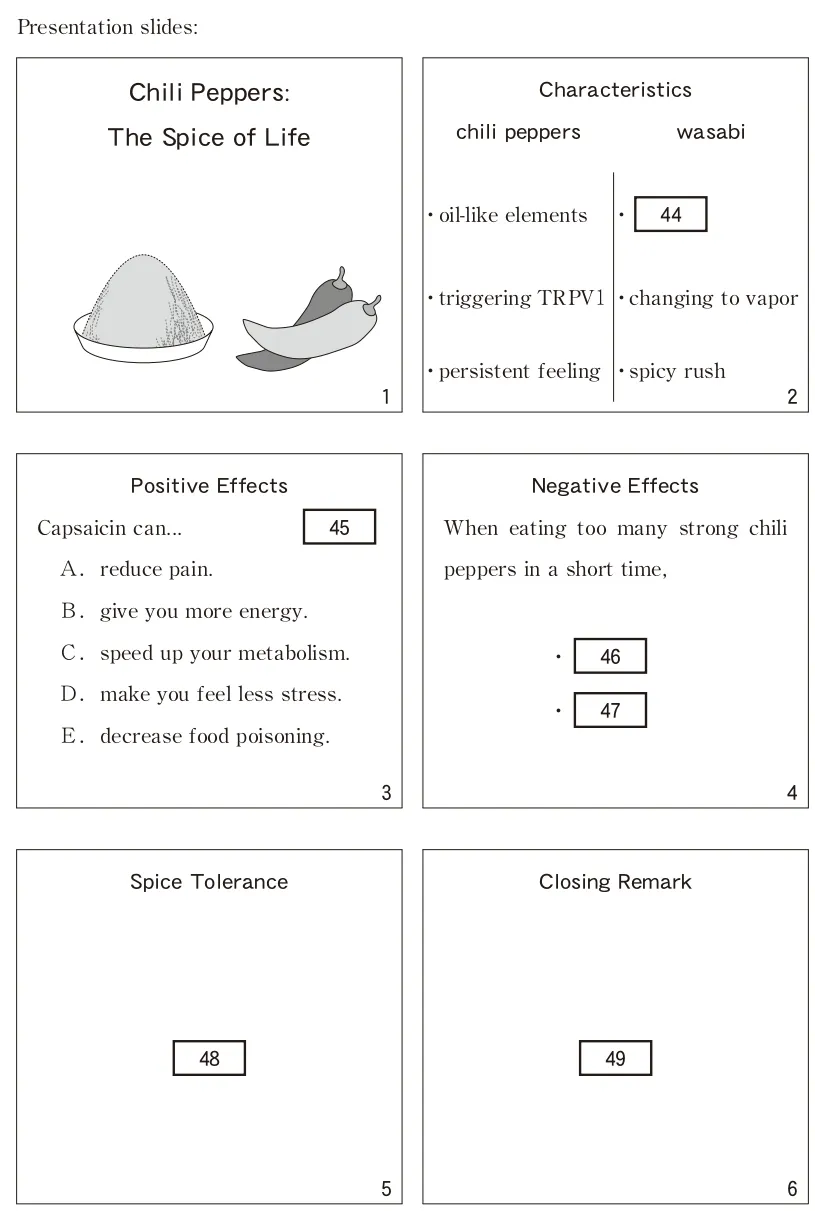
You are preparing a presentation for your science club,using the following passage from a science website.
Chili Peppers: The Spice of Life
Tiny pieces of red spice in chili chicken add a nice touch of color,but biting into even a small piece can make a person’s mouth burn as if it were on fire.While some people love this,others want to avoid the painful sensation.At the same time,though,they can eat sashimi with wasabi.This might lead one to wonder what spiciness actually is and to ask where the difference between chili and wasabi comes from.
Unlike sweetness,saltiness,and sourness,spiciness is not a taste.In fact,we do not actually taste heat,or spiciness,when we eat spicy foods.The bite we feel from eating chili peppers and wasabi is derived from different types of compounds.Chili peppers get their heat from a heavier,oil−like element called capsaicin.Capsaicin leaves a lingering,fire−like sensation in our mouths because it triggers a receptor called TRPV1.TRPV1 induces stress and tells us when something is burning our mouths.Interestingly,there is a wide range of heat across the different varieties of chili peppers,and the level depends on the amount of capsaicin they contain. This is measured using the Scoville Scale,which is also called Scoville Heat Units(SHU).SHUs range from the sweet and mild shishito pepper at 50−200 SHUs to the Carolina Reaper pepper,which can reach up to 2.2 million.
Wasabi is considered a root,not a pepper,and does not contain capsaicin. Thus,wasabi is not ranked on the Scoville Scale.However,people have compared the level of spice in it to chilis with around 1,000 SHUs,which is on the lower end of the scale.The reason some people cannot tolerate chili spice but can eat foods flavored with wasabi is that the spice compounds in it are low in density.The compounds in wasabi vaporize easily,delivering a blast of spiciness to our nose when we eat it.
Consuming chili peppers can have positive effects on our health,and much research has been conducted into the benefits of capsaicin.When capsaicin activates the TRPV1 receptor in a person’s body,it is similar to what happens when they experience stress or pain from an injury. Strangely,capsaicin can also make pain go away.Scientists found that TRPV1 ceases to be turned on after long−term exposure to chili peppers,temporarily easing painful sensations.Thus,skin creams containing capsaicin might be useful for people who experience muscle aches.
Another benefit of eating chili peppers is that they accelerate the metabolism.A group of researchers analyzed 90 studies on capsaicin and body weight and found that people had a reduced appetite when they ate spicy foods.This is because spicy foods increase the heart rate,send more energy to the muscles,and convert fat into energy.Recently,scientists at the University of Wyoming have created a weight−loss drug with capsaicin as a main ingredient.
It is also believed that chili peppers are connected with food safety,which might lead to a healthier life.When food is left outside of a refrigerated environment,microorganisms multiply on it,which may cause sickness if eaten.Studies have shown that capsaicin and other chemicals found in chili peppers have antibacterial properties that can slow down or even stop microorganism growth.As a result,food lasts longer and there are fewer food−borne illnesses.This may explain why people in hot climates have a tendency to use more chili peppers,and therefore,be more tolerant of spicier foods due to repeated exposure.Also,in the past,before there were refrigerators,they were less likely to have food poisoning than people in cooler climates.
Chili peppers seem to have health benefits,but can they also be bad for our health? Peppers that are high on the Scoville Scale can cause physical discomfort when eaten in large quantities.People who have eaten several of the world’s hottest chilis in a short time have reported experiencing upset stomachs,diarrhea,numb hands,and symptoms similar to a heart attack.Ghost peppers,which contain one million SHUs,can even burn a person’s skin if they are touched.
Luckily the discomfort some people feel after eating spicy foods tends to go away soon―usually within a few hours.Despite some negative side effects,spicy foods remain popular around the world and add a flavorful touch to the table.Remember,it is safe to consume spicy foods,but you might want to be careful about the amount of peppers you put in your dishes.
Which is an error you found on Slide 3?( 45 )
このページは閲覧用ページです。
履歴を残すには、 「新しく出題する(ここをクリック)」 をご利用ください。
問題
反映中…
共通テスト(英語)試験 令和6年度(2024年度)本試験 問45(<旧課程>英語リーディング(第6問) 問7) (訂正依頼・報告はこちら)
各問の英文や図表を読み、最も適当な選択肢を選びなさい。
You are preparing a presentation for your science club,using the following passage from a science website.
Chili Peppers: The Spice of Life
Tiny pieces of red spice in chili chicken add a nice touch of color,but biting into even a small piece can make a person’s mouth burn as if it were on fire.While some people love this,others want to avoid the painful sensation.At the same time,though,they can eat sashimi with wasabi.This might lead one to wonder what spiciness actually is and to ask where the difference between chili and wasabi comes from.
Unlike sweetness,saltiness,and sourness,spiciness is not a taste.In fact,we do not actually taste heat,or spiciness,when we eat spicy foods.The bite we feel from eating chili peppers and wasabi is derived from different types of compounds.Chili peppers get their heat from a heavier,oil−like element called capsaicin.Capsaicin leaves a lingering,fire−like sensation in our mouths because it triggers a receptor called TRPV1.TRPV1 induces stress and tells us when something is burning our mouths.Interestingly,there is a wide range of heat across the different varieties of chili peppers,and the level depends on the amount of capsaicin they contain. This is measured using the Scoville Scale,which is also called Scoville Heat Units(SHU).SHUs range from the sweet and mild shishito pepper at 50−200 SHUs to the Carolina Reaper pepper,which can reach up to 2.2 million.
Wasabi is considered a root,not a pepper,and does not contain capsaicin. Thus,wasabi is not ranked on the Scoville Scale.However,people have compared the level of spice in it to chilis with around 1,000 SHUs,which is on the lower end of the scale.The reason some people cannot tolerate chili spice but can eat foods flavored with wasabi is that the spice compounds in it are low in density.The compounds in wasabi vaporize easily,delivering a blast of spiciness to our nose when we eat it.
Consuming chili peppers can have positive effects on our health,and much research has been conducted into the benefits of capsaicin.When capsaicin activates the TRPV1 receptor in a person’s body,it is similar to what happens when they experience stress or pain from an injury. Strangely,capsaicin can also make pain go away.Scientists found that TRPV1 ceases to be turned on after long−term exposure to chili peppers,temporarily easing painful sensations.Thus,skin creams containing capsaicin might be useful for people who experience muscle aches.
Another benefit of eating chili peppers is that they accelerate the metabolism.A group of researchers analyzed 90 studies on capsaicin and body weight and found that people had a reduced appetite when they ate spicy foods.This is because spicy foods increase the heart rate,send more energy to the muscles,and convert fat into energy.Recently,scientists at the University of Wyoming have created a weight−loss drug with capsaicin as a main ingredient.
It is also believed that chili peppers are connected with food safety,which might lead to a healthier life.When food is left outside of a refrigerated environment,microorganisms multiply on it,which may cause sickness if eaten.Studies have shown that capsaicin and other chemicals found in chili peppers have antibacterial properties that can slow down or even stop microorganism growth.As a result,food lasts longer and there are fewer food−borne illnesses.This may explain why people in hot climates have a tendency to use more chili peppers,and therefore,be more tolerant of spicier foods due to repeated exposure.Also,in the past,before there were refrigerators,they were less likely to have food poisoning than people in cooler climates.
Chili peppers seem to have health benefits,but can they also be bad for our health? Peppers that are high on the Scoville Scale can cause physical discomfort when eaten in large quantities.People who have eaten several of the world’s hottest chilis in a short time have reported experiencing upset stomachs,diarrhea,numb hands,and symptoms similar to a heart attack.Ghost peppers,which contain one million SHUs,can even burn a person’s skin if they are touched.
Luckily the discomfort some people feel after eating spicy foods tends to go away soon―usually within a few hours.Despite some negative side effects,spicy foods remain popular around the world and add a flavorful touch to the table.Remember,it is safe to consume spicy foods,but you might want to be careful about the amount of peppers you put in your dishes.
Which is an error you found on Slide 3?( 45 )
You are preparing a presentation for your science club,using the following passage from a science website.
Chili Peppers: The Spice of Life
Tiny pieces of red spice in chili chicken add a nice touch of color,but biting into even a small piece can make a person’s mouth burn as if it were on fire.While some people love this,others want to avoid the painful sensation.At the same time,though,they can eat sashimi with wasabi.This might lead one to wonder what spiciness actually is and to ask where the difference between chili and wasabi comes from.
Unlike sweetness,saltiness,and sourness,spiciness is not a taste.In fact,we do not actually taste heat,or spiciness,when we eat spicy foods.The bite we feel from eating chili peppers and wasabi is derived from different types of compounds.Chili peppers get their heat from a heavier,oil−like element called capsaicin.Capsaicin leaves a lingering,fire−like sensation in our mouths because it triggers a receptor called TRPV1.TRPV1 induces stress and tells us when something is burning our mouths.Interestingly,there is a wide range of heat across the different varieties of chili peppers,and the level depends on the amount of capsaicin they contain. This is measured using the Scoville Scale,which is also called Scoville Heat Units(SHU).SHUs range from the sweet and mild shishito pepper at 50−200 SHUs to the Carolina Reaper pepper,which can reach up to 2.2 million.
Wasabi is considered a root,not a pepper,and does not contain capsaicin. Thus,wasabi is not ranked on the Scoville Scale.However,people have compared the level of spice in it to chilis with around 1,000 SHUs,which is on the lower end of the scale.The reason some people cannot tolerate chili spice but can eat foods flavored with wasabi is that the spice compounds in it are low in density.The compounds in wasabi vaporize easily,delivering a blast of spiciness to our nose when we eat it.
Consuming chili peppers can have positive effects on our health,and much research has been conducted into the benefits of capsaicin.When capsaicin activates the TRPV1 receptor in a person’s body,it is similar to what happens when they experience stress or pain from an injury. Strangely,capsaicin can also make pain go away.Scientists found that TRPV1 ceases to be turned on after long−term exposure to chili peppers,temporarily easing painful sensations.Thus,skin creams containing capsaicin might be useful for people who experience muscle aches.
Another benefit of eating chili peppers is that they accelerate the metabolism.A group of researchers analyzed 90 studies on capsaicin and body weight and found that people had a reduced appetite when they ate spicy foods.This is because spicy foods increase the heart rate,send more energy to the muscles,and convert fat into energy.Recently,scientists at the University of Wyoming have created a weight−loss drug with capsaicin as a main ingredient.
It is also believed that chili peppers are connected with food safety,which might lead to a healthier life.When food is left outside of a refrigerated environment,microorganisms multiply on it,which may cause sickness if eaten.Studies have shown that capsaicin and other chemicals found in chili peppers have antibacterial properties that can slow down or even stop microorganism growth.As a result,food lasts longer and there are fewer food−borne illnesses.This may explain why people in hot climates have a tendency to use more chili peppers,and therefore,be more tolerant of spicier foods due to repeated exposure.Also,in the past,before there were refrigerators,they were less likely to have food poisoning than people in cooler climates.
Chili peppers seem to have health benefits,but can they also be bad for our health? Peppers that are high on the Scoville Scale can cause physical discomfort when eaten in large quantities.People who have eaten several of the world’s hottest chilis in a short time have reported experiencing upset stomachs,diarrhea,numb hands,and symptoms similar to a heart attack.Ghost peppers,which contain one million SHUs,can even burn a person’s skin if they are touched.
Luckily the discomfort some people feel after eating spicy foods tends to go away soon―usually within a few hours.Despite some negative side effects,spicy foods remain popular around the world and add a flavorful touch to the table.Remember,it is safe to consume spicy foods,but you might want to be careful about the amount of peppers you put in your dishes.
Which is an error you found on Slide 3?( 45 )
- A
- B
- C
- D
- E
正解!素晴らしいです
残念...
画像拡大
この過去問の解説 (3件)
01
問題文は
「スライド3でどの間違いを見つけられるか。」
です。
スライド3はCapsaicin can (45).「カプサイシンは(45)できる」という内容です。
この内容として、本文に記載されていないものを選びます。
reduce pain「痛みを減らす」
capsaicin can also make pain go away.
(カプサイシンはまた痛みを和らげる)
という記載があるため、間違いではありません。
give you more energy「もっとエネルギーを与える」
spicy foods increase the heart rate,send more energy to the muscles,and convert fat into energy
(辛い食べ物は心拍数を増加させ、筋肉により多くのエネルギーを送り、脂肪をエネルギーに変換する)
という記載があり、正しい内容です。
speed up your metabolism.「代謝のスピードをあげる」
Another benefit of eating chili peppers is that they accelerate the metabolism
(唐辛子を食べるもう一つの利点は、代謝を加速させることだ)
という記載があり、間違いではありません。
正解 make you feel less stress「ストレスを感じにくくさせる」
このような記載はありません。したがって、これが間違いの選択肢となり、正解です。
decrease food poisoning「食品の毒を減らす」
food lasts longer and there are fewer food−borne illnesses
(食品は長く持ち、食中毒が減る)
とあり、正しい内容です。
参考になった数0
この解説の修正を提案する
02
(45)ではスライド3を見て、
Positive Effects(良い効果)についてA~Eの中から本文の内容に合わないものを選ぶ問題です。
reduce pain
訳)痛みを和らげる
→正しい
下記本文参照
capsaicin can also make pain go away.
give you more energy
訳)より多くのエネルギーを与える
→正しい
下記本文参照
spicy foods increase the heart rate,send more energy to the muscles,and convert fat into energy.
speed up your metabolism
訳)代謝を促進する
→正しい
下記本文参照
Another benefit of eating chili peppers is that they accelerate the metabolism.
make you feel less stress
訳)ストレスを軽減する
→間違い
これについては書かれていません。
decrease food poisoning
訳)食中毒を減らす
→正しい
下記本文参照
food lasts longer and there are fewer food−borne illnesses
参考になった数0
この解説の修正を提案する
03
この問題では、カプサイシンが持つ好ましい影響に含まれない回答を選ぶ必要があります。
A 訳:痛みを軽減する
第4段落3文目に、
capsaicin can also make pain go away.
(訳:カプサイシンには痛みを和らげる効果もある)
という記載があるため、この選択肢は誤りです。
B:エネルギーを高める
第5段落3文目に
spicy foods increase the heart rate,send more energy to the muscles,and convert fat into energy
(訳:辛い食べ物は心拍数を増加させ、筋肉により多くのエネルギーを送って脂肪をエネルギーに変換する)
という記載があるため、この選択肢は誤りです。
C:新陳代謝を促進する
第5段落1文目に、
Another benefit of eating chili peppers is that they accelerate the metabolism
(訳:唐辛子を摂取するもう一つの利点は、代謝を促進すること)
と記載があるため、この選択肢は誤りです。
D: ストレスを軽減する
ストレス減少について、言及した文章が問題文中にないため、この選択肢が正解です。
E:食中毒を減らす
第6段落3文目に、
food lasts longer and there are fewer food−borne illnesses
(訳:食品の保存期間が延び、食中毒の発生が減少する)
という記載があるため、誤りです。
参考になった数0
この解説の修正を提案する
前の問題(問44)へ
令和6年度(2024年度)本試験 問題一覧
次の問題(問46)へ