
共通テスト(英語) 過去問
令和8年度(2026年度)本試験
問35 (英語リーディング(第7問) 問3)
問題文
各問の英文や図表を読み、最も適当な選択肢を選びなさい。
You prepared a presentation with a discussion question for your science class using the following passage.
Mind−Wandering: Lost in Thought
Rodin’s sculpture The Thinker represents a man absorbed in thought. People may wonder if he is thinking about life’s deep questions. Likewise, teachers may wonder what students sitting at their desks are thinking about—are they focusing on their schoolwork, or are they just daydreaming?
It is natural for the mind to switch between periods of focus and periods of rest. Even when we are supposed to be concentrating, we may not be paying attention to the task at hand. Scientists have found that we engage in daydreaming, also known as “mind−wandering,” approximately 50% of the time we are awake. While our minds are wandering, we are not thinking about anything special but our brains naturally come up with ideas, images, and emotions. In short, mind−wandering is a shift away from thoughts on the current task to other unrelated thoughts.
Our understanding about mind−wandering has grown over time. Past studies argued that mind−wandering was not merely a waste of time but actually quite harmful. Mind−wandering was found to negatively influence our mood, leading to work−related mistakes, traffic accidents, and even mental conditions such as depression. New research, however, shows that mind−wandering also has positive effects which can enrich our lives in various ways.
One such effect is that mind−wandering helps us generate creative ideas. In fact, some of our best ideas become apparent when our minds are wandering. To access these ideas, however, our brains sometimes require a period of time, just like eggs need time to hatch. This is called the “incubation period.” This interval away from the problem is critical because during that time our brains are unconsciously sorting through pieces of information and associating them with the problem. This enables us to come up with a fresh solution, which appears when we least expect it, for example, when we are on a walk or taking a shower.
What is really going on in the brain when the mind wanders? Previously, the brain was thought to be in a passive state at this time. However, through neuroimaging research conducted in 2001 in the US, more than a dozen regions of the brain were found to be active during mind−wandering. These regions, as a whole, were named the Default Mode Network(DMN). Moreover, according to a study conducted in 2022 by researchers based in Norway and the Netherlands, the DMN was more active when participants were performing a low−effort task compared to a high−effort task.
How can we make use of new discoveries in brain science and increase the number of unique benefits that mind−wandering has to offer? Here are four tips to help expand your mind. First, make time for simple activities such as doing the dishes or taking a warm bath. When involved with these undemanding tasks, our mind is free to wander around. Next, we can just go outside. For example, when we are in a forest, we are able to relax in nature and our mind can more easily spread out in all directions. Another suggestion is to get enough quality sleep each night. This will not only improve our mood, but enable the brain to be more receptive to new ideas. Finally, when we wake up in the morning, we should try to notice any thoughts that occur before we get out of bed. In this half−sleep state, our mind tends to wander and our ideas can flow more freely.
We will not always be able to control all of our thoughts. However, if we are aware of when and how mind−wandering happens, we may be able to take advantage of its seemingly random nature.
Choose the best option for( ).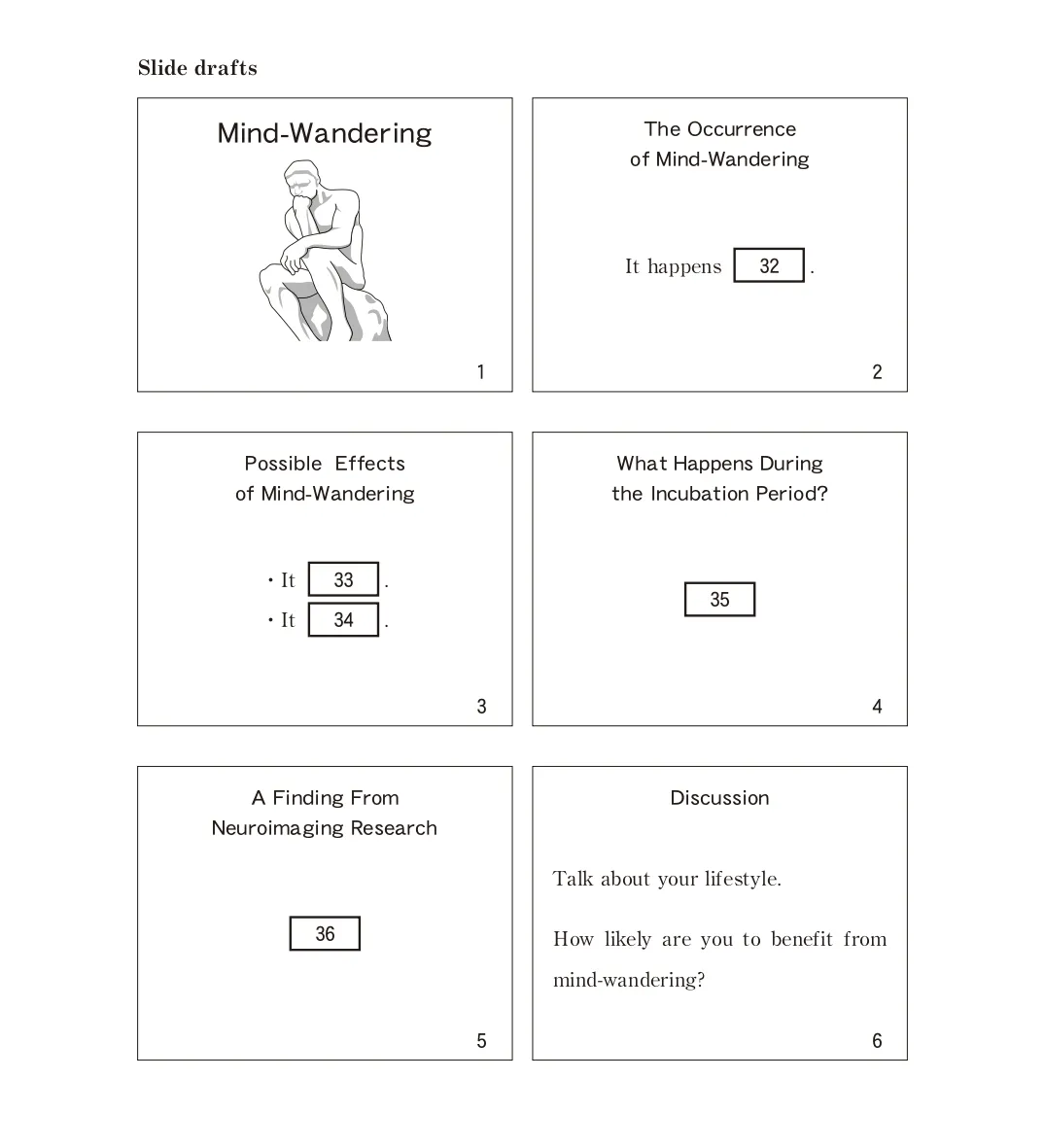
You prepared a presentation with a discussion question for your science class using the following passage.
Mind−Wandering: Lost in Thought
Rodin’s sculpture The Thinker represents a man absorbed in thought. People may wonder if he is thinking about life’s deep questions. Likewise, teachers may wonder what students sitting at their desks are thinking about—are they focusing on their schoolwork, or are they just daydreaming?
It is natural for the mind to switch between periods of focus and periods of rest. Even when we are supposed to be concentrating, we may not be paying attention to the task at hand. Scientists have found that we engage in daydreaming, also known as “mind−wandering,” approximately 50% of the time we are awake. While our minds are wandering, we are not thinking about anything special but our brains naturally come up with ideas, images, and emotions. In short, mind−wandering is a shift away from thoughts on the current task to other unrelated thoughts.
Our understanding about mind−wandering has grown over time. Past studies argued that mind−wandering was not merely a waste of time but actually quite harmful. Mind−wandering was found to negatively influence our mood, leading to work−related mistakes, traffic accidents, and even mental conditions such as depression. New research, however, shows that mind−wandering also has positive effects which can enrich our lives in various ways.
One such effect is that mind−wandering helps us generate creative ideas. In fact, some of our best ideas become apparent when our minds are wandering. To access these ideas, however, our brains sometimes require a period of time, just like eggs need time to hatch. This is called the “incubation period.” This interval away from the problem is critical because during that time our brains are unconsciously sorting through pieces of information and associating them with the problem. This enables us to come up with a fresh solution, which appears when we least expect it, for example, when we are on a walk or taking a shower.
What is really going on in the brain when the mind wanders? Previously, the brain was thought to be in a passive state at this time. However, through neuroimaging research conducted in 2001 in the US, more than a dozen regions of the brain were found to be active during mind−wandering. These regions, as a whole, were named the Default Mode Network(DMN). Moreover, according to a study conducted in 2022 by researchers based in Norway and the Netherlands, the DMN was more active when participants were performing a low−effort task compared to a high−effort task.
How can we make use of new discoveries in brain science and increase the number of unique benefits that mind−wandering has to offer? Here are four tips to help expand your mind. First, make time for simple activities such as doing the dishes or taking a warm bath. When involved with these undemanding tasks, our mind is free to wander around. Next, we can just go outside. For example, when we are in a forest, we are able to relax in nature and our mind can more easily spread out in all directions. Another suggestion is to get enough quality sleep each night. This will not only improve our mood, but enable the brain to be more receptive to new ideas. Finally, when we wake up in the morning, we should try to notice any thoughts that occur before we get out of bed. In this half−sleep state, our mind tends to wander and our ideas can flow more freely.
We will not always be able to control all of our thoughts. However, if we are aware of when and how mind−wandering happens, we may be able to take advantage of its seemingly random nature.
Choose the best option for( ).
このページは閲覧用ページです。
履歴を残すには、 「新しく出題する(ここをクリック)」 をご利用ください。
問題
反映中…
共通テスト(英語)試験 令和8年度(2026年度)本試験 問35(英語リーディング(第7問) 問3) (訂正依頼・報告はこちら) (新しいタブで開く)
各問の英文や図表を読み、最も適当な選択肢を選びなさい。
You prepared a presentation with a discussion question for your science class using the following passage.
Mind−Wandering: Lost in Thought
Rodin’s sculpture The Thinker represents a man absorbed in thought. People may wonder if he is thinking about life’s deep questions. Likewise, teachers may wonder what students sitting at their desks are thinking about—are they focusing on their schoolwork, or are they just daydreaming?
It is natural for the mind to switch between periods of focus and periods of rest. Even when we are supposed to be concentrating, we may not be paying attention to the task at hand. Scientists have found that we engage in daydreaming, also known as “mind−wandering,” approximately 50% of the time we are awake. While our minds are wandering, we are not thinking about anything special but our brains naturally come up with ideas, images, and emotions. In short, mind−wandering is a shift away from thoughts on the current task to other unrelated thoughts.
Our understanding about mind−wandering has grown over time. Past studies argued that mind−wandering was not merely a waste of time but actually quite harmful. Mind−wandering was found to negatively influence our mood, leading to work−related mistakes, traffic accidents, and even mental conditions such as depression. New research, however, shows that mind−wandering also has positive effects which can enrich our lives in various ways.
One such effect is that mind−wandering helps us generate creative ideas. In fact, some of our best ideas become apparent when our minds are wandering. To access these ideas, however, our brains sometimes require a period of time, just like eggs need time to hatch. This is called the “incubation period.” This interval away from the problem is critical because during that time our brains are unconsciously sorting through pieces of information and associating them with the problem. This enables us to come up with a fresh solution, which appears when we least expect it, for example, when we are on a walk or taking a shower.
What is really going on in the brain when the mind wanders? Previously, the brain was thought to be in a passive state at this time. However, through neuroimaging research conducted in 2001 in the US, more than a dozen regions of the brain were found to be active during mind−wandering. These regions, as a whole, were named the Default Mode Network(DMN). Moreover, according to a study conducted in 2022 by researchers based in Norway and the Netherlands, the DMN was more active when participants were performing a low−effort task compared to a high−effort task.
How can we make use of new discoveries in brain science and increase the number of unique benefits that mind−wandering has to offer? Here are four tips to help expand your mind. First, make time for simple activities such as doing the dishes or taking a warm bath. When involved with these undemanding tasks, our mind is free to wander around. Next, we can just go outside. For example, when we are in a forest, we are able to relax in nature and our mind can more easily spread out in all directions. Another suggestion is to get enough quality sleep each night. This will not only improve our mood, but enable the brain to be more receptive to new ideas. Finally, when we wake up in the morning, we should try to notice any thoughts that occur before we get out of bed. In this half−sleep state, our mind tends to wander and our ideas can flow more freely.
We will not always be able to control all of our thoughts. However, if we are aware of when and how mind−wandering happens, we may be able to take advantage of its seemingly random nature.
Choose the best option for( ).
横にスクロールして続きを読む(本文にフォーカスして左右キー)。
- Complicated problems enter our consciousness.
- Our brains organize information in new ways.
- Our moods are altered from negative to positive.
- The mind moves from an active to a passive state.
正解!素晴らしいです
残念...
画像拡大
この過去問の解説 (1件)
01
設問
What happens during the Incubation Period?
本設問では空欄(35)に当てはまる選択肢を選びます。
本文の重要な箇所は次の文です。
... during that time our brains are unconsciously sorting through pieces of information and associating them with the problem.
during that time = during the Incubation Period
during:(前置詞・「期間」の意味で)~の間に、~中に
associate A with ~: ①A を~と関連付ける、関連させる ②A から~を連想する、(考えとして)A と~が結びついている
sort:①(名詞)種類 ②(自動詞・他動詞)~を分類する
sort (through)~:~を分類する
pieces of information:不可算名詞である information を「数える」時には a piece of information, pieces of information のように表現します。
本文の記述に合致する選択肢は次のものです。
Our brains organize information in new ways.
brain:脳
organize:①~をまとめる、整理する ②~を編成する、組織化する ③~を主催する、手配する
Complicated problems enter our consciousness.
この選択肢の内容は本文に見当たりません。
そのため、この選択肢は不適切です。
complicated:複雑な
consciousness:意識
Our brains organize information in new ways.
この選択肢は本文の記述に合致し、適切です。
... during that time our brains are unconsciously sorting through pieces of information and associating them with the problem.
organize information が sorting through pieces of information に該当します。
あらかじめ脳に入っている情報を改めて分類する(sort through)ので in new ways も正しいと解釈できます。
Our moods are altered from negative to positive.
この選択肢の内容は本文に見当たりません。
そのため、この選択肢は不適切です。
また、前の段落で「うつ病になる事を招くという悪い効果がある」という記述に合わないとも言えます。
mood:気分、気持ち
alter:(自動詞・他動詞)~を変える
The mind moves from an active to a passive state.
incubation period に関する記述の次の段落に、
この時間帯に脳は passive ではなく active になっているという記述があります。
Previously, the brain was thought to be in a passive state at this time.
However, ... , more than a dozen regions of the brain were found to be active during mind−wandering.
そのため、この選択肢は不適切です。
知っておきたい単語や表現は、during, associate, sort, sort through, brain, organize, complicated, consciousness, mood, alter などです。
本文が長いので、どこに何の記述があるか分からなくなるかもしれません。
incubation period に関する段落の場所を思い出して、選択肢を一つずつ検証しましょう。
参考になった数0
この解説の修正を提案する (新しいタブで開く)
前の問題(問33)へ
令和8年度(2026年度)本試験 問題一覧
次の問題(問36)へ