
共通テスト(英語) 過去問
令和8年度(2026年度)追・再試験
問21 (英語リーディング(第5問) 問3)
問題文
各問の英文や図表を読み、最も適当な選択肢を選びなさい。
Your class will be hosting Jenny, a student from the UK. After a few email exchanges, she has emailed again about a blog post on lost and found items in Japan. You and your group members have replied.
【Jenny’s email】
Hello again,
Your emails are making me feel more comfortable about living in Japan.
Yesterday, I read a blog and was amazed to learn about the high return rate of lost property in Japan. It also mentions a well−known saying that I find fascinating. I guess that’s the main reason for the high number of returns. Please read the blog(www.************) and let me know if you agree.
In English, we have a saying, ‘Finders keepers, losers weepers.’ So, if I lose something, I don’t expect to get it back. I probably wouldn’t bother to report it to the police either. However, occasionally, ‘finders’ check for contact information and get in touch with the ‘loser.’ A couple of years ago, my uncle, who lives in Edinburgh, lost his wallet, but it just appeared in his letterbox with a note from the finder. The person who found it must have put it in there. He was very fortunate that nothing had been removed.
Anyway, I look forward to your response.
Best wishes,
Jenny
【Your group’s reply email】
Hello Jenny,
Thanks for sharing the English saying. We also find that fascinating.
It is true that the Japanese saying is common knowledge as many of us heard it when we were children. We don’t take it that seriously, though. Actually, we have a law known as the Lost Property Act. It says that the finder must report the item to the police. Otherwise, they may be punished. Also, if lost property is not claimed within 90 days, the finder is ‘rewarded’ by receiving the item. We think that this better explains the high return rate in Japan.
We can’t wait to meet you.
Yours,
Group 4 Members
P.S. Your uncle was really lucky.
According to the blog, which combination best describes the reasons for the high return rate of lost property in Japan?
A:Dealing with lost property is an essential police duty.
B:The law ensures the rights of both losers and finders.
C:The number of koban is increasing year by year.
D:‘The sun sees everything’ is widely believed.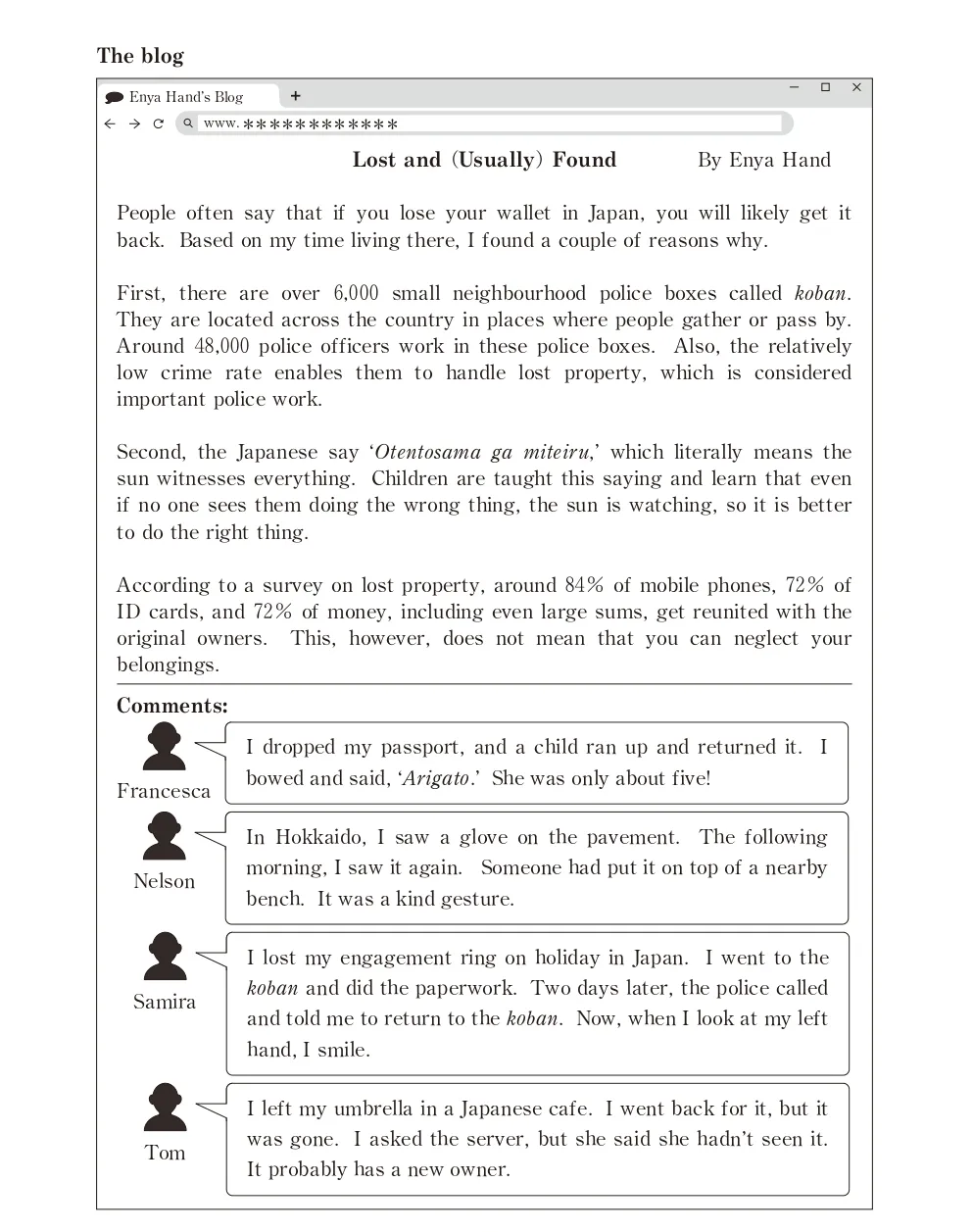
Your class will be hosting Jenny, a student from the UK. After a few email exchanges, she has emailed again about a blog post on lost and found items in Japan. You and your group members have replied.
【Jenny’s email】
Hello again,
Your emails are making me feel more comfortable about living in Japan.
Yesterday, I read a blog and was amazed to learn about the high return rate of lost property in Japan. It also mentions a well−known saying that I find fascinating. I guess that’s the main reason for the high number of returns. Please read the blog(www.************) and let me know if you agree.
In English, we have a saying, ‘Finders keepers, losers weepers.’ So, if I lose something, I don’t expect to get it back. I probably wouldn’t bother to report it to the police either. However, occasionally, ‘finders’ check for contact information and get in touch with the ‘loser.’ A couple of years ago, my uncle, who lives in Edinburgh, lost his wallet, but it just appeared in his letterbox with a note from the finder. The person who found it must have put it in there. He was very fortunate that nothing had been removed.
Anyway, I look forward to your response.
Best wishes,
Jenny
【Your group’s reply email】
Hello Jenny,
Thanks for sharing the English saying. We also find that fascinating.
It is true that the Japanese saying is common knowledge as many of us heard it when we were children. We don’t take it that seriously, though. Actually, we have a law known as the Lost Property Act. It says that the finder must report the item to the police. Otherwise, they may be punished. Also, if lost property is not claimed within 90 days, the finder is ‘rewarded’ by receiving the item. We think that this better explains the high return rate in Japan.
We can’t wait to meet you.
Yours,
Group 4 Members
P.S. Your uncle was really lucky.
According to the blog, which combination best describes the reasons for the high return rate of lost property in Japan?
A:Dealing with lost property is an essential police duty.
B:The law ensures the rights of both losers and finders.
C:The number of koban is increasing year by year.
D:‘The sun sees everything’ is widely believed.
このページは閲覧用ページです。
履歴を残すには、 「新しく出題する(ここをクリック)」 をご利用ください。
問題
反映中…
共通テスト(英語)試験 令和8年度(2026年度)追・再試験 問21(英語リーディング(第5問) 問3) (訂正依頼・報告はこちら) (新しいタブで開く)
各問の英文や図表を読み、最も適当な選択肢を選びなさい。
Your class will be hosting Jenny, a student from the UK. After a few email exchanges, she has emailed again about a blog post on lost and found items in Japan. You and your group members have replied.
【Jenny’s email】
Hello again,
Your emails are making me feel more comfortable about living in Japan.
Yesterday, I read a blog and was amazed to learn about the high return rate of lost property in Japan. It also mentions a well−known saying that I find fascinating. I guess that’s the main reason for the high number of returns. Please read the blog(www.************) and let me know if you agree.
In English, we have a saying, ‘Finders keepers, losers weepers.’ So, if I lose something, I don’t expect to get it back. I probably wouldn’t bother to report it to the police either. However, occasionally, ‘finders’ check for contact information and get in touch with the ‘loser.’ A couple of years ago, my uncle, who lives in Edinburgh, lost his wallet, but it just appeared in his letterbox with a note from the finder. The person who found it must have put it in there. He was very fortunate that nothing had been removed.
Anyway, I look forward to your response.
Best wishes,
Jenny
【Your group’s reply email】
Hello Jenny,
Thanks for sharing the English saying. We also find that fascinating.
It is true that the Japanese saying is common knowledge as many of us heard it when we were children. We don’t take it that seriously, though. Actually, we have a law known as the Lost Property Act. It says that the finder must report the item to the police. Otherwise, they may be punished. Also, if lost property is not claimed within 90 days, the finder is ‘rewarded’ by receiving the item. We think that this better explains the high return rate in Japan.
We can’t wait to meet you.
Yours,
Group 4 Members
P.S. Your uncle was really lucky.
According to the blog, which combination best describes the reasons for the high return rate of lost property in Japan?
A:Dealing with lost property is an essential police duty.
B:The law ensures the rights of both losers and finders.
C:The number of koban is increasing year by year.
D:‘The sun sees everything’ is widely believed.
横にスクロールして続きを読む(本文にフォーカスして左右キー)。
- A and B
- A and C
- A and D
- B and C
- B and D
- C and D
正解!素晴らしいです
残念...
画像拡大
この過去問の解説 (2件)
01
問題文は
「ブログによると、日本における落とし物の返却率の高さの理由をもっとも表している組み合わせはどれでしょう。」
です。
ブログで、そのことについて書かれている箇所は、まず警察について言及している段落にあります。
①the relatively low crime rate enables them to handle lost property, which is considered important police work.
(比較的低い犯罪率が、彼ら(警察)が落とし物に対処することを可能にしている。そしてそれは、警察の重要な仕事だと考えられている。)
さらに、次の段落の
②Second, the Japanese say 'Otentosama ga miteiru,' which literally means the sun witnesses everything. Children are taught this saying and learn that even if no one sees them doing the wrong thing, the sun is watching, so it is better to do the right thing.
(二つ目に、日本人は「お天道様が見ている」と言います。これは、文字通り、太陽は全てを見ていると言うことを意味します。子供はこのことわざを教えられ、たとえ誰も彼らが悪いことをしているのを見ていなくとも、太陽は見ているので、正しいことをした方が良いと学びます。)
にもあります。
この①②の内容に適するものが答えとなります。
各選択肢を見ていきます。
A: 正解
Dealing with lost property is an essential police duty.せ
「落とし物に対処するのは、警察の不可欠な義務である。」
上記①
the relatively low crime rate enables them to handle lost property, which is considered important police work.
(比較的低い犯罪率が、彼ら(警察)が無くし物に対処することを可能にしている。そしてそれは、警察の重要な仕事だと考えられている。)
に一致します。
B:The law ensures the rights of both losers and finders.
「法律は失くした人と見つけた人の両方の権利を保証している。」
このような記述はありません。
C: The number of koban is increasing year by year.
「交番の数は年々増えている。」
交番の数に関する言及はありますが、増えていると言う趣旨の記述はありません。
D: 正解
‘The sun sees everything’ is widely believed.
「「お天道様は全てを見ている」は広く信じられている。」
上記②
Second, the Japanese say 'Otentosama ga miteiru,' which literally means the sun witnesses everything. Children are taught this saying and learn that even if no one sees them doing the wrong thing, the sun is watching, so it is better
to do the right thing.
(2つ目に、日本人は「お天道様が見ている」と言います。これは、文字通り、太陽は全てを見ていると言うことを意味します。子供はこのことわざを教えられ、たとえ誰も彼らが悪いことをしているのを見ていなくとも、太陽は見ているので、正しいことをした方が良いと学びます。)
の内容と一致します。
したがって、正解は、AとDの組み合わせとなります。
問題文の「ブログによると」という指示を見落とさないように注意しましょう。
参考になった数0
この解説の修正を提案する (新しいタブで開く)
02
問題:ブログによると、日本で落し物が高い割合で持ち主に返される理由を最もよく表している組み合わせはどれですか?
A:落し物を取り扱うことは、警察の重要な業務である。
B:法律は、落し物を失くした人と拾った人の双方の権利を保障している。
C:交番の数は年々増加している。
D:「お天道様が見ている」という考え方が広く信じられている。
訳)
あなたのクラスでは、イギリスから来る留学生のJennyを受け入れる予定です。何度かメールをやり取りした後、彼女から日本の落とし物に関するブログ記事について、何度かメールが届きました。あなたとグループのメンバーはそれに返信しました。
【Jenny のメール】
こんにちは。またメールします。
皆さんからのメールのおかげで、日本で生活することへの不安が少し和らいできました。
昨日、ブログを読み、日本では落し物が非常に高い確率で持ち主に返されることを知って、とても驚きました。そのブログには、よく知られていることわざも紹介されていて、私はそれをとても興味深く感じました。それが、落し物が返される割合が高い主な理由なのだとうと思います。そのブログ(www.************)を読んで、皆さんが賛成するか教えてください。
英語では、 ‘Finders keepers, losers weepers.’(見つけた人のもの、失くした人は泣き寝入り)ということわざがあります。ですから、もし私が何かを失くしても、戻ってくるとは期待しません。おそらく、警察に届け出ることさえしないでしょう。
しかし、ときどき「拾った人」が連絡先を確認して、「失くした人」に連絡を取ることがあります。2年ほど前、エディンバラに住んでいる私のおじが財布を失くしました。しかし、その財布は拾った人からのメモと一緒に、郵便受けに入って戻ってきたのです。拾った人がそこに入れてくれたに違いありません。中身が何も抜き取られていなかったのですから、おじは本当に幸運でした。
それでは皆さんからの返信を楽しみにしています。
よろしくお願いします。
・comfortable:居心地の良い
・lost property:落し物
・well−known saying:よく知られていることわざ
・bother to:わざわざ~する
・occasionally:ときどき
・get in touch with:~と連絡を取る
【グループからの返信メール】
こんにちは、Jenny
英語のことわざを教えてくれてありがとう。とても興味深いと思います。
日本のことわざは、私たちの多くが子供の頃に聞いたことがあるので、広く知られているというのは確かです。ただし、私たちはそれをそれほど真剣に受け止めているわけではありません。実は、日本には「遺失物法」と呼ばれる法律があります。その法律は、広い主は落し物を警察に届け出なければならないと定められています。そうしなければ、罰せられる可能性があります。また、落し物が90日以内に持ち主から引き取られなかった場合、拾い主はその品物を受け取ることで「報酬」を得ることになります。私たちは、この法律のほうが、日本で落し物が高い割合で持ち主に返される理由をうまく説明していると考えています。
あなたに会えるのをとても楽しみにしています。
よろしくお願いします。
グループ4のメンバーより。
追伸:あなたのおじさんは本当に幸運でしたね。
・act:法
・otherwise:そうしなければ
・be punished:罰せられる
失くした物は(たいてい)見つかる
Enya Hand著
日本で財布を失くしても、おそらく戻ってくるだとうとよく言われています。
私自身が日本で暮らした経験から、その理由が2つあることが分かりました。
まず、交番と呼ばれる小さな地域の警察施設が6,000カ所以上あります。
それらは、人々が集まったり、通り過ぎたりする場所に、全国各地に設置されています。
約48,000人の警察官が交番で働いています。また、比較的犯罪率が低いため、
警察官は落し物の取り扱いに対応することができます。そして、落し物の取り扱いは、
警察の重要な業務と考えられています。
2つ目に、日本人は「お天道様が見ている」
と言います。これは文字通りには「太陽がすべてを見ている」という意味です。
子どもたちはこのことわざを教わり、たとえ誰も自分が悪いことをしているのを
見ていなくても、太陽は見ているのだから、正しい行いをするほうがよいのだと学びます。
落し物に関する調査によると、携帯電話の約84%、身分証明書の約72%、
そして多額のお金も含めた現金の約72%が、元の持ち主のもとに戻っています。
しかし、だからといって、自分の持ち物に注意を払わなくてもよいというわけではありません。
Francesca:私はパスポートを落としてしまいましたが、子どもが走って返してくれました。
私はお辞儀をして「ありがとう」と言いました。その子どもはまだ5歳くらいだったのです!
Nelson:北海道で、歩道に手袋が落ちているのを見かけました。翌朝、再びその手袋を見ました。
誰かが近くのベンチの上においてくれたのです。親切な行動でした。
Samira:私は日本で休暇を過ごしているときに、婚約指輪を失くしました。
交番に行き、必要な書類手続きをしました。2日後、警察から電話があり、
交番に戻ってくるように言われました。今では、自分の左手を見るたびに、
思わず笑顔になります。
Tom:私は日本のカフェに傘を置き忘れました。取りに戻りましたが、
傘はなくなっていました。店員に尋ねましたが、彼女は見ていないと言いました。
おそらく、誰か新しい持ち主ができたのでしょう。
正解
ブログでは、理由として大きく2つのことが挙げられています。
1つ目は、Also, the relatively low crime rade enables them to handle lost property, which is considered important police work(また、比較的犯罪率が低いため、警察官は落し物の取り扱いに対応することができます。そして、落し物の取り扱いは、警察の重要な業務と考えられています。).ここから、Aが正しいことが分かります。
2つ目は、Children are taught this saying and learn that even if no one sees them doing the wrong thing, the sum is watching, so it is better to do the right thing(子どもたちはこのことわざを教わり、たとえ誰も自分が悪いことをしているのを
見ていなくても、太陽は見ているのだから、正しい行いをするほうがよいのだと学びます。).ここから、Dの「お天道様が見ている」という考え方が広く信じられているが正しいと判断できます。
今回のような組み合わせ問題では、本文に書かれている事実と、選択肢で追加された情報を区別することが重要です。特にCのように本文に「交番が6,000カ所以上ある」と書かれていても、「年々増加している」という情報まで補わないようにしましょう。
参考になった数0
この解説の修正を提案する (新しいタブで開く)
前の問題(問20)へ
令和8年度(2026年度)追・再試験 問題一覧
次の問題(問22)へ