
共通テスト(英語) 過去問
令和4年度(2022年度)本試験
問44 (<旧課程>英語リーディング(第6問) 問B-1)
問題文
次の英文や図表を読み、解答番号にあてはまるものとして最も適当な選択肢を選びなさい。
You are in a student group preparing a poster for a scientific presentation contest with the theme ”What we should know in order to protect the environment.” You have been using the following passage to create the poster.
Recycling Plastic
― What You Need to Know ―
The world is full of various types of plastic. Look around, and you will see dozens of plastic items. Look closer and you will notice a recycling symbol on them. In Japan, you might have seen the first symbol in Figure 1 below, but the United States and Europe have a more detailed classification. These recycling symbols look like a triangle of chasing pointers, or sometimes a simple triangle with a number from one to seven inside. This system was started in 1988 by the Society of the Plastics Industry in the US, but since 2008 it has been administered by an international standards organization, ASTM (American Society for Testing and Materials) International. Recycling symbols provide important data about the chemical composition of plastic used and its recyclability. However, a plastic recycling symbol on an object does not always mean that the item can be recycled. It only shows what type of plastic it is made from and that it might be recyclable.
Figure 1.Plastic recycling symbols(See diagram below.)
So, what do these numbers mean? One group(numbers 2, 4, and 5)is considered to be safe for the human body, while the other group(numbers 1,3, 6, and 7)could be problematic in certain circumstances. Let us look at the safer group first.
High−density Polyethylene is a recycle−type 2 plastic and is commonly called HDPE. It is non−toxic and can be used in the human body for heart valves and artificial joints. It is strong and can be used at temperatures as low as ― 40℃ and as high as 100℃. HDPE can be reused without any harm and is also suitable for beer−bottle cases, milk jugs, chairs, and toys. Type 2 products can be recycled several times. Type 4 products are made from Low−density Polyethylene(LDPE). They are safe to use and are flexible. LDPE is used for squeezable bottles, and bread wrapping. Currently, very little Type 4 plastic is recycled. Polypropylene(PP), a Type 5 material, is the second−most widely produced plastic in the world. It is light, non−stretching, and has a high resistance to impact, heat, and freezing. It is suitable for furniture, food containers, and polymer banknotes such as the Australian dollar. Only 3% of Type 5 is recycled.
Now let us look at the second group, Types 1, 3, 6, and 7. These are more challenging because of the chemicals they contain or the difficulty in recycling them. Recycle−type 1 plastic is commonly known as PETE (Polyethylene Terephthalate), and is used mainly in food and beverage containers. PETE containers ― or PET as it is often written in Japan ― should only be used once as they are difficult to clean thoroughly. Also, they should not be heated above 70℃ as this can cause some containers to soften and change shape. Uncontaminated PETE is easy to recycle and can be made into new containers, clothes, or carpets, but if PETE is contaminated with Polyvinyl Chloride(PVC), it can make it unrecyclable. PVC, Type 3, is thought to be one of the least recyclable plastics known. It should only be disposed of by professionals and never set fire to at home or in the garden. Type 3 plastic is found in shower curtains, pipes, and flooring. Type 6, Polystyrene(PS)or Styrofoam as it is often called, is hard to recycle and catches fire easily. However, it is cheap to produce and lightweight. It is used for disposable drinking cups, instant noodle containers, and other food packaging. Type 7 plastics(acrylics, nylons, and polycarbonates)are difficult to recycle. Type 7 plastics are often used in the manufacture of vehicle parts such as seats, dashboards, and bumpers.
Currently, only about 20% of plastic is recycled, and approximately 55% ends up in a landfill. Therefore, knowledge about different types of plastic could help reduce waste and contribute to an increased awareness of the environment.
Your presentation poster draft:
(See diagraph below.)
Under the first poster heading, your group wants to introduce the plastic recycling symbols as explained in the passage. Which of the following is the most appropriate?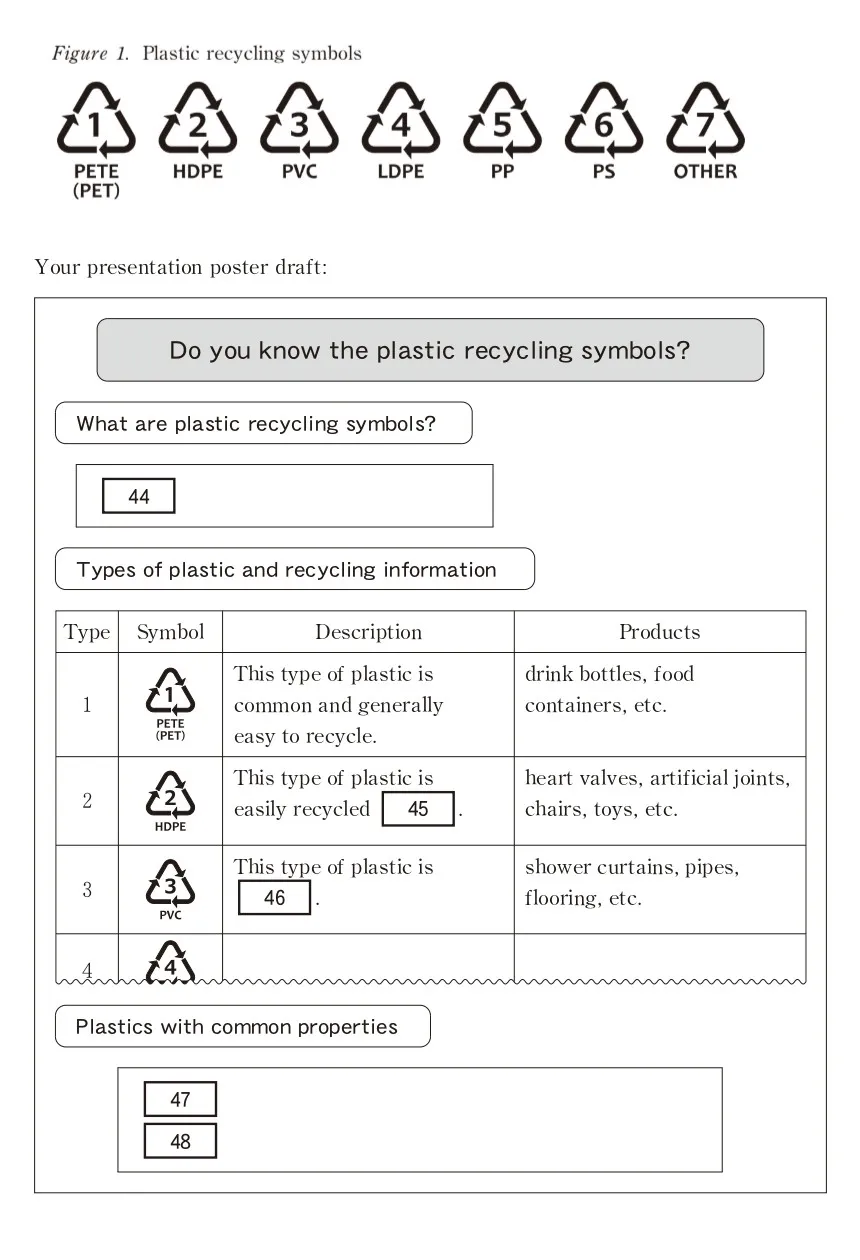
You are in a student group preparing a poster for a scientific presentation contest with the theme ”What we should know in order to protect the environment.” You have been using the following passage to create the poster.
Recycling Plastic
― What You Need to Know ―
The world is full of various types of plastic. Look around, and you will see dozens of plastic items. Look closer and you will notice a recycling symbol on them. In Japan, you might have seen the first symbol in Figure 1 below, but the United States and Europe have a more detailed classification. These recycling symbols look like a triangle of chasing pointers, or sometimes a simple triangle with a number from one to seven inside. This system was started in 1988 by the Society of the Plastics Industry in the US, but since 2008 it has been administered by an international standards organization, ASTM (American Society for Testing and Materials) International. Recycling symbols provide important data about the chemical composition of plastic used and its recyclability. However, a plastic recycling symbol on an object does not always mean that the item can be recycled. It only shows what type of plastic it is made from and that it might be recyclable.
Figure 1.Plastic recycling symbols(See diagram below.)
So, what do these numbers mean? One group(numbers 2, 4, and 5)is considered to be safe for the human body, while the other group(numbers 1,3, 6, and 7)could be problematic in certain circumstances. Let us look at the safer group first.
High−density Polyethylene is a recycle−type 2 plastic and is commonly called HDPE. It is non−toxic and can be used in the human body for heart valves and artificial joints. It is strong and can be used at temperatures as low as ― 40℃ and as high as 100℃. HDPE can be reused without any harm and is also suitable for beer−bottle cases, milk jugs, chairs, and toys. Type 2 products can be recycled several times. Type 4 products are made from Low−density Polyethylene(LDPE). They are safe to use and are flexible. LDPE is used for squeezable bottles, and bread wrapping. Currently, very little Type 4 plastic is recycled. Polypropylene(PP), a Type 5 material, is the second−most widely produced plastic in the world. It is light, non−stretching, and has a high resistance to impact, heat, and freezing. It is suitable for furniture, food containers, and polymer banknotes such as the Australian dollar. Only 3% of Type 5 is recycled.
Now let us look at the second group, Types 1, 3, 6, and 7. These are more challenging because of the chemicals they contain or the difficulty in recycling them. Recycle−type 1 plastic is commonly known as PETE (Polyethylene Terephthalate), and is used mainly in food and beverage containers. PETE containers ― or PET as it is often written in Japan ― should only be used once as they are difficult to clean thoroughly. Also, they should not be heated above 70℃ as this can cause some containers to soften and change shape. Uncontaminated PETE is easy to recycle and can be made into new containers, clothes, or carpets, but if PETE is contaminated with Polyvinyl Chloride(PVC), it can make it unrecyclable. PVC, Type 3, is thought to be one of the least recyclable plastics known. It should only be disposed of by professionals and never set fire to at home or in the garden. Type 3 plastic is found in shower curtains, pipes, and flooring. Type 6, Polystyrene(PS)or Styrofoam as it is often called, is hard to recycle and catches fire easily. However, it is cheap to produce and lightweight. It is used for disposable drinking cups, instant noodle containers, and other food packaging. Type 7 plastics(acrylics, nylons, and polycarbonates)are difficult to recycle. Type 7 plastics are often used in the manufacture of vehicle parts such as seats, dashboards, and bumpers.
Currently, only about 20% of plastic is recycled, and approximately 55% ends up in a landfill. Therefore, knowledge about different types of plastic could help reduce waste and contribute to an increased awareness of the environment.
Your presentation poster draft:
(See diagraph below.)
Under the first poster heading, your group wants to introduce the plastic recycling symbols as explained in the passage. Which of the following is the most appropriate?
このページは閲覧用ページです。
履歴を残すには、 「新しく出題する(ここをクリック)」 をご利用ください。
問題
反映中…
共通テスト(英語)試験 令和4年度(2022年度)本試験 問44(<旧課程>英語リーディング(第6問) 問B-1) (訂正依頼・報告はこちら)
次の英文や図表を読み、解答番号にあてはまるものとして最も適当な選択肢を選びなさい。
You are in a student group preparing a poster for a scientific presentation contest with the theme ”What we should know in order to protect the environment.” You have been using the following passage to create the poster.
Recycling Plastic
― What You Need to Know ―
The world is full of various types of plastic. Look around, and you will see dozens of plastic items. Look closer and you will notice a recycling symbol on them. In Japan, you might have seen the first symbol in Figure 1 below, but the United States and Europe have a more detailed classification. These recycling symbols look like a triangle of chasing pointers, or sometimes a simple triangle with a number from one to seven inside. This system was started in 1988 by the Society of the Plastics Industry in the US, but since 2008 it has been administered by an international standards organization, ASTM (American Society for Testing and Materials) International. Recycling symbols provide important data about the chemical composition of plastic used and its recyclability. However, a plastic recycling symbol on an object does not always mean that the item can be recycled. It only shows what type of plastic it is made from and that it might be recyclable.
Figure 1.Plastic recycling symbols(See diagram below.)
So, what do these numbers mean? One group(numbers 2, 4, and 5)is considered to be safe for the human body, while the other group(numbers 1,3, 6, and 7)could be problematic in certain circumstances. Let us look at the safer group first.
High−density Polyethylene is a recycle−type 2 plastic and is commonly called HDPE. It is non−toxic and can be used in the human body for heart valves and artificial joints. It is strong and can be used at temperatures as low as ― 40℃ and as high as 100℃. HDPE can be reused without any harm and is also suitable for beer−bottle cases, milk jugs, chairs, and toys. Type 2 products can be recycled several times. Type 4 products are made from Low−density Polyethylene(LDPE). They are safe to use and are flexible. LDPE is used for squeezable bottles, and bread wrapping. Currently, very little Type 4 plastic is recycled. Polypropylene(PP), a Type 5 material, is the second−most widely produced plastic in the world. It is light, non−stretching, and has a high resistance to impact, heat, and freezing. It is suitable for furniture, food containers, and polymer banknotes such as the Australian dollar. Only 3% of Type 5 is recycled.
Now let us look at the second group, Types 1, 3, 6, and 7. These are more challenging because of the chemicals they contain or the difficulty in recycling them. Recycle−type 1 plastic is commonly known as PETE (Polyethylene Terephthalate), and is used mainly in food and beverage containers. PETE containers ― or PET as it is often written in Japan ― should only be used once as they are difficult to clean thoroughly. Also, they should not be heated above 70℃ as this can cause some containers to soften and change shape. Uncontaminated PETE is easy to recycle and can be made into new containers, clothes, or carpets, but if PETE is contaminated with Polyvinyl Chloride(PVC), it can make it unrecyclable. PVC, Type 3, is thought to be one of the least recyclable plastics known. It should only be disposed of by professionals and never set fire to at home or in the garden. Type 3 plastic is found in shower curtains, pipes, and flooring. Type 6, Polystyrene(PS)or Styrofoam as it is often called, is hard to recycle and catches fire easily. However, it is cheap to produce and lightweight. It is used for disposable drinking cups, instant noodle containers, and other food packaging. Type 7 plastics(acrylics, nylons, and polycarbonates)are difficult to recycle. Type 7 plastics are often used in the manufacture of vehicle parts such as seats, dashboards, and bumpers.
Currently, only about 20% of plastic is recycled, and approximately 55% ends up in a landfill. Therefore, knowledge about different types of plastic could help reduce waste and contribute to an increased awareness of the environment.
Your presentation poster draft:
(See diagraph below.)
Under the first poster heading, your group wants to introduce the plastic recycling symbols as explained in the passage. Which of the following is the most appropriate?
You are in a student group preparing a poster for a scientific presentation contest with the theme ”What we should know in order to protect the environment.” You have been using the following passage to create the poster.
Recycling Plastic
― What You Need to Know ―
The world is full of various types of plastic. Look around, and you will see dozens of plastic items. Look closer and you will notice a recycling symbol on them. In Japan, you might have seen the first symbol in Figure 1 below, but the United States and Europe have a more detailed classification. These recycling symbols look like a triangle of chasing pointers, or sometimes a simple triangle with a number from one to seven inside. This system was started in 1988 by the Society of the Plastics Industry in the US, but since 2008 it has been administered by an international standards organization, ASTM (American Society for Testing and Materials) International. Recycling symbols provide important data about the chemical composition of plastic used and its recyclability. However, a plastic recycling symbol on an object does not always mean that the item can be recycled. It only shows what type of plastic it is made from and that it might be recyclable.
Figure 1.Plastic recycling symbols(See diagram below.)
So, what do these numbers mean? One group(numbers 2, 4, and 5)is considered to be safe for the human body, while the other group(numbers 1,3, 6, and 7)could be problematic in certain circumstances. Let us look at the safer group first.
High−density Polyethylene is a recycle−type 2 plastic and is commonly called HDPE. It is non−toxic and can be used in the human body for heart valves and artificial joints. It is strong and can be used at temperatures as low as ― 40℃ and as high as 100℃. HDPE can be reused without any harm and is also suitable for beer−bottle cases, milk jugs, chairs, and toys. Type 2 products can be recycled several times. Type 4 products are made from Low−density Polyethylene(LDPE). They are safe to use and are flexible. LDPE is used for squeezable bottles, and bread wrapping. Currently, very little Type 4 plastic is recycled. Polypropylene(PP), a Type 5 material, is the second−most widely produced plastic in the world. It is light, non−stretching, and has a high resistance to impact, heat, and freezing. It is suitable for furniture, food containers, and polymer banknotes such as the Australian dollar. Only 3% of Type 5 is recycled.
Now let us look at the second group, Types 1, 3, 6, and 7. These are more challenging because of the chemicals they contain or the difficulty in recycling them. Recycle−type 1 plastic is commonly known as PETE (Polyethylene Terephthalate), and is used mainly in food and beverage containers. PETE containers ― or PET as it is often written in Japan ― should only be used once as they are difficult to clean thoroughly. Also, they should not be heated above 70℃ as this can cause some containers to soften and change shape. Uncontaminated PETE is easy to recycle and can be made into new containers, clothes, or carpets, but if PETE is contaminated with Polyvinyl Chloride(PVC), it can make it unrecyclable. PVC, Type 3, is thought to be one of the least recyclable plastics known. It should only be disposed of by professionals and never set fire to at home or in the garden. Type 3 plastic is found in shower curtains, pipes, and flooring. Type 6, Polystyrene(PS)or Styrofoam as it is often called, is hard to recycle and catches fire easily. However, it is cheap to produce and lightweight. It is used for disposable drinking cups, instant noodle containers, and other food packaging. Type 7 plastics(acrylics, nylons, and polycarbonates)are difficult to recycle. Type 7 plastics are often used in the manufacture of vehicle parts such as seats, dashboards, and bumpers.
Currently, only about 20% of plastic is recycled, and approximately 55% ends up in a landfill. Therefore, knowledge about different types of plastic could help reduce waste and contribute to an increased awareness of the environment.
Your presentation poster draft:
(See diagraph below.)
Under the first poster heading, your group wants to introduce the plastic recycling symbols as explained in the passage. Which of the following is the most appropriate?
- They are symbols that rank the recyclability of plastics and other related problems.
- They provide information on the chemical make−up and recycling options of the plastic.
- They tell the user which standards organization gave them certificates for general use.
- They were introduced by ASTM and developed by the Society of the Plastics Industry.
正解!素晴らしいです
残念...
画像拡大
この過去問の解説 (3件)
01
設問
あなたのグループは、最初のポスターの見出しの下で、文中で説明されているプラスチックのリサイクルシンボルについて紹介したいと思っています。次のうちどれが最も適切でしょうか?
リサイクルシンボルについての説明は、本文第一段落中に記述があります。
日本やアメリカ、ヨーロッパなどの具体例ではなく、リサイクルシンボルとはどのようなものなのかを記述している箇所に着目しましょう。
The world is full of various types of plastic. Look around, and you will see dozens of plastic items. Look closer and you will notice a recycling symbol on them. In Japan, you might have seen the first symbol in Figure 1 below, but the United States and Europe have a more detailed classification. These recycling symbols look like a triangle of chasing pointers, or sometimes a simple triangle with a number from one to seven inside. This system was started in 1988 by the Society of the Plastics Industry in the US, but since 2008 it has been administered by an international standards organization, ASTM (American Society for Testing and Materials) International. Recycling symbols provide important data about the chemical composition of plastic used and its recyclability. However, a plastic recycling symbol on an object does not always mean that the item can be recycled. It only shows what type of plastic it is made from and that it might be recyclable.
「リサイクルシンボルは使用されているプラスチックの科学的組成とリサイクル可能性についての重要なデータを示す。」
「しかし、あるものにつけられたリサイクルシンボルはそれがリサイクルできることを常に意味しているわけではない。」
「リサイクルシンボルは、どんなプラスチックから作られているかとリサイクルできる可能性があることを示しているだけだ。」
といったことが書かれています。近い内容を記述している選択肢を探しましょう。
「プラスチックのリサイクル可能性や他の関連する問題を順位づけるシンボルだ」
リサイクル可能性や問題のレベルを順位づけるとは書かれていません。
「化学的組成とプラスチックのリサイクルの選択肢についての情報を提供する」
第1段落の内容と合致します。正答です。
「使用者たちに、どの標準化団体が一般的使用のための証明を与えるかを伝える」
そのような記述はありません。
「ASTMによって導入され、プラスチック産業協会によって開発された。」
第1段落には、ASTMやSociety of the Plastics Industryがこのシンボルの普及の過程に関わってきたことが記述されています。しかし、今回は「見出しの下に説明を加える」という趣旨の設問です。具体例や詳細ではなく、リサイクルシンボルの定義を記述するのが望ましいと考えられます。誤答です。
参考になった数0
この解説の修正を提案する
02
問題文は
「最初のポスターの見出しの下に、あなたのグループは、文章内で説明されたように、プラスティックのリサイクル表示を紹介したい。どれがもっとも適切か。」
です。
プラスティックのリサイクル表示について書かれた箇所は、
a plastic recycling symbol on an object does not always mean that the item can be recycled. It only shows what type of plastic it is made from and that it might be recyclable.
(物にあるプラスティックのリサイクル表示は、その商品がリサイクルできると必ずしも意味しているわけではない。それは単に、どのプラスチックから作られており、リサイクルされうるか、を示しているだけなのだ。)
です。
この内容に合うものを選びます。
「プラスティックの再利用性や関連問題をランクづけする表示」
正解 「化学構成やプラスティックのリサイクル選択についての情報を提供する」
プラスティックの内容や再利用の可否を示しているという内容と一致します。
「使い手にどの組織が一般使用の証明をしているかを教える」
「ASTMに紹介され、プラスティック産業社会によって発展させられた」\
参考になった数0
この解説の修正を提案する
03
最初のポスターの見出しの下に、本文で説明されているプラスチックのリサイクル表示について紹介したいです。次のうち、最も適切なものはどれかを選ぶ問題です。
訳)
あなたは「環境を守るために私たちが知っておくべきこと」というテーマの科学プレゼンテーションコンテストに向けて、ポスターを準備している学生グループの一員です。そのポスターを作成するために、次の文章を資料として使っています。
プラスチックのリサイクル
―知っておくべきこと―
世界は様々な種類のプラスチックであふれています。周りを見渡すと、数多くのプラスチック製品が目に入るでしょう。さらによく見ると、それらにはリサイクルマークが付いていることに気付くはずです。日本では、下の図1に示された最初のマークを見たことがあるかもしれません。しかしアメリカやヨーロッパでは、より詳しい分類が使われています。これらのリサイクルマークはポインターを追う三角形のように見えるか、あるいは1から7までの数字が入った単純な形をしています。この制度は、1988年にアメリカのプラスチック工業協会によって始められましたが、2008年以降は、国際的な標準化団体であるASTMインターナショナルによって管理されています。リサイクルマークは、使用されているプラスチックの科学的組成や、リサイクルの可能性に関する重要な情報を提供しています。しかし、製品にリサイクルマークが付いているからといって、必ずしもリサイクルできるとは限りません。それは単に、どの種類のプラスチックで作られているか、そしてリサイクルできる可能性があることを示しているだけなのです。
・dozens of : 数十の、たくさんのという意味です。
・classification(名詞) : 分類という意味です。
・triangle(名詞) : 三角形という意味です。
・administer(動詞) : 管理する、運営するという意味です。
・chemical composition : 科学的組成(何でできているか)という意味です。
図1:プラスチックのリサイクルマーク(下の図を参照)
では、これらの数字は何を意味しているのでしょうか。1つのグループ(2・4・5番)は人体に安全と考えられている一方で、もう1つのグループ(1・3・6・7番)は、特定の状況下では問題を引き起こす可能性があります。まずはより安全なグループから見ていきましょう。
・is considered to be ~ : ~と考えられているという意味です。
・in certain circumstance : 特定の状況下ではという意味です。
高密度ポリエチレンは、リサイクル区分2のプラスチックで、一般にHDPEと呼ばれています。これは無毒で、心臓弁や人工関節など、人体で使用することもできます。強度が高く、マイナス40℃という低温から、100℃という高温まで使用可能です。HDPEは何度使用しても害がなく、ビール瓶用ケース、牛乳容器、椅子、おもちゃなどにも適しています。タイプ2の製品は複数回リサイクルすることができます。タイプ4の製品は、低密度ポリエチレンから作られています。これらは安全で、柔軟性があります。LDPEは、圧縮して使うボトルやパンの包装に使用されます。現在、タイプ4のプラスチックはほとんどリサイクルされていません。ポリプロピレンはタイプ5の素材で、世界で2番目に多く生産されているプラスチックです。軽量で伸びにくく、衝撃・熱・凍結に対する耐性が高いのが特徴です。家具、食品容器、オーストラリアドル紙幣のような高分子製紙幣にも使われています。しかし、タイプ5のリサイクル率はわずか3%です。
・commonly(副詞) : 一般的にという意味です。
・heart valve : 心臓弁という意味です。
・artificial joint : 人工関節という意味です。
・flexible(形容詞) : 柔軟なという意味です。
・squeezable(形容詞) : 圧縮できるという意味です。
・resistance to ~ : ~への耐性という意味です。
次に第2のグループ(タイプ1・3・6・7)を見ていきましょう。これらは、含まれる化学物質やリサイクルの難しさのため、より扱いが困難です。タイプ1のプラスチックは、一般にPETEとして知られており、主に食品や飲料の容器に使われています。PETE容器は(日本ではPETとよく表示されています)、十分に洗浄するのが難しいため、一度しか使用すべきではありません。また、70℃以上に加熱してはいけません。容器が柔らかくなり、変形する可能性があるからです。汚染されていないPETEはリサイクルしやすく、新しい容器、衣類、カーペットなどに生まれ変わります。しかし、塩化ビニルで汚染されると、リサイクル不可能になることがあります。タイプ3のPVCは、最もリサイクルが難しいプラスチックの1つだと考えられています。専門業者によって処分されるべきであり、家庭や庭で燃やしてはいけません。タイプ3のプラスチックは、シャワーカーテン、配管、床材などに使われています。タイプ6のポリエチレン、または発泡スチロールは、リサイクルが難しく、燃えやすい素材です。しかし、製造コストが安く、軽量という利点があります。使い捨てカップ、カップ麵容器、食品包装などに使用されています。タイプ7のプラスチック(アクリル、ナイロン、ポリカーボネート)は、リサイクルが困難です。主に自動車部品に使用され、座席、ダッシュボード、バンパーなどの製造に使われています。
・thoroughly(副詞) : まったく、完全にという意味です。
・uncontaminated(形容詞) : 汚染されていないという意味です。
・contaminated(形容詞) : 汚染されたという意味です。
・disposable(形容詞) : 使い捨てのという意味です。
現在、プラスチックの約20%しかリサイクルされておらず、約55%が埋立地に送られています。そのため、プラスチックの種類についての知識は、廃棄物削減につながり、環境意識の向上にも貢献するといえるでしょう。
・landfill(名詞) : 埋立地という意味です。
・contribute to ~ : ~に貢献するという意味です。
プレゼンテーション用ポスター草案:
(下の図を参照)
この種類のプラスチックは一般的で、
通常はリサイクルしやすい。
この種類のプラスチックは容易にリサイクル
でき、( 46 )。
心臓弁、人工関節、椅子、
おもちゃなど。
シャワーカーテン、配管、
床材など。
不正解
プラスチックのリサイクルのしやすさや、その他の関連問題をランク付けする記号という意味です。
本文では「安全・問題があるグループ」に分かれているが、順位付けはしていないため不正解です。
正解
プラスチックの科学的構成や、リサイクルの可否・方法に関する情報を提供するという意味です。
1段落目の文末に、Recycling symbols provide important data about the chemical composition of plastic used and its recyclability. It only shows what type of plastic it is made from and that it might be recyclable(リサイクルマークは、使用されているプラスチックの科学的組成や、リサイクルの可能性に関する重要な情報を提供しています。それは単に、どの種類のプラスチックで作られているか、そしてリサイクルできる可能性があることを示しているだけなのです).と記載があります。
chemical composition = chemical make-up、recyclability = recycling optionsです。
不正解
どの標準化団体が一般使用の認証を与えたかを利用者に知らせるという意味です。
認証の話しではないため不正解です。
・certificate(名詞) : 証明書、証書という意味です。
不正解
ASTMによって導入され、プラスチック工業協会によって開発されたという意味です。
問題は「何を説明するための表示か」なのでポスターの導入文としては不適切です。
参考になった数0
この解説の修正を提案する
前の問題(問43)へ
令和4年度(2022年度)本試験 問題一覧
次の問題(問45)へ