
共通テスト(英語) 過去問
令和4年度(2022年度)追・再試験
問45 (<旧課程>英語リーディング(第6問) 問7)
問題文
各問いの英文や図表を読み、解答番号にあてはまるものとして最も適当な選択肢を選びなさい。
You are in a student group preparing a poster for a presentation contest.You have been using the following passage to create the poster.
A Brief History of Units of Length
Since ancient times, people have measured things.Measuring helps humans say how long, far, big, or heavy something is with some kind of accuracy.While weight and volume are important for the exchange of food, it can be argued that one of the most useful measurements is length because it is needed to calculate area, which helps in the exchange, protection, and taxation of property.
Measuring systems would often be based on or related to the human body.One of the earliest known measuring systems was the cubit, which was created around the 3rd millennium BC in Egypt and Mesopotamia.One cubit was the length of a man’s forearm from the elbow to the tip of the middle finger, which according to one royal standard was 524 millimeters(mm).In addition, the old Roman foot (296mm)、 which probably came from the Egyptians, was based on a human foot.
A unit of measurement known as the yard probably originated in Britain after the Roman occupation and it is said to be based on the double cubit.Whatever its origin, there were several different yards in use in Britain.Each one was a different length until the 12th century when the yard was standardized as the length from King Henry I’s nose to his thumb on his outstretched arm.But it was not until the 14th century that official documents described the yard as being divided into three equal parts ― three feet ― with one foot consisting of 12 inches.While this description helped standardize the inch and foot, it wasn’t until the late 15th century, when King Henry Ⅶ distributed official metal samples of feet and yards, that people knew for certain their true length.Over the years, a number of small adjustments were made until the International Yard and Pound Agreement of 1959 finally defined the standard inch, foot, and yard as 25.4mm, 304.8mm, and 914.4mm respectively.
The use of the human body as a standard from which to develop a measuring system was not unique to western cultures.The traditional Chinese unit of length called chi ― now one-third of a meter ― was originally defined as the length from the tip of the thumb to the outstretched tip of the middle finger, which was around 200mm.However, over the years it increased in length and became known as the Chinese foot.Interestingly, the Japanese shaku, which was based on the chi, is almost the same as one standard foot.It is only 1.8mm shorter.
The connection between the human body and measurement can also be found in sailing.The fathom(6 feet)、the best-known unit for measuring the depth of the sea in the English-speaking world, was historically an ancient Greek measurement.It was not a very accurate measurement as it was based on the length of rope a sailor could extend from open arm to open arm.Like many other British and American units, it was also standardized in 1959.
The metric system, first described in 1668 and officially adopted by the French government in 1799, has now become the dominant measuring system worldwide.This system has slowly been adopted by many countries as either their standard measuring system or as an alternative to their traditional system.While the metric system is mainly used by the scientific, medical, and industrial professions, traditional commercial activities still continue to use local traditional measuring systems.For example, in Japan, window widths are measured in ken(6 shaku).
Once, an understanding of the relationship between different measures was only something traders and tax officials needed to know.However, now that international online shopping has spread around the world, we all need to know a little about other countries’ measuring systems so that we know how much, or how little, of something we are buying.
Under the second poster heading, you need to write statements concerning units of length.Choose the two below which are most accurate.(The order does not matter.)( 45 )・( 46 )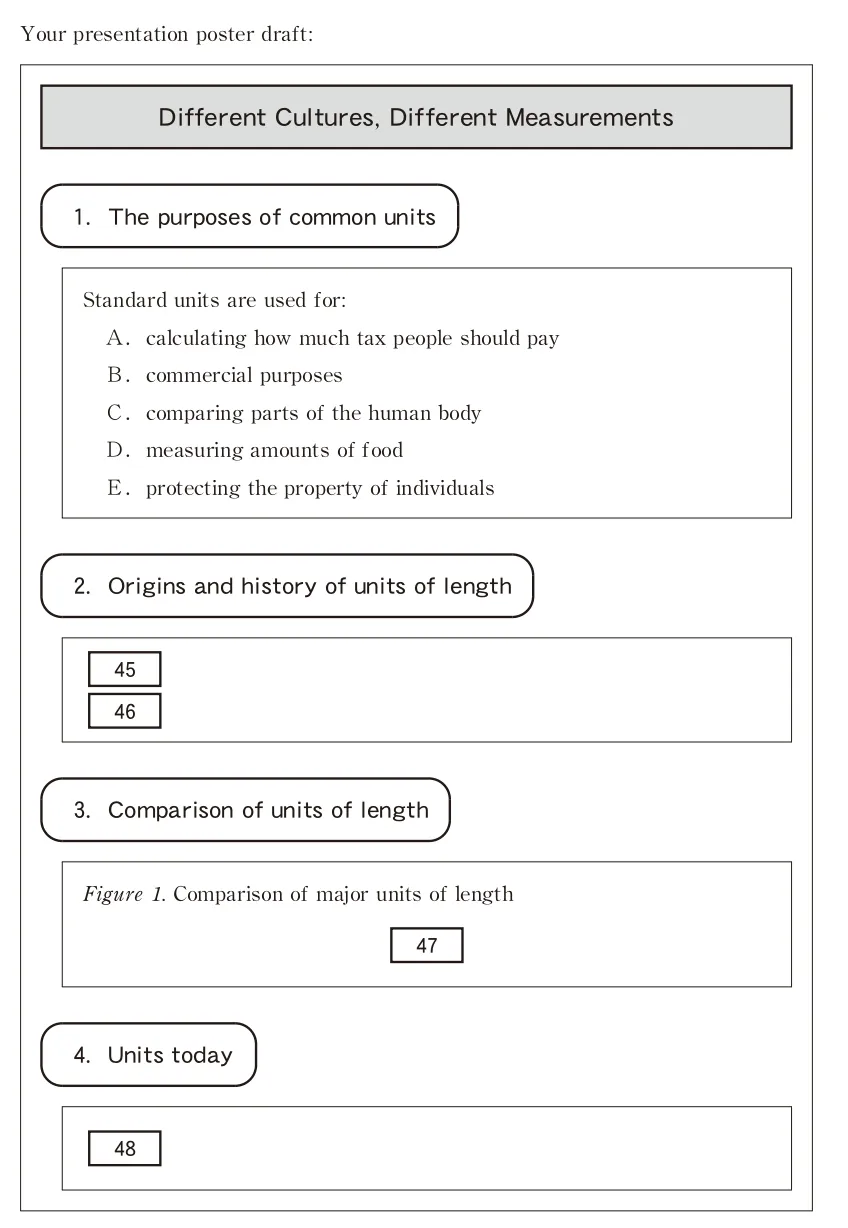
You are in a student group preparing a poster for a presentation contest.You have been using the following passage to create the poster.
A Brief History of Units of Length
Since ancient times, people have measured things.Measuring helps humans say how long, far, big, or heavy something is with some kind of accuracy.While weight and volume are important for the exchange of food, it can be argued that one of the most useful measurements is length because it is needed to calculate area, which helps in the exchange, protection, and taxation of property.
Measuring systems would often be based on or related to the human body.One of the earliest known measuring systems was the cubit, which was created around the 3rd millennium BC in Egypt and Mesopotamia.One cubit was the length of a man’s forearm from the elbow to the tip of the middle finger, which according to one royal standard was 524 millimeters(mm).In addition, the old Roman foot (296mm)、 which probably came from the Egyptians, was based on a human foot.
A unit of measurement known as the yard probably originated in Britain after the Roman occupation and it is said to be based on the double cubit.Whatever its origin, there were several different yards in use in Britain.Each one was a different length until the 12th century when the yard was standardized as the length from King Henry I’s nose to his thumb on his outstretched arm.But it was not until the 14th century that official documents described the yard as being divided into three equal parts ― three feet ― with one foot consisting of 12 inches.While this description helped standardize the inch and foot, it wasn’t until the late 15th century, when King Henry Ⅶ distributed official metal samples of feet and yards, that people knew for certain their true length.Over the years, a number of small adjustments were made until the International Yard and Pound Agreement of 1959 finally defined the standard inch, foot, and yard as 25.4mm, 304.8mm, and 914.4mm respectively.
The use of the human body as a standard from which to develop a measuring system was not unique to western cultures.The traditional Chinese unit of length called chi ― now one-third of a meter ― was originally defined as the length from the tip of the thumb to the outstretched tip of the middle finger, which was around 200mm.However, over the years it increased in length and became known as the Chinese foot.Interestingly, the Japanese shaku, which was based on the chi, is almost the same as one standard foot.It is only 1.8mm shorter.
The connection between the human body and measurement can also be found in sailing.The fathom(6 feet)、the best-known unit for measuring the depth of the sea in the English-speaking world, was historically an ancient Greek measurement.It was not a very accurate measurement as it was based on the length of rope a sailor could extend from open arm to open arm.Like many other British and American units, it was also standardized in 1959.
The metric system, first described in 1668 and officially adopted by the French government in 1799, has now become the dominant measuring system worldwide.This system has slowly been adopted by many countries as either their standard measuring system or as an alternative to their traditional system.While the metric system is mainly used by the scientific, medical, and industrial professions, traditional commercial activities still continue to use local traditional measuring systems.For example, in Japan, window widths are measured in ken(6 shaku).
Once, an understanding of the relationship between different measures was only something traders and tax officials needed to know.However, now that international online shopping has spread around the world, we all need to know a little about other countries’ measuring systems so that we know how much, or how little, of something we are buying.
Under the second poster heading, you need to write statements concerning units of length.Choose the two below which are most accurate.(The order does not matter.)( 45 )・( 46 )
このページは閲覧用ページです。
履歴を残すには、 「新しく出題する(ここをクリック)」 をご利用ください。
問題
反映中…
共通テスト(英語)試験 令和4年度(2022年度)追・再試験 問45(<旧課程>英語リーディング(第6問) 問7) (訂正依頼・報告はこちら)
各問いの英文や図表を読み、解答番号にあてはまるものとして最も適当な選択肢を選びなさい。
You are in a student group preparing a poster for a presentation contest.You have been using the following passage to create the poster.
A Brief History of Units of Length
Since ancient times, people have measured things.Measuring helps humans say how long, far, big, or heavy something is with some kind of accuracy.While weight and volume are important for the exchange of food, it can be argued that one of the most useful measurements is length because it is needed to calculate area, which helps in the exchange, protection, and taxation of property.
Measuring systems would often be based on or related to the human body.One of the earliest known measuring systems was the cubit, which was created around the 3rd millennium BC in Egypt and Mesopotamia.One cubit was the length of a man’s forearm from the elbow to the tip of the middle finger, which according to one royal standard was 524 millimeters(mm).In addition, the old Roman foot (296mm)、 which probably came from the Egyptians, was based on a human foot.
A unit of measurement known as the yard probably originated in Britain after the Roman occupation and it is said to be based on the double cubit.Whatever its origin, there were several different yards in use in Britain.Each one was a different length until the 12th century when the yard was standardized as the length from King Henry I’s nose to his thumb on his outstretched arm.But it was not until the 14th century that official documents described the yard as being divided into three equal parts ― three feet ― with one foot consisting of 12 inches.While this description helped standardize the inch and foot, it wasn’t until the late 15th century, when King Henry Ⅶ distributed official metal samples of feet and yards, that people knew for certain their true length.Over the years, a number of small adjustments were made until the International Yard and Pound Agreement of 1959 finally defined the standard inch, foot, and yard as 25.4mm, 304.8mm, and 914.4mm respectively.
The use of the human body as a standard from which to develop a measuring system was not unique to western cultures.The traditional Chinese unit of length called chi ― now one-third of a meter ― was originally defined as the length from the tip of the thumb to the outstretched tip of the middle finger, which was around 200mm.However, over the years it increased in length and became known as the Chinese foot.Interestingly, the Japanese shaku, which was based on the chi, is almost the same as one standard foot.It is only 1.8mm shorter.
The connection between the human body and measurement can also be found in sailing.The fathom(6 feet)、the best-known unit for measuring the depth of the sea in the English-speaking world, was historically an ancient Greek measurement.It was not a very accurate measurement as it was based on the length of rope a sailor could extend from open arm to open arm.Like many other British and American units, it was also standardized in 1959.
The metric system, first described in 1668 and officially adopted by the French government in 1799, has now become the dominant measuring system worldwide.This system has slowly been adopted by many countries as either their standard measuring system or as an alternative to their traditional system.While the metric system is mainly used by the scientific, medical, and industrial professions, traditional commercial activities still continue to use local traditional measuring systems.For example, in Japan, window widths are measured in ken(6 shaku).
Once, an understanding of the relationship between different measures was only something traders and tax officials needed to know.However, now that international online shopping has spread around the world, we all need to know a little about other countries’ measuring systems so that we know how much, or how little, of something we are buying.
Under the second poster heading, you need to write statements concerning units of length.Choose the two below which are most accurate.(The order does not matter.)( 45 )・( 46 )
You are in a student group preparing a poster for a presentation contest.You have been using the following passage to create the poster.
A Brief History of Units of Length
Since ancient times, people have measured things.Measuring helps humans say how long, far, big, or heavy something is with some kind of accuracy.While weight and volume are important for the exchange of food, it can be argued that one of the most useful measurements is length because it is needed to calculate area, which helps in the exchange, protection, and taxation of property.
Measuring systems would often be based on or related to the human body.One of the earliest known measuring systems was the cubit, which was created around the 3rd millennium BC in Egypt and Mesopotamia.One cubit was the length of a man’s forearm from the elbow to the tip of the middle finger, which according to one royal standard was 524 millimeters(mm).In addition, the old Roman foot (296mm)、 which probably came from the Egyptians, was based on a human foot.
A unit of measurement known as the yard probably originated in Britain after the Roman occupation and it is said to be based on the double cubit.Whatever its origin, there were several different yards in use in Britain.Each one was a different length until the 12th century when the yard was standardized as the length from King Henry I’s nose to his thumb on his outstretched arm.But it was not until the 14th century that official documents described the yard as being divided into three equal parts ― three feet ― with one foot consisting of 12 inches.While this description helped standardize the inch and foot, it wasn’t until the late 15th century, when King Henry Ⅶ distributed official metal samples of feet and yards, that people knew for certain their true length.Over the years, a number of small adjustments were made until the International Yard and Pound Agreement of 1959 finally defined the standard inch, foot, and yard as 25.4mm, 304.8mm, and 914.4mm respectively.
The use of the human body as a standard from which to develop a measuring system was not unique to western cultures.The traditional Chinese unit of length called chi ― now one-third of a meter ― was originally defined as the length from the tip of the thumb to the outstretched tip of the middle finger, which was around 200mm.However, over the years it increased in length and became known as the Chinese foot.Interestingly, the Japanese shaku, which was based on the chi, is almost the same as one standard foot.It is only 1.8mm shorter.
The connection between the human body and measurement can also be found in sailing.The fathom(6 feet)、the best-known unit for measuring the depth of the sea in the English-speaking world, was historically an ancient Greek measurement.It was not a very accurate measurement as it was based on the length of rope a sailor could extend from open arm to open arm.Like many other British and American units, it was also standardized in 1959.
The metric system, first described in 1668 and officially adopted by the French government in 1799, has now become the dominant measuring system worldwide.This system has slowly been adopted by many countries as either their standard measuring system or as an alternative to their traditional system.While the metric system is mainly used by the scientific, medical, and industrial professions, traditional commercial activities still continue to use local traditional measuring systems.For example, in Japan, window widths are measured in ken(6 shaku).
Once, an understanding of the relationship between different measures was only something traders and tax officials needed to know.However, now that international online shopping has spread around the world, we all need to know a little about other countries’ measuring systems so that we know how much, or how little, of something we are buying.
Under the second poster heading, you need to write statements concerning units of length.Choose the two below which are most accurate.(The order does not matter.)( 45 )・( 46 )
- Inch and meter were defined by the 1959 International Yard and Pound Agreement.
- The chi began as a unit related to a hand and gradually became longer over time.
- The cubit is one of the oldest units based on the length of a man’s foot.
- The length of the current standard yard was standardized by King Henry Ⅶ.
- The origin of the fathom was from the distance between a man’s open arms.
- The origin of the Roman foot can be traced back to Great Britain.
正解!素晴らしいです
残念...
画像拡大
この過去問の解説 (3件)
01
設問文
2つ目のポスター見出しの下に、長さの単位についての記述をする必要があります。最も正確な2つを選びなさい。(順序は問いません。)
2つ目の見出し
2. 長さの単位の起源と歴史
本文中では、第2段落以降に長さの単位についての具体的な記述があります。選択肢の記述と照合し、正誤を判断しましょう。
「インチとメートルは1959年国際ヤード・ポンド合意によって定義された。」
第3段落
Over the years, a number of small adjustments were made until the International Yard and Pound Agreement of 1959 finally defined the standard inch, foot, and yard as 25.4mm, 304.8mm, and 914.4mm respectively.
より、「1959年の国際ヤード・ポンド合意が標準インチ・フィート・ヤードを定義した」とあります。メートルは定義されていません。
「チは手に関連した単位として始まり、徐々に長くなっていった。」
第4段落
The traditional Chinese unit of length called chi ― now one-third of a meter ― was originally defined as the length from the tip of the thumb to the outstretched tip of the middle finger, which was around 200mm.However, over the years it increased in length and became known as the Chinese foot.Interestingly, the Japanese shaku, which was based on the chi, is almost the same as one standard foot.It is only 1.8mm shorter.
より、「チは年を経て長さが長くなった」ということがわかります。正答です。
「キュビットは、男性の足の長さを元にした最も古い単位の1つだ。」
第2段落
One of the earliest known measuring systems was the cubit, which was created around the 3rd millennium BC in Egypt and Mesopotamia.One cubit was the length of a man’s forearm from the elbow to the tip of the middle finger, which according to one royal standard was 524 millimeters(mm).
「最も古い計測システムの1つがキュビット」「1キュビットは男性の肘から中指までの長さ」とありますので、足の長さを元にしていないことがわかります。
「現在の標準ヤードの長さはヘンリー7世に標準化された。」
第3段落
While this description helped standardize the inch and foot, it wasn’t until the late 15th century, when King Henry Ⅶ distributed official metal samples of feet and yards, that people knew for certain their true length.
とヘンリー7世について記述がありますが、彼は「フィートとヤードの金属サンプルを配布した」だけです。
「ファソームの起源は男性の広げた腕の距離から来ている。」
第5段落
The fathom(6 feet)、the best-known unit for measuring the depth of the sea in the English-speaking world, was historically an ancient Greek measurement.It was not a very accurate measurement as it was based on the length of rope a sailor could extend from open arm to open arm.
より、「ファソームは船乗りが腕から腕へ広げられるロープの長さに基づいている。」ことがわかります。正答です。
「ローマのフィートの起源はイギリスに遡る。」
第2段落
In addition, the old Roman foot (296mm)、 which probably came from the Egyptians, was based on a human foot.
より、「フィートの起源はエジプト人である」ことがわかります。イギリスではありません。
参考になった数0
この解説の修正を提案する
02
問題文は
「ポスターの2番目の見出しの下で、長さの単位に関する記述を書く必要がある。最も正確なものを下から2つ選びなさい。(順不同)」
です。
2番目の見出しとは、
Origins and history of units of length
(長さの単位の起源と歴史)
関連する英文はかなり長いため、選択肢から探して、正誤を確認していきましょう。
「インチやメートルは1959年の国際ヤード・ポンド協定により定義された。」
the International Yard and Pound Agreement of 1959 finally defined the standard inch, foot, and yard as 25.4mm, 304.8mm, and 914.4mm respectively.
(1959年の国際ヤード・ポンド協定は、最終的に、標準のインチ、フィート、ヤードをそれぞれ25.4mm、304.8mm、914.4mmと定義した。)
メートルが含まれていないので、誤りです。
正解「「チ」は、手に関連のある単位として始まり、時間とともに、段々長くなった。」
The traditional Chinese unit of length called chi ― now one-third of a meter ― was originally defined as the length from the tip of the thumb to the outstretched tip of the middle finger, which was around 200mm.However, over the years it increased in length and became known as the Chinese foot.
(チと呼ばれる伝統的な中国の長さの単位(今はメートルの3分の1)は、もともと親指の先から中指の先までの長さと定義され、それは、約200mmだった。しかし、時とともに、長さが伸び、中国のフィートとして知られるようになった。)
とあり、内容が一致します。
「キュビットは、人間の足の長さに基づく最も古い単位の一つだ。」
One cubit was the length of a man’s forearm from the elbow to the tip of the middle finger,
(1キュビットは、男性の前腕の肘から中指の先までの長さだった。)
とあり、足ではないので誤りです。
「現在の標準ヤードの長さは、ヘンリー7世王によって標準化された。」
it wasn’t until the late 15th century, when King Henry Ⅶ distributed official metal samples of feet and yards, that people knew for certain their true length.
(15世紀後半になって初めて、ヘンリー7世王はフィートとヤードの正式な金属のサンプルを配布し、人々はその本当の長さを確実に知った。)
とあり、一致しません。
正解「ファゾムの起源は、男性の開いた腕の間の距離なら来ている。」
It was not a very accurate measurement as it was based on the length of rope a sailor could extend from open arm to open arm.
(ファゾムは、船乗りが広げた腕から腕までで、伸ばすことができるロープの長さに基づいていたので、あまり正確な測定ではなかった。)
とあり、一致します。
「ローマのフィートの起源は、イギリスに遡ることができる。」
the old Roman foot (296mm)、 which probably came from the Egyptians, was based on a human foot.
(古代ローマのフィート(296mm)は、おそらくエジプト人から来ており、人間の足に基づいていた。)
とあり、イギリスではないので、誤りです。
参考になった数0
この解説の修正を提案する
03
ホスターの2番目の見出しの下に、長さの単位に関する説明文を書く必要があります。最も適切な選択肢を2つ選ぶ問題です(順不同)。
訳)
発表コンテストのポスターを準備している学生グループに所属しています。そのポスター作成のため、次の文章を使用してきました。
長さの単位の簡潔な歴史
古代から、人々は様々な物を測ってきました。測ることで、ある物の長さ、距離、大きさ、重さなどをある程度正確に知ることができます。重さと体積は食料の交換に重要ですが、最も有用な測定単位の1つは長さと言えるでしょう。長さは面積を計算するのに必要であり、財産の交換、保護、課税に役立つからです。
・unit(名詞) : 単位
・with some kind of : ある種の、何らかの
・accuracy(名詞) : 正確
・it can be argued that ~ : ~であると言える
・calculate(動詞) : 計算する
・property(名詞) : 財産
計測システムは多くの場合、人体に基づいているか、人体と関連していました。最も古い計測システムの1つは、キュビットで紀元前3千年頃にエジプトとメソポタミアで作られました。1キュビットは、男性の肘から中指の先までの前腕の長さで、ある王室標準によれば、524mmでした。さらに、おそらくエジプトから伝わったとされる古代ローマのフィート(296mm)は、人間の足に基づいていました。
・related to ~ : ~に関連する
・millennium(名詞) : 千年間
・forearm(名詞) : 前腕
・tip of ~ : ~の先
ヤードとして知られる計測単位は、おそらくローマによる占領後にイギリスで生まれ、2キュビットに基づいていると言われています。起源がどうであれ、イギリスではいくつかの異なるヤードが使用されていました。12世紀まで、それぞれの長さが異なっていましたが、このときヤードはヘンリー 1 世の鼻から腕を伸ばした親指までの長さとして標準化されました。しかし、公式文書でヤードが3つの等しい部分に分割され、1フィートが12インチであると説明されたのは14世紀になってからのことでした。この説明はインチとフィートの標準化に役立ちましたが、15世紀後半にヘンリー7世がフィートとヤードの公式の金属サンプルを配布して初めて、人々は本当の長さを知るようになりました。長年にわたり、いくつかの小さな調整が行われ、1959年の国際ヤード・ポンド協定で最終的に標準のインチ、フィート、ヤードがそれぞれ25.4mm、304.8mm、914.4mmとなりました。
・originate(動詞) : 生じる、始まる
・occupation(名詞): 占領
・standardize(動詞) : 標準化する
・thumb(名詞) : 親指 ※発音はサムです。
・divide into ~ : ~に分かれる
・adjustment(名詞) : 調整
・define(動詞) : 定義する
・respectively(副詞) : それぞれ
人体を基準にして計測システムを開発することは、西洋文化に限ったことではありませんでした。1メートルの3分の1に相当する中国の伝統的な長さの単位、「チ」は元々親指の先から中指の先までの長さとして定義され、約200mmでした。しかし、長年にわたってその長さが伸び、中国のフィートとして知られるようになりました。興味深いことに、「チ」に基づいた日本の「尺」は、標準フィートとほぼ同じでわずか1.8mm短いだけです。
・originally(副詞) : 元々は
人体と計測のつながりは、セーリングにも見られます。英語圏で最もよく知られている海の深さの単位であるファゾム(6フィート)は、歴史的には古代ギリシャの計測単位です。船乗りが腕から腕まで広げられるロープの長さに基づいていたため、あまり正確な計測ではありませんでした。他の多くのイギリスとアメリカの単位と同様に、これも1959年に標準化されました。
メートル法は、1668年に初めて紹介され、1799年にフランス政府によって公式に採用されました。現在では世界中で主要な計測システムになっています。これは多くの国で標準計測システムとして、または従来のシステムの代替として、徐々に採用されてきました。メートル法は主に科学、医療、産業の専門家によって使用されていますが、慣習的な商業活動では現在でも地元の伝統的な計測システムが使用され続けています。たとえば、日本では窓の幅は間(6尺)で測定されています。
・adopt(動詞) : 採用する
・dominant(形容詞) : 優勢な、支配的な
・alternative to ~ : ~の代わりとなるもの
かつては異なる測定単位の関係性を理解する必要があったのは、貿易業者や税務当局者くらいでした。しかし、今では国際的なオンラインショッピングが世界中に広まり、購入品の量がどれくらいか、またはどれくらい少ないかを知るために他の国の測定システムについて少し知っておく必要があります。
プレゼンテーションポスターの草案
標準的な単位は、次の目的で使われる
A.人々が支払うべき税額を計算するため
B.商業目的のため
C.人体の各部位を比較するため
D.食料の量を図るため
E.個人の財産を守るため
( 45 )
( 46 )
図1:主要な長さの単位の比較
( 47 )
不正解
インチとメートルは、1959年の国際ヤード・ポンド協定によって定義されたとういう意味です。
1959年に定義されたのはインチ・フィート・ヤードです。メートルは含まれていないため不正解です。
正解
「チ」は、手に基づく単位として始まり、時代とともに長くなったという意味です。
4段落目に、The traditional Chinese unit of length called chi was originally defined as the length from the tip of the thumb to the outstretched tip of the middle finger, which was around 200mm.However, over the years it increased in length(中国の伝統的な長さの単位、「チ」は元々親指の先から中指の先までの長さとして定義され、約200mmでした。しかし、長年にわたってその長さが伸び~)と記載があるため正解です。
不正解
キュビットは、人の足の長さに基づく最古の単位の1つであるという意味です。
キュビットは前腕(肘~中指)なので不正解です。
不正解
現在の標準ヤードの長さは、ヘンリー7世によって標準化されたという意味です。
ヘンリー7世は金属サンプルを配布しただけなので不正解です。
正解
ファゾムの起源は、人が両腕を広げた長さであるという意味です。
5段落目に、The fathom(6 feet) was historically an ancient Greek measurement. ~ it was based on the length of rope a sailor could extend from open arm to open arm(ファゾム(6フィート)は、歴史的には古代ギリシャの計測単位です。船乗りが腕から腕まで広げられるロープの長さに基づいていたため~).と記載があるため正解です。
不正解
ローマのフィートの起源は、イギリスに遡ることができるという意味です。
ローマのフィートは、エジプト由来の可能性があると記載があるため不正解です。
・trace back to ~ : ~に遡る
数字・年代・誰が(どの組織が)決めたのかを熟読しましょう。また、foot、arm、handなど混同に注意しましょう。
参考になった数0
この解説の修正を提案する
前の問題(問44)へ
令和4年度(2022年度)追・再試験 問題一覧
次の問題(問47)へ