
共通テスト(英語) 過去問
令和5年度(2023年度)本試験
問113 (<旧課程>英語リーディング(第4問) 問5)
問題文
各問いの英文や図表を読み、解答番号にあてはまるものとして最も適当な選択肢を選びなさい。
Your teacher has asked you to read two articles about effective ways to study. You will discuss what you learned in your next class.
How to Study Effectively: Contextual Learning!
Tim Oxford
Science Teacher, Stone City Junior High School
As a science teacher, I am always concerned about how to help students who struggle to learn. Recently, I found that their main way of learning was to study new information repeatedly until they could recall it all. For example, when they studied for a test, they would use a workbook like the example below and repeatedly say the terms that go in the blanks: ”Obsidian is igneous, dark, and glassy. Obsidian is igneous, dark, and glassy....” These students would feel as if they had learned the information, but would quickly forget it and get low scores on the test. Also, this sort of repetitive learning is dull and demotivating.
To help them learn, I tried applying ”contextual learning.” In this kind of learning, new knowledge is constructed through students’ own experiences. For my science class, students learned the properties of different kinds of rocks. Rather than having them memorize the terms from a workbook, I brought a big box of various rocks to the class. Students examined the rocks and identified their names based on the characteristics they observed.
Thanks to this experience, I think these students will always be able to describe the properties of the rocks they studied. One issue, however, is that we don’t always have the time to do contextual learning, so students will still study by doing drills. I don’t think this is the best way. I’m still searching for ways to improve their learning.
How to Make Repetitive Learning Effective
Cheng Lee
Professor, Stone City University
Mr. Oxford’s thoughts on contextual learning were insightful. I agree that it can be beneficial. Repetition, though, can also work well. However, the repetitive learning strategy he discussed, which is called ”massed learning,” is not effective. There is another kind of repetitive learning called ”spaced learning,” in which students memorize new information and then review it over longer intervals.
The interval between studying is the key difference. In Mr. Oxford’s example, his students probably used their workbooks to study over a short period of time. In this case, they might have paid less attention to the content as they continued to review it. The reason for this is that the content was no longer new and could easily be ignored. In contrast, when the intervals are longer, the students’ memory of the content is weaker. Therefore, they pay more attention because they have to make a greater effort to recall what they had learned before. For example, if students study with their workbooks, wait three days, and then study again, they are likely to learn the material better.
Previous research has provided evidence for the advantages of spaced learning. In one experiment, students in Groups A and B tried to memorize the names of 50 animals. Both groups studied four times, but Group A studied at one−day intervals while Group B studied at one−week intervals. As the figure to the right shows, 28 days after the last learning session, the average ratio of recalled names on a test was higher for the spaced learning group.
I understand that students often need to learn a lot of information in a short period of time, and long intervals between studying might not be practical. You should understand, though, that massed learning might not be good for long−term recall.
Both writers agree that ( 28 ) is helpful for remembering new information.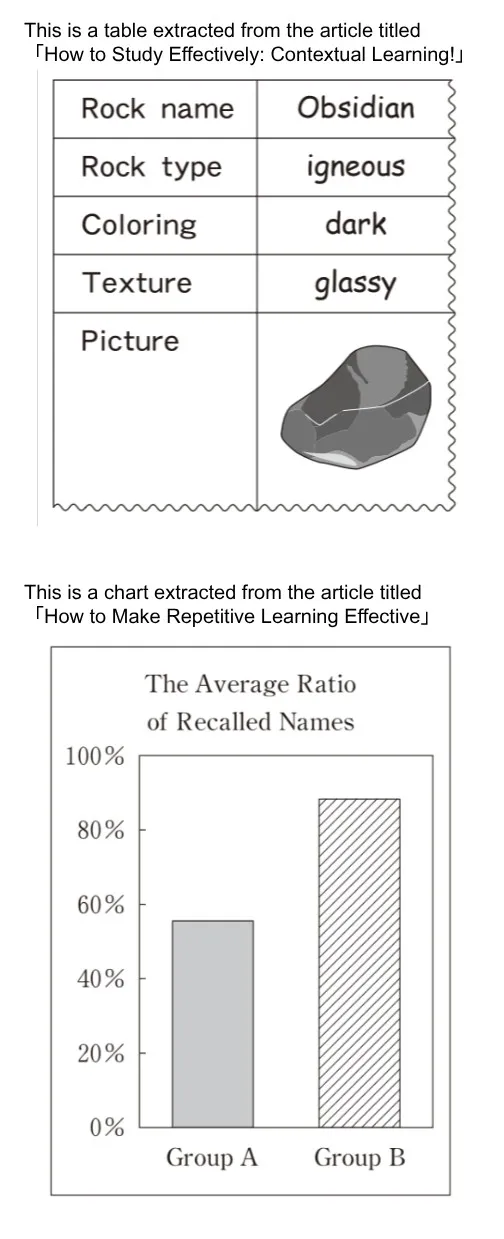
Your teacher has asked you to read two articles about effective ways to study. You will discuss what you learned in your next class.
How to Study Effectively: Contextual Learning!
Tim Oxford
Science Teacher, Stone City Junior High School
As a science teacher, I am always concerned about how to help students who struggle to learn. Recently, I found that their main way of learning was to study new information repeatedly until they could recall it all. For example, when they studied for a test, they would use a workbook like the example below and repeatedly say the terms that go in the blanks: ”Obsidian is igneous, dark, and glassy. Obsidian is igneous, dark, and glassy....” These students would feel as if they had learned the information, but would quickly forget it and get low scores on the test. Also, this sort of repetitive learning is dull and demotivating.
To help them learn, I tried applying ”contextual learning.” In this kind of learning, new knowledge is constructed through students’ own experiences. For my science class, students learned the properties of different kinds of rocks. Rather than having them memorize the terms from a workbook, I brought a big box of various rocks to the class. Students examined the rocks and identified their names based on the characteristics they observed.
Thanks to this experience, I think these students will always be able to describe the properties of the rocks they studied. One issue, however, is that we don’t always have the time to do contextual learning, so students will still study by doing drills. I don’t think this is the best way. I’m still searching for ways to improve their learning.
How to Make Repetitive Learning Effective
Cheng Lee
Professor, Stone City University
Mr. Oxford’s thoughts on contextual learning were insightful. I agree that it can be beneficial. Repetition, though, can also work well. However, the repetitive learning strategy he discussed, which is called ”massed learning,” is not effective. There is another kind of repetitive learning called ”spaced learning,” in which students memorize new information and then review it over longer intervals.
The interval between studying is the key difference. In Mr. Oxford’s example, his students probably used their workbooks to study over a short period of time. In this case, they might have paid less attention to the content as they continued to review it. The reason for this is that the content was no longer new and could easily be ignored. In contrast, when the intervals are longer, the students’ memory of the content is weaker. Therefore, they pay more attention because they have to make a greater effort to recall what they had learned before. For example, if students study with their workbooks, wait three days, and then study again, they are likely to learn the material better.
Previous research has provided evidence for the advantages of spaced learning. In one experiment, students in Groups A and B tried to memorize the names of 50 animals. Both groups studied four times, but Group A studied at one−day intervals while Group B studied at one−week intervals. As the figure to the right shows, 28 days after the last learning session, the average ratio of recalled names on a test was higher for the spaced learning group.
I understand that students often need to learn a lot of information in a short period of time, and long intervals between studying might not be practical. You should understand, though, that massed learning might not be good for long−term recall.
Both writers agree that ( 28 ) is helpful for remembering new information.
このページは閲覧用ページです。
履歴を残すには、 「新しく出題する(ここをクリック)」 をご利用ください。
問題
反映中…
共通テスト(英語)試験 令和5年度(2023年度)本試験 問113(<旧課程>英語リーディング(第4問) 問5) (訂正依頼・報告はこちら)
各問いの英文や図表を読み、解答番号にあてはまるものとして最も適当な選択肢を選びなさい。
Your teacher has asked you to read two articles about effective ways to study. You will discuss what you learned in your next class.
How to Study Effectively: Contextual Learning!
Tim Oxford
Science Teacher, Stone City Junior High School
As a science teacher, I am always concerned about how to help students who struggle to learn. Recently, I found that their main way of learning was to study new information repeatedly until they could recall it all. For example, when they studied for a test, they would use a workbook like the example below and repeatedly say the terms that go in the blanks: ”Obsidian is igneous, dark, and glassy. Obsidian is igneous, dark, and glassy....” These students would feel as if they had learned the information, but would quickly forget it and get low scores on the test. Also, this sort of repetitive learning is dull and demotivating.
To help them learn, I tried applying ”contextual learning.” In this kind of learning, new knowledge is constructed through students’ own experiences. For my science class, students learned the properties of different kinds of rocks. Rather than having them memorize the terms from a workbook, I brought a big box of various rocks to the class. Students examined the rocks and identified their names based on the characteristics they observed.
Thanks to this experience, I think these students will always be able to describe the properties of the rocks they studied. One issue, however, is that we don’t always have the time to do contextual learning, so students will still study by doing drills. I don’t think this is the best way. I’m still searching for ways to improve their learning.
How to Make Repetitive Learning Effective
Cheng Lee
Professor, Stone City University
Mr. Oxford’s thoughts on contextual learning were insightful. I agree that it can be beneficial. Repetition, though, can also work well. However, the repetitive learning strategy he discussed, which is called ”massed learning,” is not effective. There is another kind of repetitive learning called ”spaced learning,” in which students memorize new information and then review it over longer intervals.
The interval between studying is the key difference. In Mr. Oxford’s example, his students probably used their workbooks to study over a short period of time. In this case, they might have paid less attention to the content as they continued to review it. The reason for this is that the content was no longer new and could easily be ignored. In contrast, when the intervals are longer, the students’ memory of the content is weaker. Therefore, they pay more attention because they have to make a greater effort to recall what they had learned before. For example, if students study with their workbooks, wait three days, and then study again, they are likely to learn the material better.
Previous research has provided evidence for the advantages of spaced learning. In one experiment, students in Groups A and B tried to memorize the names of 50 animals. Both groups studied four times, but Group A studied at one−day intervals while Group B studied at one−week intervals. As the figure to the right shows, 28 days after the last learning session, the average ratio of recalled names on a test was higher for the spaced learning group.
I understand that students often need to learn a lot of information in a short period of time, and long intervals between studying might not be practical. You should understand, though, that massed learning might not be good for long−term recall.
Both writers agree that ( 28 ) is helpful for remembering new information.
Your teacher has asked you to read two articles about effective ways to study. You will discuss what you learned in your next class.
How to Study Effectively: Contextual Learning!
Tim Oxford
Science Teacher, Stone City Junior High School
As a science teacher, I am always concerned about how to help students who struggle to learn. Recently, I found that their main way of learning was to study new information repeatedly until they could recall it all. For example, when they studied for a test, they would use a workbook like the example below and repeatedly say the terms that go in the blanks: ”Obsidian is igneous, dark, and glassy. Obsidian is igneous, dark, and glassy....” These students would feel as if they had learned the information, but would quickly forget it and get low scores on the test. Also, this sort of repetitive learning is dull and demotivating.
To help them learn, I tried applying ”contextual learning.” In this kind of learning, new knowledge is constructed through students’ own experiences. For my science class, students learned the properties of different kinds of rocks. Rather than having them memorize the terms from a workbook, I brought a big box of various rocks to the class. Students examined the rocks and identified their names based on the characteristics they observed.
Thanks to this experience, I think these students will always be able to describe the properties of the rocks they studied. One issue, however, is that we don’t always have the time to do contextual learning, so students will still study by doing drills. I don’t think this is the best way. I’m still searching for ways to improve their learning.
How to Make Repetitive Learning Effective
Cheng Lee
Professor, Stone City University
Mr. Oxford’s thoughts on contextual learning were insightful. I agree that it can be beneficial. Repetition, though, can also work well. However, the repetitive learning strategy he discussed, which is called ”massed learning,” is not effective. There is another kind of repetitive learning called ”spaced learning,” in which students memorize new information and then review it over longer intervals.
The interval between studying is the key difference. In Mr. Oxford’s example, his students probably used their workbooks to study over a short period of time. In this case, they might have paid less attention to the content as they continued to review it. The reason for this is that the content was no longer new and could easily be ignored. In contrast, when the intervals are longer, the students’ memory of the content is weaker. Therefore, they pay more attention because they have to make a greater effort to recall what they had learned before. For example, if students study with their workbooks, wait three days, and then study again, they are likely to learn the material better.
Previous research has provided evidence for the advantages of spaced learning. In one experiment, students in Groups A and B tried to memorize the names of 50 animals. Both groups studied four times, but Group A studied at one−day intervals while Group B studied at one−week intervals. As the figure to the right shows, 28 days after the last learning session, the average ratio of recalled names on a test was higher for the spaced learning group.
I understand that students often need to learn a lot of information in a short period of time, and long intervals between studying might not be practical. You should understand, though, that massed learning might not be good for long−term recall.
Both writers agree that ( 28 ) is helpful for remembering new information.
- experiential learning
- having proper rest
- long−term attention
- studying with workbooks
正解!素晴らしいです
残念...
画像拡大
この過去問の解説 (3件)
01
まずは2人が同意している内容について考えていきましょう。
2つ目のテキストの第1段落冒頭で、
“Mr. Oxford’s thoughts on contextual learning were insightful. I agree that it can be beneficial.”
とあります。
翻訳すると「Oxford氏のcontextual learningに関する考えは示唆に富んだものであった。私もこれが有益であると支持する。」となります。
つまり、Lee氏はOxford氏の提唱する勉強法が有意義だと賛成しています。
続いて、Oxford氏が提唱する勉強法であるcontextual learningの内容についてです。
1つ目のテキストの第2段落冒頭で、
“I tried applying “contextual learning.” In this kind of learning, new knowledge is constructed through student’s own experience.“
とあります。
翻訳すると「私はcontextual learningを導入することを試みた。この勉強法では、新しい知識は生徒たち自身の経験によって構築される。」となります。
つまりOxford氏は実際に体験し、それを元に自ら知識を得るような学習法を提唱していることがわかります。
これらを踏まえて選択肢を見ていきましょう。
適切
「体験学習」
2人が同意しているOxford氏の学習法では、実際の経験から知識を得ます。
これは体験学習と言い換えても問題ないでしょう。
よって正解です。
不適切
「適当なテストを受けること」
2人が同意している学習法では、特に試験については言及されていません。
よって不正解です。
不適切
「長期にわたる注意」
2人が同意している学習法では、特に注意についても言及されていません。
よって不正解です。
不適切
「ワークを用いた勉強」
2人はこのような従来の勉強法には反対の立場をとっています。
よって不正解です。
参考になった数1
この解説の修正を提案する
02
問題文は
「どちらの書き手も、新しい情報を覚えるのに、(28)は役に立つと同意している」
です。
OxfordさんとLeeさんの2人が賛同した学習法を選ぶ問題です。
まずOxfordさんは、
To help them learn, I tried applying ”contextual learning.” In this kind of learning, new knowledge is constructed through students’ own experiences.
(彼らが学ぶのを助けるために、私は「文脈学習」を導入してみた。この種の学習では、新しい知識が、生徒自身の経験を通して構造されます。)
と述べています。
さらに、
Thanks to this experience, I think these students will always be able to describe the properties of the rocks they studied.
(この経験のおかげで、生徒たちは勉強した岩の成分についていつでも描写できると思う。)
という好結果も述べられており、この学習法は役立つと考えていると言えます。
一方、Leeさんは
Mr. Oxford’s thoughts on contextual learning were insightful. I agree that it can be beneficial.
(Oxford氏の文脈学習に関する考えは、洞察に満ちている。それが有効でありうることに賛成だ。)
と述べており、文脈学習は役立つと考えています。
したがって、「文脈学習」を両者とも称賛しています。
正解 「体験学習」
contextual learning(文脈学習)は、内容的に「体験学習」と言えるため、正解です。
「適したテストをすること」
「長期間の注意」
「ワークブックで学習すること」
参考になった数0
この解説の修正を提案する
03
設問:両方の筆者は、( 28 )が新しい情報を覚えるのに役立つと考えている。
!問題のポイント!
①両方=Oxford先生とLee教授です。
②この2人が同意している内容(共通点)を探しましょう。
訳)
あなたの先生は、効果的な勉強方法について書かれた2つの記事を読むようにあなたに頼みました。次の授業で、そこで学んだことについて話し合う予定です。
効果的な勉強法:コンテクスト学習!
Tim Oxford
ストーンシティ中学校 理科教師
理科教師として、学習に苦労する生徒をどのように助けるかについて常に気にかけています。最近、生徒たちの主な学習方法が、新しい情報を覚えるまで繰り返し暗唱することだと気づきました。例えば、テスト勉強するとき、下記の例のようなワークブックを使い、空欄に入る語句を何度も口に出していました。「黒曜石は火成岩で、暗い色で、ガラス状である。黒曜石は火成岩で、暗い色で、ガラス状である……」生徒たちは覚えたつもりになりますが、すぐに忘れてしまい、テストでは低い点数を取ってしまいます。また、このような反復学習は退屈で、やる気を失わせるものです。
・is concerned about ~ : ~について気にかける。
・recall(動詞) : 覚える、思い出す
・as if ~ : まるで~のように
・dull(形容詞) : 退屈な
・demotivating : やる気を失わせる
生徒の学習を助けるために、「コンテクスト学習」を取り入れました。この学習法では、新しい知識は生徒自身の経験を通して作られています。私の理科の授業では、生徒たちはさまざまな岩石の性質を学びました。ワークブックの語句を暗記させる代わりに、さまざまな岩石が入った大きな箱を教室に持っていきました。生徒たちは岩石を観察し、見つけた特徴に基づいて名前を特定しました。
・construct(動詞) : 作る、組み立てる
・property(名詞) : 性質
・rather than ing : ~するより
・examine(動詞) : 観察、調べる
・identify(動詞) : 特定する
この経験のおかげで、生徒たちは学んだ岩石の性質をいつでも説明できると思います。しかし問題は、コンテクスト学習をする時間がいつもあるわけではないことです。そのため、生徒たちは結局ドリル学習も続けることになります。私はこれが最善の方法だとは思いません。私は今もなお、彼らの学習を改善する方法を探し続けています。
反復学習を効果的にする方法
Cheng Lee
ストーンシティ大学 教授
オックスフォード先生のコンテクスト学習についての考えは洞察に富んでいました。それが有益であるという点には私も賛成です。しかし、反復学習もまた効果的に働くことがあります。ただし、彼が述べた反復学習法、つまり「集中学習」は効果的ではありません。もう1つの反復学習として、「分散学習」と呼ばれるものがあります。これは、生徒が新しい情報を覚えた後、長い間隔をあけて復習する方法です。
・thought on ~ : ~の洞察、考え
・insightful(形容詞) : 洞察に富む
・strategy(名詞) : 戦略
・interval(名詞) : 間隔
この学習間隔が重要な違いです。オックスフォード先生の例では、生徒たちは短時間にワークブックを使って勉強したのでしょう。この場合、繰り返すうちに内容への注意が薄れてしまった可能性があります。その理由は内容が新しくなくなり、簡単に無視できるようになったからです。
一方で、間隔が長いと生徒の記憶は弱まっています。そのため、以前学んだことを思い出すためにより努力が必要となり、注意を払うようになります。例えば、生徒がワークブックで勉強し、3日空けてからもう1度勉強すると、その内容をよりよく学べる可能性があります。
・in contrast : 一方で
・is likely to ~ : ~する可能性がある。
これまでの研究は、分散学習の利点を示す証拠を提供しています。ある実験では、AグループとBグループの生徒が50種類の動物名を覚えようとしました。両グループは4回学習しましたが、Aグループは1日間隔、Bグループは1週間間隔でした。右の図が示しているように、最後の学習から28日後のテストでは思い出せた名前の平均割合は、分散学習グループの方が高かったのです。生徒はしばしば短期間で大量の情報を学ばなければならないこと、また勉強の間隔を長く取ることが現実的でない場合もあることは理解しています。しかし、集中学習は長期記憶には向かないことを理解しておくべきです。
・advantage(名詞) : 利点
・ratio(名詞) : 割合
・practical(形容詞) : 現実的
これは「効果的な勉強法:コンテクスト学習!」という題名の
記事から抜き出された表です。
これは「反復学習を効果的にする方法」という題名の記事
から抜き出されたグラフです。
正解
体験型学習という意味です。
まずOxford先生から確認しましょう。根拠となる文はOxford先生の段落の2段落目文頭、I tried applying ”contextual learning.” In this kind of learning,new knowledge is constructed through students’ own experiences(「コンテクスト学習」を取り入れました。この学習法では、新しい知識は生徒自身の経験を通して作られています).です。
つまり、実際に経験した学習が良いということが分かります。
Lee教授はこの意見に対し、Mr. Oxford’s thoughts on contextual learning were insightful. I agree that it can be beneficial. Repetition, though, can also work well(オックスフォード先生のコンテクスト学習についての考えは洞察に富んでいました。それが有益であるという点には私も賛成です).と認めているため正解です。
不正解
適切な休憩をとることという意味です。
本文には記載がないため不正解です。
・proper(形容詞) : 適切な、妥当な
不正解
長期的な注意という意味です。
本文には記載がないため不正解です。
不正解
ワークブックで勉強することという意味です。
Oxford先生はワークブックを使用した反復学習は、「すぐに忘れてしまい、テストでは低い点数を取ってしまいます」と述べているため不正解です。
参考になった数0
この解説の修正を提案する
前の問題(問112)へ
令和5年度(2023年度)本試験 問題一覧
次の問題(問114)へ