
共通テスト(英語) 過去問
令和5年度(2023年度)本試験
問125 (<旧課程>英語リーディング(第6問) 問2)
問題文
各問いの英文や図表を読み、解答番号にあてはまるものとして最も適当な選択肢を選びなさい。
You are in a discussion group in school. You have been asked to summarize the following article. You will speak about it, using only notes.
Collecting
Collecting has existed at all levels of society, across cultures and age groups since early times. Museums are proof that things have been collected, saved, and passed down for future generations. There are various reasons for starting a collection. For example, Ms. A enjoys going to yard sales every Saturday morning with her children. At yard sales, people sell unwanted things in front of their houses. One day, while looking for antique dishes, an unusual painting caught her eye and she bought it for only a few dollars. Over time, she found similar pieces that left an impression on her, and she now has a modest collection of artwork, some of which may be worth more than she paid. One person’s trash can be another person’s treasure. Regardless of how someone’s collection was started, it is human nature to collect things.
In 1988, researchers Brenda Danet and Tamar Katriel analyzed 80 years of studies on children under the age of 10, and found that about 90% collected something. This shows us that people like to gather things from an early age. Even after becoming adults, people continue collecting stuff. Researchers in the field generally agree that approximately one third of adults maintain this behavior. Why is this? The primary explanation is related to emotions. Some save greeting cards from friends and family, dried flowers from special events, seashells from a day at the beach, old photos, and so on. For others, their collection is a connection to their youth. They may have baseball cards, comic books, dolls, or miniature cars that they have kept since they were small. Others have an attachment to history; they seek and hold onto historical documents, signed letters and autographs from famous people, and so forth.
For some individuals there is a social reason. People collect things such as pins to share, show, and even trade, making new friends this way. Others, like some holders of Guinness World Records, appreciate the fame they achieve for their unique collection. Cards, stickers, stamps, coins, and toys have topped the ”usual” collection list, but some collectors lean toward the more unexpected. In September 2014, Guinness World Records recognized Harry Sperl, of Germany, for having the largest hamburger−related collection in the world, with 3,724 items; from T−shirts to pillows to dog toys, Sperl’s room is filled with all things ”hamburger.” Similarly, Liu Fuchang, of China, is a collector of playing cards. He has 11,087 different sets.
Perhaps the easiest motivation to understand is pleasure. Some people start collections for pure enjoyment. They may purchase and put up paintings just to gaze at frequently, or they may collect audio recordings and old− fashioned vinyl records to enjoy listening to their favorite music. This type of collector is unlikely to be very interested in the monetary value of their treasured music, while others collect objects specifically as an investment. While it is possible to download certain classic games for free, having the same game unopened in its original packaging, in ”mint condition,” can make the game worth a lot. Owning various valuable ”collector’s items” could ensure some financial security.
This behavior of collecting things will definitely continue into the distant future. Although the reasons why people keep things will likely remain the same, advances in technology will have an influence on collections. As technology can remove physical constraints, it is now possible for an individual to have vast digital libraries of music and art that would have been unimaginable 30 years ago. It is unclear, though, what other impacts technology will have on collections. Can you even imagine the form and scale that the next generation’s collections will take?
Choose the best option for ( 40 ).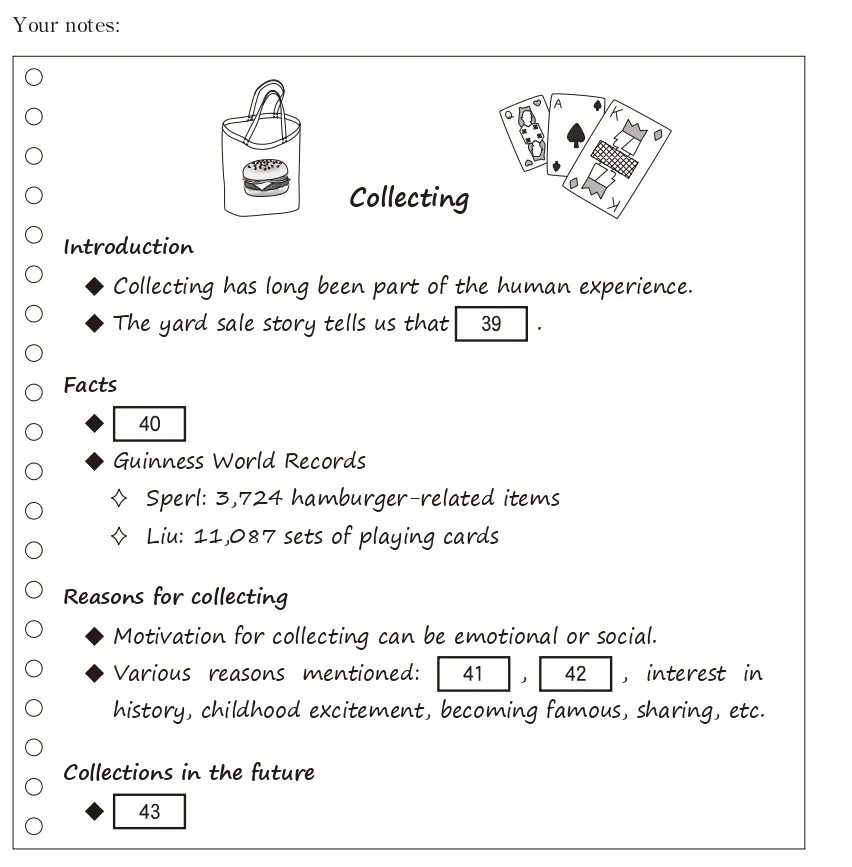
You are in a discussion group in school. You have been asked to summarize the following article. You will speak about it, using only notes.
Collecting
Collecting has existed at all levels of society, across cultures and age groups since early times. Museums are proof that things have been collected, saved, and passed down for future generations. There are various reasons for starting a collection. For example, Ms. A enjoys going to yard sales every Saturday morning with her children. At yard sales, people sell unwanted things in front of their houses. One day, while looking for antique dishes, an unusual painting caught her eye and she bought it for only a few dollars. Over time, she found similar pieces that left an impression on her, and she now has a modest collection of artwork, some of which may be worth more than she paid. One person’s trash can be another person’s treasure. Regardless of how someone’s collection was started, it is human nature to collect things.
In 1988, researchers Brenda Danet and Tamar Katriel analyzed 80 years of studies on children under the age of 10, and found that about 90% collected something. This shows us that people like to gather things from an early age. Even after becoming adults, people continue collecting stuff. Researchers in the field generally agree that approximately one third of adults maintain this behavior. Why is this? The primary explanation is related to emotions. Some save greeting cards from friends and family, dried flowers from special events, seashells from a day at the beach, old photos, and so on. For others, their collection is a connection to their youth. They may have baseball cards, comic books, dolls, or miniature cars that they have kept since they were small. Others have an attachment to history; they seek and hold onto historical documents, signed letters and autographs from famous people, and so forth.
For some individuals there is a social reason. People collect things such as pins to share, show, and even trade, making new friends this way. Others, like some holders of Guinness World Records, appreciate the fame they achieve for their unique collection. Cards, stickers, stamps, coins, and toys have topped the ”usual” collection list, but some collectors lean toward the more unexpected. In September 2014, Guinness World Records recognized Harry Sperl, of Germany, for having the largest hamburger−related collection in the world, with 3,724 items; from T−shirts to pillows to dog toys, Sperl’s room is filled with all things ”hamburger.” Similarly, Liu Fuchang, of China, is a collector of playing cards. He has 11,087 different sets.
Perhaps the easiest motivation to understand is pleasure. Some people start collections for pure enjoyment. They may purchase and put up paintings just to gaze at frequently, or they may collect audio recordings and old− fashioned vinyl records to enjoy listening to their favorite music. This type of collector is unlikely to be very interested in the monetary value of their treasured music, while others collect objects specifically as an investment. While it is possible to download certain classic games for free, having the same game unopened in its original packaging, in ”mint condition,” can make the game worth a lot. Owning various valuable ”collector’s items” could ensure some financial security.
This behavior of collecting things will definitely continue into the distant future. Although the reasons why people keep things will likely remain the same, advances in technology will have an influence on collections. As technology can remove physical constraints, it is now possible for an individual to have vast digital libraries of music and art that would have been unimaginable 30 years ago. It is unclear, though, what other impacts technology will have on collections. Can you even imagine the form and scale that the next generation’s collections will take?
Choose the best option for ( 40 ).
このページは閲覧用ページです。
履歴を残すには、 「新しく出題する(ここをクリック)」 をご利用ください。
問題
反映中…
共通テスト(英語)試験 令和5年度(2023年度)本試験 問125(<旧課程>英語リーディング(第6問) 問2) (訂正依頼・報告はこちら)
各問いの英文や図表を読み、解答番号にあてはまるものとして最も適当な選択肢を選びなさい。
You are in a discussion group in school. You have been asked to summarize the following article. You will speak about it, using only notes.
Collecting
Collecting has existed at all levels of society, across cultures and age groups since early times. Museums are proof that things have been collected, saved, and passed down for future generations. There are various reasons for starting a collection. For example, Ms. A enjoys going to yard sales every Saturday morning with her children. At yard sales, people sell unwanted things in front of their houses. One day, while looking for antique dishes, an unusual painting caught her eye and she bought it for only a few dollars. Over time, she found similar pieces that left an impression on her, and she now has a modest collection of artwork, some of which may be worth more than she paid. One person’s trash can be another person’s treasure. Regardless of how someone’s collection was started, it is human nature to collect things.
In 1988, researchers Brenda Danet and Tamar Katriel analyzed 80 years of studies on children under the age of 10, and found that about 90% collected something. This shows us that people like to gather things from an early age. Even after becoming adults, people continue collecting stuff. Researchers in the field generally agree that approximately one third of adults maintain this behavior. Why is this? The primary explanation is related to emotions. Some save greeting cards from friends and family, dried flowers from special events, seashells from a day at the beach, old photos, and so on. For others, their collection is a connection to their youth. They may have baseball cards, comic books, dolls, or miniature cars that they have kept since they were small. Others have an attachment to history; they seek and hold onto historical documents, signed letters and autographs from famous people, and so forth.
For some individuals there is a social reason. People collect things such as pins to share, show, and even trade, making new friends this way. Others, like some holders of Guinness World Records, appreciate the fame they achieve for their unique collection. Cards, stickers, stamps, coins, and toys have topped the ”usual” collection list, but some collectors lean toward the more unexpected. In September 2014, Guinness World Records recognized Harry Sperl, of Germany, for having the largest hamburger−related collection in the world, with 3,724 items; from T−shirts to pillows to dog toys, Sperl’s room is filled with all things ”hamburger.” Similarly, Liu Fuchang, of China, is a collector of playing cards. He has 11,087 different sets.
Perhaps the easiest motivation to understand is pleasure. Some people start collections for pure enjoyment. They may purchase and put up paintings just to gaze at frequently, or they may collect audio recordings and old− fashioned vinyl records to enjoy listening to their favorite music. This type of collector is unlikely to be very interested in the monetary value of their treasured music, while others collect objects specifically as an investment. While it is possible to download certain classic games for free, having the same game unopened in its original packaging, in ”mint condition,” can make the game worth a lot. Owning various valuable ”collector’s items” could ensure some financial security.
This behavior of collecting things will definitely continue into the distant future. Although the reasons why people keep things will likely remain the same, advances in technology will have an influence on collections. As technology can remove physical constraints, it is now possible for an individual to have vast digital libraries of music and art that would have been unimaginable 30 years ago. It is unclear, though, what other impacts technology will have on collections. Can you even imagine the form and scale that the next generation’s collections will take?
Choose the best option for ( 40 ).
You are in a discussion group in school. You have been asked to summarize the following article. You will speak about it, using only notes.
Collecting
Collecting has existed at all levels of society, across cultures and age groups since early times. Museums are proof that things have been collected, saved, and passed down for future generations. There are various reasons for starting a collection. For example, Ms. A enjoys going to yard sales every Saturday morning with her children. At yard sales, people sell unwanted things in front of their houses. One day, while looking for antique dishes, an unusual painting caught her eye and she bought it for only a few dollars. Over time, she found similar pieces that left an impression on her, and she now has a modest collection of artwork, some of which may be worth more than she paid. One person’s trash can be another person’s treasure. Regardless of how someone’s collection was started, it is human nature to collect things.
In 1988, researchers Brenda Danet and Tamar Katriel analyzed 80 years of studies on children under the age of 10, and found that about 90% collected something. This shows us that people like to gather things from an early age. Even after becoming adults, people continue collecting stuff. Researchers in the field generally agree that approximately one third of adults maintain this behavior. Why is this? The primary explanation is related to emotions. Some save greeting cards from friends and family, dried flowers from special events, seashells from a day at the beach, old photos, and so on. For others, their collection is a connection to their youth. They may have baseball cards, comic books, dolls, or miniature cars that they have kept since they were small. Others have an attachment to history; they seek and hold onto historical documents, signed letters and autographs from famous people, and so forth.
For some individuals there is a social reason. People collect things such as pins to share, show, and even trade, making new friends this way. Others, like some holders of Guinness World Records, appreciate the fame they achieve for their unique collection. Cards, stickers, stamps, coins, and toys have topped the ”usual” collection list, but some collectors lean toward the more unexpected. In September 2014, Guinness World Records recognized Harry Sperl, of Germany, for having the largest hamburger−related collection in the world, with 3,724 items; from T−shirts to pillows to dog toys, Sperl’s room is filled with all things ”hamburger.” Similarly, Liu Fuchang, of China, is a collector of playing cards. He has 11,087 different sets.
Perhaps the easiest motivation to understand is pleasure. Some people start collections for pure enjoyment. They may purchase and put up paintings just to gaze at frequently, or they may collect audio recordings and old− fashioned vinyl records to enjoy listening to their favorite music. This type of collector is unlikely to be very interested in the monetary value of their treasured music, while others collect objects specifically as an investment. While it is possible to download certain classic games for free, having the same game unopened in its original packaging, in ”mint condition,” can make the game worth a lot. Owning various valuable ”collector’s items” could ensure some financial security.
This behavior of collecting things will definitely continue into the distant future. Although the reasons why people keep things will likely remain the same, advances in technology will have an influence on collections. As technology can remove physical constraints, it is now possible for an individual to have vast digital libraries of music and art that would have been unimaginable 30 years ago. It is unclear, though, what other impacts technology will have on collections. Can you even imagine the form and scale that the next generation’s collections will take?
Choose the best option for ( 40 ).
- About two thirds of children do not collect ordinary things.
- Almost one third of adults start collecting things for pleasure.
- Approximately 10% of kids have collections similar to their friends.
- Roughly 30% of people keep collecting into adulthood.
正解!素晴らしいです
残念...
画像拡大
この過去問の解説 (3件)
01
問題文は
「( 40 )にもっとも適するものを選びなさい。」
です。
これは、コレクションに関してのFact(事実)の項目の一つ目です。
二つ目は、ギネス世界記録が書かれています。
したがって、答えは、ギネス世界記録の記述の前にあると推測できます。
該当箇所は
This shows us that people like to gather things from an early age. Even after becoming adults, people continue collecting stuff. Researchers in the field generally agree that approximately one third of adults maintain this behavior.
(これは、人々は幼い時から物を集めるのが好きだと示している。大人になった後でさえ、人々は物を集め続ける。その分野の研究者は、一般的に、おおよそ3分の1の大人がこの振る舞いを維持していると賛同している。)
です。
この内容に適する物を選びます。
「約3分の2の子供は、普通のものを集めない。」
researchers Brenda Danet and Tamar Katriel analyzed 80 years of studies on children under the age of 10, and found that about 90% collected something.
(研究者のブレンダ・ダネット氏とタマー・カトリエル氏は、10歳未満の子どもを対象とした80年にわたる研究を分析し、約90%が何かを収集していることを発見しました。)
とあり、3分の2が誤りです。
「約3分の1の大人が、楽しみのために物を集め始める。」
コレクションは、幼い時から始まるとあるため、誤りです。
「おおよそ10%の子供は、友達に似た物を集める。」
このような記述はありません。
正解「約30%の人が、大人になってもコレクションを続ける」
Researchers in the field generally agree that approximately one third of adults maintain this behavior.
(その分野の研究者は、一般的に、おおよそ3分の1の大人がこの振る舞いを維持していると賛同している。)
とあり、3分の1は約30%であるため、内容と一致します。
参考になった数0
この解説の修正を提案する
02
fact「事実」を探し読みして適切な選択肢を選ぶ問題です。
★要約メモの( 40 )の下には、ギネス記録についての記述があります。ギネス記録については第3段落に書かれていますので、第2段落に( 40 )の手がかりがあるのではないか?と予測して読むことで、素早く正答に辿り着けます。
「約3分の2の子供達が普通のものを集めない。」
第2段落
In 1988, researchers Brenda Danet and Tamar Katriel analyzed 80 years of studies on children under the age of 10, and found that about 90% collected something.
「約90%(の子どもたち)が何かを収集していた」という調査結果について記述があります。3分の2ではないので、誤りです。
「約3分の1の大人が楽しみのために収集を始める。」
第2段落
Even after becoming adults, people continue collecting stuff. Researchers in the field generally agree that approximately one third of adults maintain this behavior.
「大人になってからも収集を続ける」「約3分の1の大人が習慣を維持している」とあります。新しく収集を始めるということではないので、誤りです。
「約10%の子供達が友達と似たような収集をする。」
そのような記述はありません。
「およそ30%の人々が大人になっても収集を続けている。」
第2段落
Even after becoming adults, people continue collecting stuff. Researchers in the field generally agree that approximately one third of adults maintain this behavior.
「大人になってからも収集を続ける」「約3分の1の大人が習慣を維持している」とあります。内容が合致します。
参考になった数0
この解説の修正を提案する
03
設問:( 40 )に入る最も適切な選択肢を1つ選びなさい。
!問題のポイント!
①( 40 )は事実の欄に入ります。
②本文のデータ・統計・数字の情報をまとめましょう。
訳)
あなたは学校でディスカッショングループに参加してます。次の文章を要約するよう求められています。メモだけを使ってその内容について話すことになります。
収集
収集は古くから社会のあらゆる階層において、文化や年齢層を問わず存在してきた。博物館は、物が収集され、保存され。そして将来の世代へ受け継がれてきたことの証拠である。人が収集を始める理由はさまざまだ。例えばAさんは、毎週土曜日の朝に子どもたちと一緒にガレージセールへ行くのを楽しみにしている。ガレージセールでは、人々が家の前で不要になった物を売る。ある日、彼女がアンティークの皿を探していると、風変わりな絵が目に留まり、数ドルという安い値段でそれを買った。時がたつにつれて、彼女は同じように印象に残る作品を見つけるようになり、今ではささやかなアート作品のコレクションを持つようになった。その中には、購入時よりも高い値段がついているかもしれないものもある。ある人にとってのゴミが、別の人になっては宝物になることもある。どのようにしてその人のコレクションが始まったにせよ、物を集めることは人間の本能なのである。
・pass down : 受け継ぐ
・unwanted things : 不用品
・impression(名詞) : 印象
・modest(形容詞) : 控え目
・regardless of ~ : ~にかかわらず
1988年、研究者のBrenda DanetとTamar Katrielは、10歳未満の子どもに関する80年分の研究を分析し、約90%の子どもが何かを集めていることを発見した。これは、人が幼い頃から物を集めることを好むということを示している。大人になってからも、人々は物を集め続ける。研究分野の専門家たちは、成人のおよそ3分の1がこの行動を維持しているという点でおおむね一致している。なぜなのだろうか。主な説明は感情に関係している。友人や家族からのグリーティングカード、特別な出来事の際のドライフラワー、海辺で拾った貝殻、古い写真などを保存している人もいる。また別の人にとっては、コレクションが若い頃のつながりになっている。彼らは野球カード、漫画本、人形、ミニカーなど、幼い頃から持ち続けている物を集めているかもしれない。さらに別の人々は歴史に愛着を持っており、歴史的文書や、有名人の署名入りの手紙やサインなどを探し求めて保管する。
・approximately(副詞) : おおよそ、約
・primary(形容詞) : 主な、主要な
・attachment(名詞) : 愛着
・and so forth : などなど
人によっては社会的な理由もある。例えばピンバッチなどを集め、それを見せ合ったり交換したりすることで新しい友人を作る人がいる。また、ギネス世界記録の保持者の中には、自分のユニークなコレクションによって得られる名声を喜ぶ人もいる。カード、シール、切手、硬貨、おもちゃなどは「よくある」コレクションの上位を占めているが、意外なものに傾く収集家もいる。2014年9月、ギネス世界記録はドイツのHarry Sperlを世界最大ハンバーガー関連コレクションを所有する人物として認定した。その数は3,724点で、Tシャツから枕、犬のおもちゃに至るまで、彼の部屋には「ハンバーガー」づくしである。同様に、中国のLiu Fuchangはトランプの収集家であり、11,087種類もの異なるセットを持っている。
・lean(動詞) : 傾く
・recognize(動詞) : 認定する
・is filled with ~ : ~で満たされている
おそらく最も理解しやすい動機は楽しさである。純粋な喜びのためにコレクションを始めた人もいる。例えば、絵画を購入して飾り、頻繁に眺めることを楽しむ人もいれば、音声録音や昔ながらのレコード盤(ビニールレコード)を集めて、好きな音楽を聴くことを楽しむ人もいる。このタイプの収集家は、自分が大切にしている音楽の金銭的価値にはあまり興味がないことが多い。一方で投資目的で物を集める人もいる。ある種の古典的なゲームは無料でダウンロードできるが、同じゲームでも未開封で元の包装のまま、いわゆる新品同様の状態で持っていると、非常に高い価値がつくことがある。さまざまな価値ある「コレクターズアイテム」を所有していれば、ある程度の経済的安心につながるかもしれない。
・vinyl record : ビニールレコード
・investment(名詞) : 投資
・classic(形容詞) : 古典的な
・mint condition : 新品同様の状態
物を集めるという行動は、遠い未来に至るまで確実に続いていくだろう。人々が物を保管する理由はおそらく変えられないが、技術の進歩はコレクションに影響を与えるだろう。技術は物理的な制約を取り除くことができるため、30年前には想像もできなかったほど膨大な音楽や芸術のデジタルライブラリーを個人が持つことも、今では可能になっている。しかし、技術がコレクションにどのような影響をさらに与えるのかは不明である。次世代のコレクションがどのような形や規模になるのか、想像できるだろうか。
・definitely(副詞) : 間違いなく
・physical(形容詞) : 物理的な
・constraint(名詞) : 制約
・unimaginabl(形容詞) : 想像できない
収集
導入
・収集することは、長い間人間の経験の一部である。
・ヤードセールの話しは( 39 )ということを示している。
事実
・( 40 )
・ギネス世界記録
☆Sperl : ハンバーガー関連グッズ3,724点
☆Liu : トランプのセット11,087点
収集する理由
・収集の動機は、感情的なものや社会的なものになり得る。
・さまざまな理由として、( 41 )、( 42 )、歴史への関心、子供の頃の興奮、
有名になりたい気持ち、今日数することなどが挙げられます。
未来のコレクション
・( 43 )
不正解
子どもの約3分の2は、普通の物を集めないという意味です。
「子供の約90%が何かを集める」と記載があるため不正解です。
不正解
大人の約3分の1は、楽しみのために収集を始めるという意味です。
「収集を始める」のではなく「子供のころから収集を続けている」と記載があるため不正解です。また、本文では収集する理由が1つだけではなく、socialやinvestment、emotionなどの理由も含まれています。
不正解
子どもの約10%は、友達と似たコレクションを持っているという意味です。
本文に10%という数字は出てこないため不正解です。
正解
およそ30%の人は、大人になっても収集を続けるという意味です。
根拠となる文は2段落目の文頭、In 1988, researchers Brenda Danet and Tamar Katriel analyzed 80 years of studies on children under the age of 10, and found that about 90% collected something.Researchers in the field generally agree that approximately one third of adults maintain this behavior(1988年、研究者のBrenda DanetとTamar Katrielは、10歳未満の子どもに関する80年分の研究を分析し、約90%の子どもが何かを集めていることを発見した。研究分野の専門家たちは、成人のおよそ3分の1がこの行動を維持しているという点でおおむね一致している).です。
つまり、子供の約90%が何かを集め、大人になってからもその3分の1がそれを続けるという事実が記載されているため正解です。
本文に数字が出たら必ずチェックしましょう。今回の数字は90%(子ども)、one third(大人)です。
①数字がある文を探す。
②数字を言い換えた表現を見抜く。
例)one third=約33%
などです。
参考になった数0
この解説の修正を提案する
前の問題(問124)へ
令和5年度(2023年度)本試験 問題一覧
次の問題(問126)へ