
共通テスト(英語) 過去問
令和5年度(2023年度)追・再試験
問42 (<旧課程>英語リーディング(第6問) 問4)
問題文
各問いの英文や図表を読み、解答番号にあてはまるものとして最も適当な選択肢を選びなさい。
You belong to an English discussion group. Each week, members read an article, create a summary, and make a challenging quiz question to share. For the next meeting, you read the following article.
Getting to Know Aquatic Species
The mysteries of the deep blue sea have fascinated ocean−watchers for millennia. Aquatic beings, however, cannot easily get to us. What if we go to them? Despite what you may expect, certain ocean animals will come right up to you. Dan McSweeney, a Hawaii−based underwater research photographer, tells a fascinating story. While he was studying whales underwater, one came charging at him. Whales are huge, so he was worried. The whale stopped, opened its mouth, and“passed” him some tuna. He accepted the gift. McSweeney believes that because of the air bubbles coming from his tank, the whale recognized him as a similar animal and offered the sashimi. Later, the whale came back, and McSweeney returned the food.
Friendly interactions with dolphins or whales are possible, but how about octopuses? Science fiction sometimes describes aliens as looking like octopuses, so this animal group“cephalopods,” which means“head−feet,” may be perceived as being distant from humans. Yet, if you learn more about them, you might be convinced there is the possibility of interaction. Octopuses have long tentacles(arms/legs)extending from soft round bodies. Besides touch and motion, each tentacle experiences smell and taste and has sucking disks, called suckers, that grab and manipulate things. Their eyes, like two independent cameras, can move 80°and focus on two different things at once. UC Berkeley researcher, Alexander Stubbs, confirms that while octopuses sense light and color differently from humans, they do recognize color changes. These features might indicate that they are intelligent enough to interact with us. In fact, an article in Everyday Mysteries begins:“Question. Can an octopus get to know you? Answer. Yes.”
Octopuses are known to“return your gaze” when you look at them. They may even remember you. This notion was tested by Roland C. Anderson and his colleagues, who conducted experiments with two similar−looking people wearing the same uniforms. The friendly person, who had fed and socialized with them, got a completely different reaction from the cephalopods than the other person who had not.
When taken from their natural habitat, octopuses can be mischievous, so watch out. They can push the lids off their tanks, escape, and go for a walk. Scientists sometimes get surprise visits. A paper from the Naples Zoological Station, written in 1959, talks about trying to teach three octopuses to pull a lever down for food. Two of them, Albert and Bertram, cooperated with the experiment, but Charles, a clever cephalopod, refused to do so. He shot water at the scientists and ended the experiment by breaking the equipment.
If you are interested in seeing their natural behavior and interactions, getting into the sea and having them come to you might work better. They may even raise a tentacle to motion you over. Around 2007, Peter Godfrey− Smith, a philosophy professor teaching at Harvard University, was home on vacation in Sydney, Australia. Exploring in the ocean, he came across a giant cephalopod. Godfrey−Smith was so impressed by the behavior he witnessed that he started developing philosophy theories based on his observations. Determined to find out what humans could learn from cephalopods, Godfrey− Smith let them guide him. On one ocean trip, another cephalopod took Godfrey−Smith’s colleague by the hand on a 10−minute tour of the octopus’s home,“as if he were being led across the sea floor by a very small, eight− legged child!”
How can you get sea creatures to come to you if you don’t swim? The Kahn family has solved this with“Coral World” in Eilat, Israel. The lowest floor of the building is actually constructed in the Red Sea, creating a“human display.” Rather than the sea−life performances at many aquariums, you find yourself in a“people tank,” where curious fish and sea creatures, swimming freely in the ocean, come to look at you. To make a good impression, you may want to wear nice clothes.
Choose the best option for ( 42 ).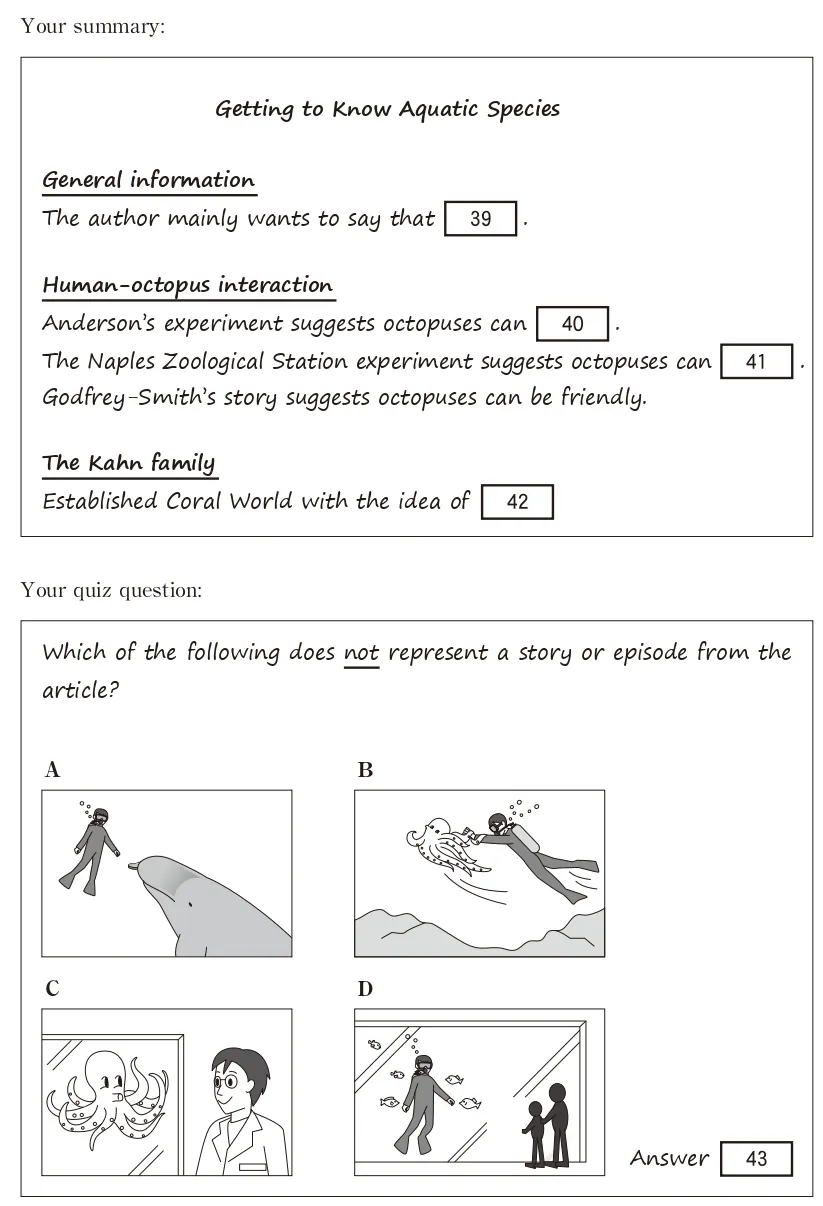
You belong to an English discussion group. Each week, members read an article, create a summary, and make a challenging quiz question to share. For the next meeting, you read the following article.
Getting to Know Aquatic Species
The mysteries of the deep blue sea have fascinated ocean−watchers for millennia. Aquatic beings, however, cannot easily get to us. What if we go to them? Despite what you may expect, certain ocean animals will come right up to you. Dan McSweeney, a Hawaii−based underwater research photographer, tells a fascinating story. While he was studying whales underwater, one came charging at him. Whales are huge, so he was worried. The whale stopped, opened its mouth, and“passed” him some tuna. He accepted the gift. McSweeney believes that because of the air bubbles coming from his tank, the whale recognized him as a similar animal and offered the sashimi. Later, the whale came back, and McSweeney returned the food.
Friendly interactions with dolphins or whales are possible, but how about octopuses? Science fiction sometimes describes aliens as looking like octopuses, so this animal group“cephalopods,” which means“head−feet,” may be perceived as being distant from humans. Yet, if you learn more about them, you might be convinced there is the possibility of interaction. Octopuses have long tentacles(arms/legs)extending from soft round bodies. Besides touch and motion, each tentacle experiences smell and taste and has sucking disks, called suckers, that grab and manipulate things. Their eyes, like two independent cameras, can move 80°and focus on two different things at once. UC Berkeley researcher, Alexander Stubbs, confirms that while octopuses sense light and color differently from humans, they do recognize color changes. These features might indicate that they are intelligent enough to interact with us. In fact, an article in Everyday Mysteries begins:“Question. Can an octopus get to know you? Answer. Yes.”
Octopuses are known to“return your gaze” when you look at them. They may even remember you. This notion was tested by Roland C. Anderson and his colleagues, who conducted experiments with two similar−looking people wearing the same uniforms. The friendly person, who had fed and socialized with them, got a completely different reaction from the cephalopods than the other person who had not.
When taken from their natural habitat, octopuses can be mischievous, so watch out. They can push the lids off their tanks, escape, and go for a walk. Scientists sometimes get surprise visits. A paper from the Naples Zoological Station, written in 1959, talks about trying to teach three octopuses to pull a lever down for food. Two of them, Albert and Bertram, cooperated with the experiment, but Charles, a clever cephalopod, refused to do so. He shot water at the scientists and ended the experiment by breaking the equipment.
If you are interested in seeing their natural behavior and interactions, getting into the sea and having them come to you might work better. They may even raise a tentacle to motion you over. Around 2007, Peter Godfrey− Smith, a philosophy professor teaching at Harvard University, was home on vacation in Sydney, Australia. Exploring in the ocean, he came across a giant cephalopod. Godfrey−Smith was so impressed by the behavior he witnessed that he started developing philosophy theories based on his observations. Determined to find out what humans could learn from cephalopods, Godfrey− Smith let them guide him. On one ocean trip, another cephalopod took Godfrey−Smith’s colleague by the hand on a 10−minute tour of the octopus’s home,“as if he were being led across the sea floor by a very small, eight− legged child!”
How can you get sea creatures to come to you if you don’t swim? The Kahn family has solved this with“Coral World” in Eilat, Israel. The lowest floor of the building is actually constructed in the Red Sea, creating a“human display.” Rather than the sea−life performances at many aquariums, you find yourself in a“people tank,” where curious fish and sea creatures, swimming freely in the ocean, come to look at you. To make a good impression, you may want to wear nice clothes.
Choose the best option for ( 42 ).
このページは閲覧用ページです。
履歴を残すには、 「新しく出題する(ここをクリック)」 をご利用ください。
問題
反映中…
共通テスト(英語)試験 令和5年度(2023年度)追・再試験 問42(<旧課程>英語リーディング(第6問) 問4) (訂正依頼・報告はこちら)
各問いの英文や図表を読み、解答番号にあてはまるものとして最も適当な選択肢を選びなさい。
You belong to an English discussion group. Each week, members read an article, create a summary, and make a challenging quiz question to share. For the next meeting, you read the following article.
Getting to Know Aquatic Species
The mysteries of the deep blue sea have fascinated ocean−watchers for millennia. Aquatic beings, however, cannot easily get to us. What if we go to them? Despite what you may expect, certain ocean animals will come right up to you. Dan McSweeney, a Hawaii−based underwater research photographer, tells a fascinating story. While he was studying whales underwater, one came charging at him. Whales are huge, so he was worried. The whale stopped, opened its mouth, and“passed” him some tuna. He accepted the gift. McSweeney believes that because of the air bubbles coming from his tank, the whale recognized him as a similar animal and offered the sashimi. Later, the whale came back, and McSweeney returned the food.
Friendly interactions with dolphins or whales are possible, but how about octopuses? Science fiction sometimes describes aliens as looking like octopuses, so this animal group“cephalopods,” which means“head−feet,” may be perceived as being distant from humans. Yet, if you learn more about them, you might be convinced there is the possibility of interaction. Octopuses have long tentacles(arms/legs)extending from soft round bodies. Besides touch and motion, each tentacle experiences smell and taste and has sucking disks, called suckers, that grab and manipulate things. Their eyes, like two independent cameras, can move 80°and focus on two different things at once. UC Berkeley researcher, Alexander Stubbs, confirms that while octopuses sense light and color differently from humans, they do recognize color changes. These features might indicate that they are intelligent enough to interact with us. In fact, an article in Everyday Mysteries begins:“Question. Can an octopus get to know you? Answer. Yes.”
Octopuses are known to“return your gaze” when you look at them. They may even remember you. This notion was tested by Roland C. Anderson and his colleagues, who conducted experiments with two similar−looking people wearing the same uniforms. The friendly person, who had fed and socialized with them, got a completely different reaction from the cephalopods than the other person who had not.
When taken from their natural habitat, octopuses can be mischievous, so watch out. They can push the lids off their tanks, escape, and go for a walk. Scientists sometimes get surprise visits. A paper from the Naples Zoological Station, written in 1959, talks about trying to teach three octopuses to pull a lever down for food. Two of them, Albert and Bertram, cooperated with the experiment, but Charles, a clever cephalopod, refused to do so. He shot water at the scientists and ended the experiment by breaking the equipment.
If you are interested in seeing their natural behavior and interactions, getting into the sea and having them come to you might work better. They may even raise a tentacle to motion you over. Around 2007, Peter Godfrey− Smith, a philosophy professor teaching at Harvard University, was home on vacation in Sydney, Australia. Exploring in the ocean, he came across a giant cephalopod. Godfrey−Smith was so impressed by the behavior he witnessed that he started developing philosophy theories based on his observations. Determined to find out what humans could learn from cephalopods, Godfrey− Smith let them guide him. On one ocean trip, another cephalopod took Godfrey−Smith’s colleague by the hand on a 10−minute tour of the octopus’s home,“as if he were being led across the sea floor by a very small, eight− legged child!”
How can you get sea creatures to come to you if you don’t swim? The Kahn family has solved this with“Coral World” in Eilat, Israel. The lowest floor of the building is actually constructed in the Red Sea, creating a“human display.” Rather than the sea−life performances at many aquariums, you find yourself in a“people tank,” where curious fish and sea creatures, swimming freely in the ocean, come to look at you. To make a good impression, you may want to wear nice clothes.
Choose the best option for ( 42 ).
You belong to an English discussion group. Each week, members read an article, create a summary, and make a challenging quiz question to share. For the next meeting, you read the following article.
Getting to Know Aquatic Species
The mysteries of the deep blue sea have fascinated ocean−watchers for millennia. Aquatic beings, however, cannot easily get to us. What if we go to them? Despite what you may expect, certain ocean animals will come right up to you. Dan McSweeney, a Hawaii−based underwater research photographer, tells a fascinating story. While he was studying whales underwater, one came charging at him. Whales are huge, so he was worried. The whale stopped, opened its mouth, and“passed” him some tuna. He accepted the gift. McSweeney believes that because of the air bubbles coming from his tank, the whale recognized him as a similar animal and offered the sashimi. Later, the whale came back, and McSweeney returned the food.
Friendly interactions with dolphins or whales are possible, but how about octopuses? Science fiction sometimes describes aliens as looking like octopuses, so this animal group“cephalopods,” which means“head−feet,” may be perceived as being distant from humans. Yet, if you learn more about them, you might be convinced there is the possibility of interaction. Octopuses have long tentacles(arms/legs)extending from soft round bodies. Besides touch and motion, each tentacle experiences smell and taste and has sucking disks, called suckers, that grab and manipulate things. Their eyes, like two independent cameras, can move 80°and focus on two different things at once. UC Berkeley researcher, Alexander Stubbs, confirms that while octopuses sense light and color differently from humans, they do recognize color changes. These features might indicate that they are intelligent enough to interact with us. In fact, an article in Everyday Mysteries begins:“Question. Can an octopus get to know you? Answer. Yes.”
Octopuses are known to“return your gaze” when you look at them. They may even remember you. This notion was tested by Roland C. Anderson and his colleagues, who conducted experiments with two similar−looking people wearing the same uniforms. The friendly person, who had fed and socialized with them, got a completely different reaction from the cephalopods than the other person who had not.
When taken from their natural habitat, octopuses can be mischievous, so watch out. They can push the lids off their tanks, escape, and go for a walk. Scientists sometimes get surprise visits. A paper from the Naples Zoological Station, written in 1959, talks about trying to teach three octopuses to pull a lever down for food. Two of them, Albert and Bertram, cooperated with the experiment, but Charles, a clever cephalopod, refused to do so. He shot water at the scientists and ended the experiment by breaking the equipment.
If you are interested in seeing their natural behavior and interactions, getting into the sea and having them come to you might work better. They may even raise a tentacle to motion you over. Around 2007, Peter Godfrey− Smith, a philosophy professor teaching at Harvard University, was home on vacation in Sydney, Australia. Exploring in the ocean, he came across a giant cephalopod. Godfrey−Smith was so impressed by the behavior he witnessed that he started developing philosophy theories based on his observations. Determined to find out what humans could learn from cephalopods, Godfrey− Smith let them guide him. On one ocean trip, another cephalopod took Godfrey−Smith’s colleague by the hand on a 10−minute tour of the octopus’s home,“as if he were being led across the sea floor by a very small, eight− legged child!”
How can you get sea creatures to come to you if you don’t swim? The Kahn family has solved this with“Coral World” in Eilat, Israel. The lowest floor of the building is actually constructed in the Red Sea, creating a“human display.” Rather than the sea−life performances at many aquariums, you find yourself in a“people tank,” where curious fish and sea creatures, swimming freely in the ocean, come to look at you. To make a good impression, you may want to wear nice clothes.
Choose the best option for ( 42 ).
-
attracting more people with a unique aquarium
- creating a convenient place to swim with sea life
- raising more intelligent and cooperative octopuses
- reversing the roles of people and sea creatures
正解!素晴らしいです
残念...
画像拡大
この過去問の解説 (3件)
01
問題文は
「(42)に当てはまるものを選びなさい。」
です。
(42) を含む文は、
The Kahn family
Established Coral World with the idea of (42).
(Kahn家)
((42)という考えでコラルワールドを建てた)
です。
Kahn familyやCoral World という固有名詞をキーワードに該当箇所を探しましょう。
該当箇所は、
The Kahn family has solved this with“Coral World” in Eilat, Israel. The lowest floor of the building is actually constructed in the Red Sea, creating a“human display.” Rather than the sea−life performances at many aquariums, you find yourself in a“people tank,” where curious fish and sea creatures, swimming freely in the ocean, come to look at you.
(Kahn家は、これをイスラエルのエイラットにある「コーラルワールド」で解決した。建物の最下階は、紅海の中に建てられており、「人間の展示」を作り出しています。水族館での演出より、海の中を自由に泳ぐ好奇心のある魚や海洋生物は、「人間タンク」にいるあなたを見に来てくれるだろう。)
です。
この内容に適するものを選びましょう。
attracting more people with a unique aquarium
「もっと多くの人を独創的な水族館で魅了する」
「海洋生物と泳ぐのに便利なところを作る」
「もっと知的で協力的なタコを育てる」
正解 「人と海洋生物の役割を入れかえる」
本文では、魚や海洋生物が、人間タンクの中の人間を見に来るという、水族館での状況と真逆の状況が描写されています。
参考になった数0
この解説の修正を提案する
02
( 42 )に入る最も適切な選択肢を選ぶ問題です。
訳)
あなたは英語ディスカッショングループに所属しています。毎週、メンバーは記事を読み要約を作成し、みんなに共有するために難しいクイズ問題を作ります。次のミーティングに向けて、あなたは次の記事を読みました。
海の生き物を知る
深い青い海の神秘は何千年もの間、海洋を観察する人々を魅了してきました。しかし、水中の生き物たちは簡単に私たちのところへ来ることはできません。では、私たちが彼らのもとへ行ってみたらどうでしょうか?予想に反してある種の海の生き物は、こちらに近づいてくることがあります。ハワイを拠点とする水中研究写真家、Dan McSweeneyは、興味深い話を語っています。彼が水中でクジラを研究していた時、1頭のクジラが彼に向かってきました。クジラは巨大なので、彼は不安になりました。しかしクジラは止まり、口を開け、マグロを彼に渡したのです。彼はその贈り物を受け取りました。
McSweeneyは、タンクから出る空気の泡のせいで、クジラが彼を仲間のような生き物だと認識し、刺身を差し出したのではないかと考えています。その後、クジラは戻ってきて、今度は彼が食べ物を渡しました。イルカやクジラとの交友的な交流は可能かもしれません。では、タコはどうでしょうか?SFでは宇宙人がタコのような姿で描かれることがあります。そのため頭足類は、人間から遠い存在のように思われがちです。しかし、彼らについてもっと知れば、交流の可能性があると納得するかもしれません。タコは柔らかく丸い体から長い触腕を伸ばしています。触れることや動くことだけでなく、それぞれの触腕は匂いや味を感じ、吸盤で物をつかみ、操作します。彼らの目は、2台の独立したカメラのように動き、80度動かせ同時に2つの異なる対象に焦点を合わせることができます。カリフォルニア大学バークレー校の研究者Alexander Stubbsは、タコは人間と異なる方法で光や色を感じるものの、色の変化を認識していると確認しています。これからの特徴は、彼らが人間と交流できるほど十分に知的である可能性を示しています。実際「Everyday Mysteries」の記事はこう始まります。
「質問:タコはあなたを覚えることができますか?
答え:はい。」
・interaction(名詞) : 交流
・distant from ~ : ~から離れる
・convince(動詞) : 納得させる
・tentacle(名詞) : 触手
・sucker(名詞) : 吸盤
・manipulate(動詞) : 操作する
・intelligent(形容詞) : 知的な
タコは、あなたが見つめると見返すことが知られています。さらに、あなたを覚えることさえあるかもしれません。この考えは、Roland C. Andersonとその同僚たちによって実験されました、見た目がよく似ていて同じ制服を着た2人を用意しました。エサを与え、交流していた友好的な人物には、頭足類は全く違う反応を示しました。
・gaze(動詞) : 見つめる
・notion(名詞) : 考え
・socialize(動詞) : 社交する
自然の生息地から連れ出されたタコは、いたずら好きになることがあります。注意が必要です。タンクのふたを押しのけて脱出し、歩き回ることもあります。科学者が思いがけない訪問を受けることもあります。1959年にナポリ動物学習研究所から発表された論文では、3匹のタコに、エサを得るためにレバーを引くことを教えようとした話が紹介されています。AlbertとBertramの2匹は協力しましたが、Charlesという賢い頭足類は拒否しました。彼は科学者に水をかけ、装置を壊して実験を終わらせました。
・mischievous(形容詞) : いたずら好きな、茶目っ気のある
・lid(名詞) : 蓋
もし彼らの自然な行動や交流を見たいなら、海に入り、彼らがあなたのところへ来るのを待つほうが良いかもしれません。触腕を上げてあなたを呼ぶことさえあるかもしれません。2007年ごろ、ハーバード大学で教えていた哲学教授 Peter Godfrey− Smithは、休暇でオーストラリアのシドニーにいました。海を探索中、彼は巨大な頭足類に出会いました。その行動に感銘を受け、彼は観察をもとに哲学理論を発展させ始めました。
・philosophy(名詞) : 哲学
・come across : 出会う、遭遇する
・impressed(形容詞) : 感銘を受ける
・witness(動詞) : 目撃する
人間が頭足類から何を学べるかを知ろうとした彼は、彼らに導いてもらいました。ある海の探検では、別の頭足類が彼の同僚の手を取り、10分間タコの住処を案内しました。「まるで、とても小さな8本足の子どもに海底を案内されているようだった」と語られています。泳がなくても、海の生き物をこちらに来させる方法はあるのでしょうか? Kahn家は、イスラエルのエイラットにあるコーラルワールドでその問題を解決しました。建物の最下階は紅海の中に建てられており、「人間の展示」を作り出しています。多くの水族館のように海の生き物のショーを見るのではなく、自由に泳ぐ魚や海の生き物が人間タンクにいるあなたを見に来るのです。良い印象を与えたいなら、きちんとした服を着て行った方が良いかもしれません。
・curious(形容詞) : 好奇心旺盛な
・you may want to ~ : ~した方が良い
海の生き物を知る
全体的な内容
筆者が伝えたいのは( 39 )ということである。
人間とタコの交流
Andersonの実験は、タコが( 40 )できることを示唆している。
ナポリ動物学研究所の実験は、タコが( 41 )できることを示唆している。
Godfrey− Smithの話しは、タコが交友的でありうることを示している。
Kahn家
Kahn家は( 42 )という考えでコーラルワールドを設立した。
次のうち、この記事に出てくる物語やエピソードを表していない
ものはどれですか?
A
B
C
D
答え( 43 )
attracting more people with a unique aquarium
不正解
ユニークな水族館でより多くの人を引き付けることという意味です。
「集客」が目的とは述べられていないため不正解です。
不正解
海の生き物と一緒に泳げる便利な場所を作ることという意味です。
泳ぐ場所を作ったとは述べられていないため不正解です。
不正解
より賢く協力的なタコを育てることという意味です。
飼育目的ではないため不正解です。
正解
人間と海の生き物の役割を逆転させることという意味です。
How can you get sea creatures to come to you if you don’t swim? The Kahn family has solved this with“Coral World” in Eilat, Israel. The lowest floor of the building is actually constructed in the Red Sea, creating a“human display.” Rather than the sea−life performances at many aquariums, you find yourself in a“people tank,” where curious fish and sea creatures, swimming freely in the ocean, come to look at you(一番最後の段落に、泳がなくても、海の生き物をこちらに来させる方法はあるのでしょうか? Kahn家は、イスラエルのエイラットにあるコーラルワールドでその問題を解決しました。建物の最下階は紅海の中に建てられており、「人間の展示」を作り出しています。多くの水族館のように海の生き物のショーを見るのではなく、自由に泳ぐ魚や海の生き物が人間タンクにいるあなたを見に来るのです).と記載があります。
一般的な水族館は人間が見る側ですが、ここでは人間が展示される側になっています。つまり、人間と海の生物の役割が逆転しているので正解です。
・reverse(動詞) : 逆転する、逆にする
参考になった数0
この解説の修正を提案する
03
The Khan Familyの取り組みについては最後の段落に書いてあります。それでは、問題を見てみましょう。
attracting more people with a unique aquarium
不正解です。The Khan Familyの目的は特殊な水族館を作りより多くの人を集めることではありません。
不正解です。The khan familyの目的は人と魚が泳ぐ場所を作ることではありません。
不正解です。The khan familyの目的はより賢いタコを育成することではありません。
正解です。文章中には、The Khan Familyの取り組みについて次のような記載があります。
"Rather than the sea−life performances at many aquariums, you find yourself in a'people tank,' where curious fish and sea creatures, swimming freely in the ocean, come to look at you."
訳すと、The Khan Familyが作った水族館は、好奇心旺盛な魚たちが観客を見に来る空間、すなわち観客と魚の役割(roles of people and sea creatures)が通常の水族館と逆転した空間です。よって、正解です。
参考になった数0
この解説の修正を提案する
前の問題(問40)へ
令和5年度(2023年度)追・再試験 問題一覧
次の問題(問43)へ