
共通テスト(英語) 過去問
令和5年度(2023年度)追・再試験
問45 (<旧課程>英語リーディング(第6問) 問7)
問題文
各問いの英文や図表を読み、解答番号にあてはまるものとして最も適当な選択肢を選びなさい。
You are preparing a poster for an in−school presentation on a scientific discovery, using the following article.
As you are reading this, you probably have a pencil in your hand. In the center of every pencil is something called“lead.” This dark gray material is not actually lead(Pb), but a different substance, graphite. Graphite has been a major area of research for many years. It is made up of thin layers of carbon that can be easily separated. Indeed, it is this ease of separation that enables the pencil to write. As the pencil rubs against the paper, thin layers of carbon are pulled off the pencil lead and left on the paper as lines or writing.
In 2004, two scientists, Andre Geim and Konstantin Novoselov, were investigating graphite at the University of Manchester, in the UK. They were trying to see if they could obtain a very thin slice of graphite to study. Their goal was to get a slice of carbon which was between 10 and 100 layers thick. Even though their university laboratory had the latest scientific equipment, they made their incredible breakthrough ― for what was later to become a Nobel Prize−winning discovery ― with only a cheap roll of sticky tape.
In a BBC News interview, Professor Geim described their technique. He said that the first step was to put sticky tape on a piece of graphite. Then, when the tape is pulled off, a flake of graphite will come off on the tape. Next, fold the tape in half, sticking the flake onto the other side of the tape. Then pull the tape apart to split the flake. You now have two flakes, roughly half as thick as before. Fold the tape together once more in a slightly different position to avoid having the flakes touch each other. Pull it apart again, and you will now have four thinner flakes than before. Repeat this procedure 10 or 20 times, and you’re left with many very thin flakes attached to your tape. Finally, you dissolve the tape using chemicals so everything goes into a solution.
Geim and Novoselov then looked at the solution, and were surprised to see that the thin flakes were flat and not rolled up − and even more surprised that the flakes were as thin as only a matter of weeks before they were studying whether these thin sheets could be used in computer chips.By 2005,they had succeeded in separating a single layer of graphite.As this does not exist naturally,this new material was given a new name:graphene.Graphene is one of the few two−dimensional(2D)materials known,and forms a six−sided,honeycomb−patterned structure.In addition,it is possibly the lightest and strongest substance known on earth.It is also excellent at carrying electricity.In fact,at laboratory temperatures (20−25°C),graphene conducts electricity faster than any known substance. This has led to manufacturers investing in further research because graphene−based batteries could last three times longer and be charged five times faster than lithium−ion batteries.
Graphene has been called a super−material because of its amazing
properties. It is 1,000 times lighter than paper and close to being totally transparent. It allows 98% of light to pass through it while at the same time it is so dense that even one molecule of helium gas cannot pass through it. It can also convert light into electricity. It is 200 times stronger than steel by weight: So strong in fact,that if you could make a 1m2sheet of graphene,it would weigh less than a human hair and be strong enough to hold the weight of a cat. Quite simply,this material found in pencil lead has the potential to revolutionize the development of computer chips,rechargeable batteries,and strong,light−weight materials.
You are going to summarize the five−step process used to separate layers of graphite. Choose the best combination of steps to complete the process.( 45 )
A Do this process over and over again.
B Fold tape in two again so another part of the tape touches the graphite.
C Fold tape in two and pull it apart.
D Place tape on the thinner flakes and press down.
E Pull a flake of graphite off some sticky tape.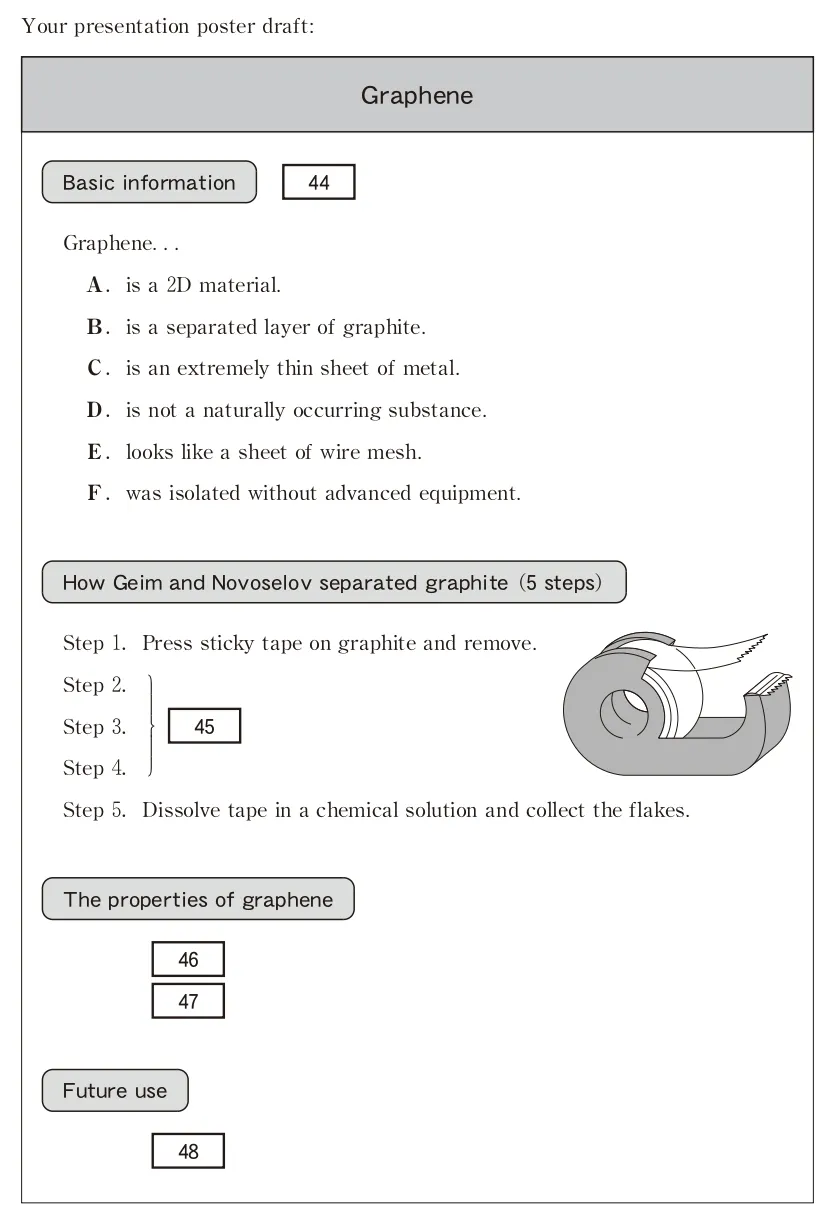
You are preparing a poster for an in−school presentation on a scientific discovery, using the following article.
As you are reading this, you probably have a pencil in your hand. In the center of every pencil is something called“lead.” This dark gray material is not actually lead(Pb), but a different substance, graphite. Graphite has been a major area of research for many years. It is made up of thin layers of carbon that can be easily separated. Indeed, it is this ease of separation that enables the pencil to write. As the pencil rubs against the paper, thin layers of carbon are pulled off the pencil lead and left on the paper as lines or writing.
In 2004, two scientists, Andre Geim and Konstantin Novoselov, were investigating graphite at the University of Manchester, in the UK. They were trying to see if they could obtain a very thin slice of graphite to study. Their goal was to get a slice of carbon which was between 10 and 100 layers thick. Even though their university laboratory had the latest scientific equipment, they made their incredible breakthrough ― for what was later to become a Nobel Prize−winning discovery ― with only a cheap roll of sticky tape.
In a BBC News interview, Professor Geim described their technique. He said that the first step was to put sticky tape on a piece of graphite. Then, when the tape is pulled off, a flake of graphite will come off on the tape. Next, fold the tape in half, sticking the flake onto the other side of the tape. Then pull the tape apart to split the flake. You now have two flakes, roughly half as thick as before. Fold the tape together once more in a slightly different position to avoid having the flakes touch each other. Pull it apart again, and you will now have four thinner flakes than before. Repeat this procedure 10 or 20 times, and you’re left with many very thin flakes attached to your tape. Finally, you dissolve the tape using chemicals so everything goes into a solution.
Geim and Novoselov then looked at the solution, and were surprised to see that the thin flakes were flat and not rolled up − and even more surprised that the flakes were as thin as only a matter of weeks before they were studying whether these thin sheets could be used in computer chips.By 2005,they had succeeded in separating a single layer of graphite.As this does not exist naturally,this new material was given a new name:graphene.Graphene is one of the few two−dimensional(2D)materials known,and forms a six−sided,honeycomb−patterned structure.In addition,it is possibly the lightest and strongest substance known on earth.It is also excellent at carrying electricity.In fact,at laboratory temperatures (20−25°C),graphene conducts electricity faster than any known substance. This has led to manufacturers investing in further research because graphene−based batteries could last three times longer and be charged five times faster than lithium−ion batteries.
Graphene has been called a super−material because of its amazing
properties. It is 1,000 times lighter than paper and close to being totally transparent. It allows 98% of light to pass through it while at the same time it is so dense that even one molecule of helium gas cannot pass through it. It can also convert light into electricity. It is 200 times stronger than steel by weight: So strong in fact,that if you could make a 1m2sheet of graphene,it would weigh less than a human hair and be strong enough to hold the weight of a cat. Quite simply,this material found in pencil lead has the potential to revolutionize the development of computer chips,rechargeable batteries,and strong,light−weight materials.
You are going to summarize the five−step process used to separate layers of graphite. Choose the best combination of steps to complete the process.( 45 )
A Do this process over and over again.
B Fold tape in two again so another part of the tape touches the graphite.
C Fold tape in two and pull it apart.
D Place tape on the thinner flakes and press down.
E Pull a flake of graphite off some sticky tape.
このページは閲覧用ページです。
履歴を残すには、 「新しく出題する(ここをクリック)」 をご利用ください。
問題
共通テスト(英語)試験 令和5年度(2023年度)追・再試験 問45(<旧課程>英語リーディング(第6問) 問7) (訂正依頼・報告はこちら)
各問いの英文や図表を読み、解答番号にあてはまるものとして最も適当な選択肢を選びなさい。
You are preparing a poster for an in−school presentation on a scientific discovery, using the following article.
As you are reading this, you probably have a pencil in your hand. In the center of every pencil is something called“lead.” This dark gray material is not actually lead(Pb), but a different substance, graphite. Graphite has been a major area of research for many years. It is made up of thin layers of carbon that can be easily separated. Indeed, it is this ease of separation that enables the pencil to write. As the pencil rubs against the paper, thin layers of carbon are pulled off the pencil lead and left on the paper as lines or writing.
In 2004, two scientists, Andre Geim and Konstantin Novoselov, were investigating graphite at the University of Manchester, in the UK. They were trying to see if they could obtain a very thin slice of graphite to study. Their goal was to get a slice of carbon which was between 10 and 100 layers thick. Even though their university laboratory had the latest scientific equipment, they made their incredible breakthrough ― for what was later to become a Nobel Prize−winning discovery ― with only a cheap roll of sticky tape.
In a BBC News interview, Professor Geim described their technique. He said that the first step was to put sticky tape on a piece of graphite. Then, when the tape is pulled off, a flake of graphite will come off on the tape. Next, fold the tape in half, sticking the flake onto the other side of the tape. Then pull the tape apart to split the flake. You now have two flakes, roughly half as thick as before. Fold the tape together once more in a slightly different position to avoid having the flakes touch each other. Pull it apart again, and you will now have four thinner flakes than before. Repeat this procedure 10 or 20 times, and you’re left with many very thin flakes attached to your tape. Finally, you dissolve the tape using chemicals so everything goes into a solution.
Geim and Novoselov then looked at the solution, and were surprised to see that the thin flakes were flat and not rolled up − and even more surprised that the flakes were as thin as only a matter of weeks before they were studying whether these thin sheets could be used in computer chips.By 2005,they had succeeded in separating a single layer of graphite.As this does not exist naturally,this new material was given a new name:graphene.Graphene is one of the few two−dimensional(2D)materials known,and forms a six−sided,honeycomb−patterned structure.In addition,it is possibly the lightest and strongest substance known on earth.It is also excellent at carrying electricity.In fact,at laboratory temperatures (20−25°C),graphene conducts electricity faster than any known substance. This has led to manufacturers investing in further research because graphene−based batteries could last three times longer and be charged five times faster than lithium−ion batteries.
Graphene has been called a super−material because of its amazing
properties. It is 1,000 times lighter than paper and close to being totally transparent. It allows 98% of light to pass through it while at the same time it is so dense that even one molecule of helium gas cannot pass through it. It can also convert light into electricity. It is 200 times stronger than steel by weight: So strong in fact,that if you could make a 1m2sheet of graphene,it would weigh less than a human hair and be strong enough to hold the weight of a cat. Quite simply,this material found in pencil lead has the potential to revolutionize the development of computer chips,rechargeable batteries,and strong,light−weight materials.
You are going to summarize the five−step process used to separate layers of graphite. Choose the best combination of steps to complete the process.( 45 )
A Do this process over and over again.
B Fold tape in two again so another part of the tape touches the graphite.
C Fold tape in two and pull it apart.
D Place tape on the thinner flakes and press down.
E Pull a flake of graphite off some sticky tape.
You are preparing a poster for an in−school presentation on a scientific discovery, using the following article.
As you are reading this, you probably have a pencil in your hand. In the center of every pencil is something called“lead.” This dark gray material is not actually lead(Pb), but a different substance, graphite. Graphite has been a major area of research for many years. It is made up of thin layers of carbon that can be easily separated. Indeed, it is this ease of separation that enables the pencil to write. As the pencil rubs against the paper, thin layers of carbon are pulled off the pencil lead and left on the paper as lines or writing.
In 2004, two scientists, Andre Geim and Konstantin Novoselov, were investigating graphite at the University of Manchester, in the UK. They were trying to see if they could obtain a very thin slice of graphite to study. Their goal was to get a slice of carbon which was between 10 and 100 layers thick. Even though their university laboratory had the latest scientific equipment, they made their incredible breakthrough ― for what was later to become a Nobel Prize−winning discovery ― with only a cheap roll of sticky tape.
In a BBC News interview, Professor Geim described their technique. He said that the first step was to put sticky tape on a piece of graphite. Then, when the tape is pulled off, a flake of graphite will come off on the tape. Next, fold the tape in half, sticking the flake onto the other side of the tape. Then pull the tape apart to split the flake. You now have two flakes, roughly half as thick as before. Fold the tape together once more in a slightly different position to avoid having the flakes touch each other. Pull it apart again, and you will now have four thinner flakes than before. Repeat this procedure 10 or 20 times, and you’re left with many very thin flakes attached to your tape. Finally, you dissolve the tape using chemicals so everything goes into a solution.
Geim and Novoselov then looked at the solution, and were surprised to see that the thin flakes were flat and not rolled up − and even more surprised that the flakes were as thin as only a matter of weeks before they were studying whether these thin sheets could be used in computer chips.By 2005,they had succeeded in separating a single layer of graphite.As this does not exist naturally,this new material was given a new name:graphene.Graphene is one of the few two−dimensional(2D)materials known,and forms a six−sided,honeycomb−patterned structure.In addition,it is possibly the lightest and strongest substance known on earth.It is also excellent at carrying electricity.In fact,at laboratory temperatures (20−25°C),graphene conducts electricity faster than any known substance. This has led to manufacturers investing in further research because graphene−based batteries could last three times longer and be charged five times faster than lithium−ion batteries.
Graphene has been called a super−material because of its amazing
properties. It is 1,000 times lighter than paper and close to being totally transparent. It allows 98% of light to pass through it while at the same time it is so dense that even one molecule of helium gas cannot pass through it. It can also convert light into electricity. It is 200 times stronger than steel by weight: So strong in fact,that if you could make a 1m2sheet of graphene,it would weigh less than a human hair and be strong enough to hold the weight of a cat. Quite simply,this material found in pencil lead has the potential to revolutionize the development of computer chips,rechargeable batteries,and strong,light−weight materials.
You are going to summarize the five−step process used to separate layers of graphite. Choose the best combination of steps to complete the process.( 45 )
A Do this process over and over again.
B Fold tape in two again so another part of the tape touches the graphite.
C Fold tape in two and pull it apart.
D Place tape on the thinner flakes and press down.
E Pull a flake of graphite off some sticky tape.
- C → B → A
- C → E → D
- D → C → B
- D → E → A
- E → C → A
- E → C → D
正解!素晴らしいです
残念...
画像拡大
この過去問の解説 (3件)
01
問題文は
「グラファイトを分離させるのに使う5つの手順を要約する。過程を完成させる手順の組み合わせとして正しいものを選びなさい。」
です。
該当箇所は、
He said that the first step was to put sticky tape on a piece of graphite. (Step1)
Then, when the tape is pulled off, a flake of graphite will come off on the tape. Next, fold the tape in half, sticking the flake onto the other side of the tape. Then pull the tape apart to split the flake. You now have two flakes, roughly half as thick as before.(Step 2)
Fold the tape together once more in a slightly different position to avoid having the flakes touch each other. Pull it apart again, and you will now have four thinner flakes than before. (Step 3)
Repeat this procedure 10 or 20 times, and you’re left with many very thin flakes attached to your tape. (Step 4)
Finally, you dissolve the tape using chemicals so everything goes into a solution.(Step 5)
(まず最初は、黒鉛に粘着テープを貼ります。)
(そしてテープをはがすと、グラファイトの薄片がテープ上に現れます。次にテープを半分に折り、薄片をテープの反対側につけます。そしてテープを引き離すと、薄片は2つに分かれます。これでもとのほぼ半分の厚さの2枚の薄片ができます。)
(薄片同士が触れるのをさけるため、少し違う箇所で再びテープを折り、ます。また引き離すと、より薄い4枚の薄片ができます。)
(この作業を10回から20回繰り返すと、非常に薄い多くの薄片がテープに残ります。)
(最後に、すべてを溶液になるように、化学薬品を使ってテープを溶かします。)
各選択肢は、
A Do this process over and over again.(何度も何度もその過程をやる)
B Fold tape in two again so another part of the tape touches the graphite.(テープの違う箇所が黒鉛に当たるように、もう一度テープを半分に折る。)
C Fold tape in two and pull it apart.(テープを2つに折り、引きはがす。)
D Place tape on the thinner flakes and press down.(より薄い破片をテープに置き、押し付ける)
E Pull a flake of graphite off some sticky tape.(粘着テープから黒鉛の破片を引きはがす。)
です。
求められるのは、手順2~4の内容なので、該当するものを選びます。
参考になった数0
この解説の修正を提案する
02
黒鉛の層を分離する5段階の手順を要約しようとしています。それを完成させる最も適切な組み合わせを選ぶ問題です。
A この作業を何度も繰り返す。
B テープをもう一度2つ折りにし、別の部分が黒鉛に触れるようにする。
C テープを2つ折りにして、引き離す。
D より薄くなった薄片の上にテープを置いて抑える。
E 粘着テープから黒鉛の薄片を引きはがす。
訳)
あなたがこれを読んでいる今、おそらく手に鉛筆を持っているでしょう。すべての鉛筆の中心には「芯」と呼ばれるものがあります。この濃い灰色の物質は実際には鉛(Pb)ではなく、黒鉛という別の物質です。黒鉛は長年にわたり主要な研究対象となってきました。これは簡単に分離できる薄い炭素の層からできています。実際、鉛筆が文字を書けるのは、このはがれやすさのおかげです。鉛筆が紙にこすられると、薄い炭素の層が芯からはがれ、線や文字として紙に残るのです。
・substance(名詞) : 物質
・rub(動詞) : こする
・pull off : はがれる
2004年、イギリスのマンチェスター大学で、Andre Geim と Konstantin Novoselov の2人の科学者が黒鉛を研究していました。彼らは研究のために、非常に薄い黒鉛の断片を得られるかどうかを試していました。目標は、10層から100層ほどの厚さの炭素の薄片を作ることでした。大学の研究室には最新の科学機器がそろっていましたが、後にノーベル賞受賞につながるこの驚くべき発見は、たった1巻きの安価な粘着テープによって達成されました。
・investigate(動詞) : 研究する
・breakthrough(名詞): 突破口
BBCニュースのインタビューで、Geim教授はその方法を説明しています。まず、黒鉛に粘着テープを貼ります。そしてテープをはがすと、グラファイトの薄片がテープに付着します。次にテープを半分に折り、薄片を反対側にくっつけます。そしてテープを引き離すと、薄片は2つに分かれます。これで厚さがほぼ半分になった2枚の薄片ができます。さらに、薄片同士が触れないよう少しずらして再びテープを折り、また引き離します。すると、より薄い4枚の薄片になります。この作業を10回から20回繰り返すと、非常に薄い多数の薄片がテープに残ります。最後に、化学薬品を使ってテープを溶かし、すべてを溶液にします。
・flake(名詞) : 薄片
・come off : はがれる、外れる
・roughly(副詞) : だいたい
・procedure(名詞) : 手順
・dissolve(動詞) : 溶かす
・solution(名詞) : 溶液
その後、GeimとNovoselovはその溶液を観察し、薄片が丸まらず平らであることに驚きました。そしてさらに驚いたのは、その薄片が極めて薄かったことです。数週間のうちに、彼らはこれらの薄いシートがコンピューターチップに利用できるかどうかを研究し始めました。2005年までに、彼らはついに黒鉛の単一層を分離することに成功しました。これは自然界には存在しないため、この新しい物質はグラフェンと名付けられました。グラフェンは、知られている数少ない2次元(2D)物質の一つで、六角形の蜂の巣状構造をしています。さらに、地球上で最も軽く、最も強い物質の1つと考えられています。また、電気を非常によく通します。実験室の温度(20〜25℃)では、グラフェンは既知のどの物質よりも速く電気を伝導します。そのため、グラフェンを使った電池はリチウムイオン電池よりも3倍長持ちし、5倍速く充電できる可能性があり、メーカーはさらなる研究に投資しています。
・two−dimensional(形容詞) : 二次元の
conduct(動詞) : 伝導する
グラフェンは、その驚くべき特性からスーパー素材と呼ばれています。紙の1000分の1の軽さで、ほぼ完全に透明です。光の98%を通す一方で、非常に密度が高く、ヘリウムガスの分子1つでさえ通すことができません。また、光を電気に変えることもできます。重さあたりでは鋼鉄の200倍の強さを持っています。もし1平方メートルのグラフェンシートを作ることができれば、その重さは人間の髪の毛よりも軽く、それでいて猫1匹を支えられるほどの強度があります。
要するに、鉛筆の芯に含まれているこの物質は、コンピューターチップ、充電式電池、そして軽くて強い素材の開発に革命をもたらす可能性を秘めているのです。
・property(名詞) : 特性
・transparent(形容詞) : 透明な
・dense(形容詞) : 密集した
・convert A into B : AをBに変える
基本情報(44)
グラフェンは…
A. 二次元(2D)物質である。
B. 黒鉛から分離された単一層である。
C. 非常に薄い金属のシートである。
D. 自然界には存在しない物質である。
E. 金網のように見える。
F. 高度な装置を使わずに分離された。
ガイムとノボセロフがグラファイトを分離した方法(5段階)
ステップ1:黒鉛に粘着テープを押しつけ、はがす。
ステップ2:(45)
ステップ3:(45)
ステップ4:(45)
ステップ5:テープを化学溶液で溶かし、薄片を回収する。
グラフェンの特性
(46)
(47)
将来の利用
(48)
正解
①C テープを2つ折りにして、引き離す。
3段落目の中盤に、Next, fold the tape in half, sticking the flake onto the other side of the tape. Then pull the tape apart to split the flake. You now have two flakes(次にテープを半分に折り、薄片を反対側にくっつけます。そしてテープを引き離すと、薄片は2つに分かれます).
②B テープをもう一度2つ折りにし、別の部分が黒鉛に触れるようにする。
上記の文に続きます。Fold the tape together once more in a slightly different position to avoid having the flakes touch each other(さらに、薄片同士が触れないよう少しずらして再びテープを折り、また引き離します).
③A この作業を何度も繰り返す。
上記の文に続きます。Repeat this procedure 10 or 20 times(この作業を10回から20回繰り返す).
と記載があります。
つまり正しい流れは、
①テープを貼ってはがす
②折って引き離す(C)
③少しずらしてまた折る(B)
④これを繰り返す(A)
⑤溶かす
となります。
参考になった数0
この解説の修正を提案する
03
Grapheneの作り方は第3段落に書いてあります。では、問題を見てみましょう。
正解です。以下は文章からの記述です。
"He said that the first step was to put sticky tape on a piece of graphite. Then, when the tape is pulled off, a flake of graphite will come off on the tape. Next, fold the tape in half, sticking the flake onto the other side of the tape. Then pull the tape apart to split the flake. You now have two flakes, roughly half as thick as before. Fold the tape together once more in a slightly different position to avoid having the flakes touch each other. Pull it apart again, and you will now have four thinner flakes than before. Repeat this procedure 10 or 20 times, and you’re left with many very thin flakes attached to your tape. Finally, you dissolve the tape using chemicals so everything goes into a solution."
下線が引いてある接続詞を見つければ、読解が楽になります。FirstとFinallyの箇所がもうすでに埋まっているので、Next、Thenのマーク部分を並べると、C、B、Aになります。
参考になった数0
この解説の修正を提案する
前の問題(問44)へ
令和5年度(2023年度)追・再試験 問題一覧
次の問題(問46)へ