
共通テスト(英語) 過去問
令和6年度(2024年度)本試験
問48 (<旧課程>英語リーディング(第6問) 問10)
問題文
各問の英文や図表を読み、最も適当な選択肢を選びなさい。
You are preparing a presentation for your science club,using the following passage from a science website.
Chili Peppers: The Spice of Life
Tiny pieces of red spice in chili chicken add a nice touch of color,but biting into even a small piece can make a person’s mouth burn as if it were on fire.While some people love this,others want to avoid the painful sensation.At the same time,though,they can eat sashimi with wasabi.This might lead one to wonder what spiciness actually is and to ask where the difference between chili and wasabi comes from.
Unlike sweetness,saltiness,and sourness,spiciness is not a taste.In fact,we do not actually taste heat,or spiciness,when we eat spicy foods.The bite we feel from eating chili peppers and wasabi is derived from different types of compounds.Chili peppers get their heat from a heavier,oil−like element called capsaicin.Capsaicin leaves a lingering,fire−like sensation in our mouths because it triggers a receptor called TRPV1.TRPV1 induces stress and tells us when something is burning our mouths.Interestingly,there is a wide range of heat across the different varieties of chili peppers,and the level depends on the amount of capsaicin they contain. This is measured using the Scoville Scale,which is also called Scoville Heat Units(SHU).SHUs range from the sweet and mild shishito pepper at 50−200 SHUs to the Carolina Reaper pepper,which can reach up to 2.2 million.
Wasabi is considered a root,not a pepper,and does not contain capsaicin. Thus,wasabi is not ranked on the Scoville Scale.However,people have compared the level of spice in it to chilis with around 1,000 SHUs,which is on the lower end of the scale.The reason some people cannot tolerate chili spice but can eat foods flavored with wasabi is that the spice compounds in it are low in density.The compounds in wasabi vaporize easily,delivering a blast of spiciness to our nose when we eat it.
Consuming chili peppers can have positive effects on our health,and much research has been conducted into the benefits of capsaicin.When capsaicin activates the TRPV1 receptor in a person’s body,it is similar to what happens when they experience stress or pain from an injury. Strangely,capsaicin can also make pain go away.Scientists found that TRPV1 ceases to be turned on after long−term exposure to chili peppers,temporarily easing painful sensations.Thus,skin creams containing capsaicin might be useful for people who experience muscle aches.
Another benefit of eating chili peppers is that they accelerate the metabolism.A group of researchers analyzed 90 studies on capsaicin and body weight and found that people had a reduced appetite when they ate spicy foods.This is because spicy foods increase the heart rate,send more energy to the muscles,and convert fat into energy.Recently,scientists at the University of Wyoming have created a weight−loss drug with capsaicin as a main ingredient.
It is also believed that chili peppers are connected with food safety,which might lead to a healthier life.When food is left outside of a refrigerated environment,microorganisms multiply on it,which may cause sickness if eaten.Studies have shown that capsaicin and other chemicals found in chili peppers have antibacterial properties that can slow down or even stop microorganism growth.As a result,food lasts longer and there are fewer food−borne illnesses.This may explain why people in hot climates have a tendency to use more chili peppers,and therefore,be more tolerant of spicier foods due to repeated exposure.Also,in the past,before there were refrigerators,they were less likely to have food poisoning than people in cooler climates.
Chili peppers seem to have health benefits,but can they also be bad for our health? Peppers that are high on the Scoville Scale can cause physical discomfort when eaten in large quantities.People who have eaten several of the world’s hottest chilis in a short time have reported experiencing upset stomachs,diarrhea,numb hands,and symptoms similar to a heart attack.Ghost peppers,which contain one million SHUs,can even burn a person’s skin if they are touched.
Luckily the discomfort some people feel after eating spicy foods tends to go away soon―usually within a few hours.Despite some negative side effects,spicy foods remain popular around the world and add a flavorful touch to the table.Remember,it is safe to consume spicy foods,but you might want to be careful about the amount of peppers you put in your dishes.
What can be inferred about tolerance for spices for Slide 5?( 48 )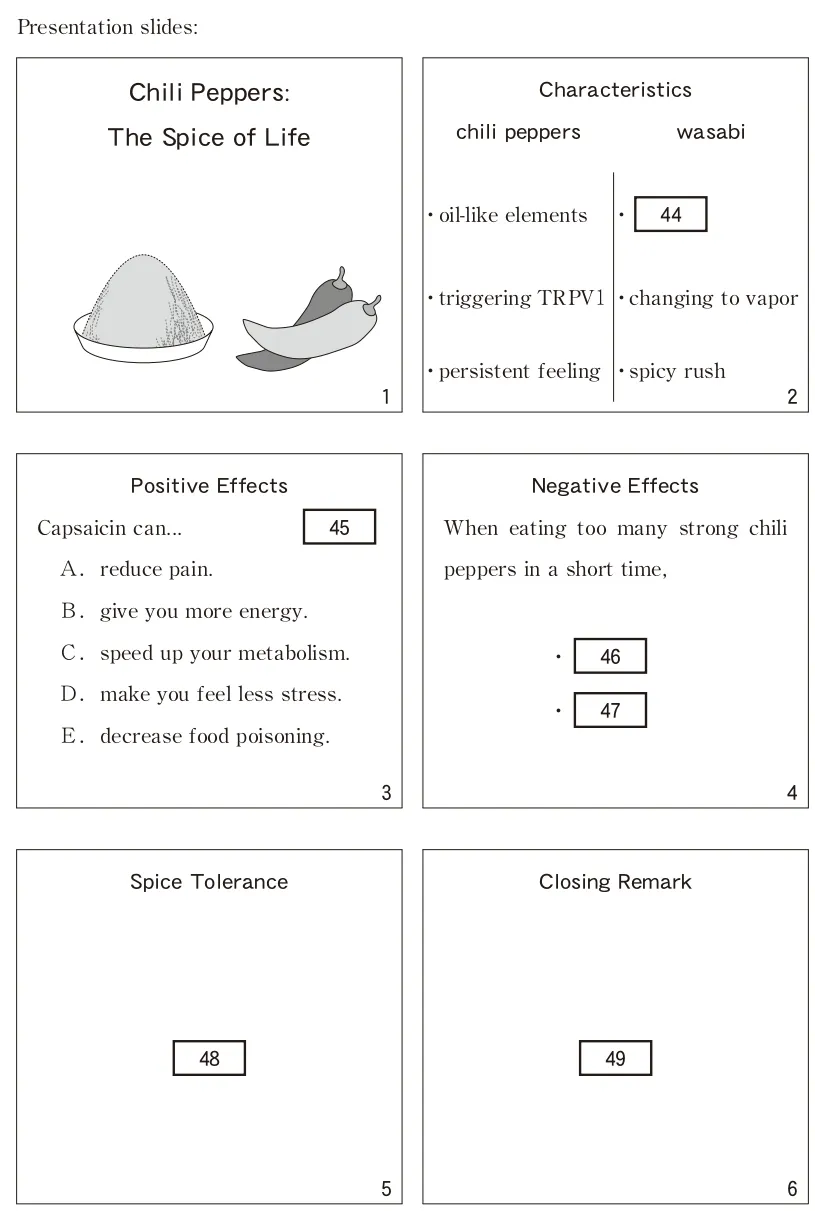
You are preparing a presentation for your science club,using the following passage from a science website.
Chili Peppers: The Spice of Life
Tiny pieces of red spice in chili chicken add a nice touch of color,but biting into even a small piece can make a person’s mouth burn as if it were on fire.While some people love this,others want to avoid the painful sensation.At the same time,though,they can eat sashimi with wasabi.This might lead one to wonder what spiciness actually is and to ask where the difference between chili and wasabi comes from.
Unlike sweetness,saltiness,and sourness,spiciness is not a taste.In fact,we do not actually taste heat,or spiciness,when we eat spicy foods.The bite we feel from eating chili peppers and wasabi is derived from different types of compounds.Chili peppers get their heat from a heavier,oil−like element called capsaicin.Capsaicin leaves a lingering,fire−like sensation in our mouths because it triggers a receptor called TRPV1.TRPV1 induces stress and tells us when something is burning our mouths.Interestingly,there is a wide range of heat across the different varieties of chili peppers,and the level depends on the amount of capsaicin they contain. This is measured using the Scoville Scale,which is also called Scoville Heat Units(SHU).SHUs range from the sweet and mild shishito pepper at 50−200 SHUs to the Carolina Reaper pepper,which can reach up to 2.2 million.
Wasabi is considered a root,not a pepper,and does not contain capsaicin. Thus,wasabi is not ranked on the Scoville Scale.However,people have compared the level of spice in it to chilis with around 1,000 SHUs,which is on the lower end of the scale.The reason some people cannot tolerate chili spice but can eat foods flavored with wasabi is that the spice compounds in it are low in density.The compounds in wasabi vaporize easily,delivering a blast of spiciness to our nose when we eat it.
Consuming chili peppers can have positive effects on our health,and much research has been conducted into the benefits of capsaicin.When capsaicin activates the TRPV1 receptor in a person’s body,it is similar to what happens when they experience stress or pain from an injury. Strangely,capsaicin can also make pain go away.Scientists found that TRPV1 ceases to be turned on after long−term exposure to chili peppers,temporarily easing painful sensations.Thus,skin creams containing capsaicin might be useful for people who experience muscle aches.
Another benefit of eating chili peppers is that they accelerate the metabolism.A group of researchers analyzed 90 studies on capsaicin and body weight and found that people had a reduced appetite when they ate spicy foods.This is because spicy foods increase the heart rate,send more energy to the muscles,and convert fat into energy.Recently,scientists at the University of Wyoming have created a weight−loss drug with capsaicin as a main ingredient.
It is also believed that chili peppers are connected with food safety,which might lead to a healthier life.When food is left outside of a refrigerated environment,microorganisms multiply on it,which may cause sickness if eaten.Studies have shown that capsaicin and other chemicals found in chili peppers have antibacterial properties that can slow down or even stop microorganism growth.As a result,food lasts longer and there are fewer food−borne illnesses.This may explain why people in hot climates have a tendency to use more chili peppers,and therefore,be more tolerant of spicier foods due to repeated exposure.Also,in the past,before there were refrigerators,they were less likely to have food poisoning than people in cooler climates.
Chili peppers seem to have health benefits,but can they also be bad for our health? Peppers that are high on the Scoville Scale can cause physical discomfort when eaten in large quantities.People who have eaten several of the world’s hottest chilis in a short time have reported experiencing upset stomachs,diarrhea,numb hands,and symptoms similar to a heart attack.Ghost peppers,which contain one million SHUs,can even burn a person’s skin if they are touched.
Luckily the discomfort some people feel after eating spicy foods tends to go away soon―usually within a few hours.Despite some negative side effects,spicy foods remain popular around the world and add a flavorful touch to the table.Remember,it is safe to consume spicy foods,but you might want to be careful about the amount of peppers you put in your dishes.
What can be inferred about tolerance for spices for Slide 5?( 48 )
このページは閲覧用ページです。
履歴を残すには、 「新しく出題する(ここをクリック)」 をご利用ください。
問題
反映中…
共通テスト(英語)試験 令和6年度(2024年度)本試験 問48(<旧課程>英語リーディング(第6問) 問10) (訂正依頼・報告はこちら)
各問の英文や図表を読み、最も適当な選択肢を選びなさい。
You are preparing a presentation for your science club,using the following passage from a science website.
Chili Peppers: The Spice of Life
Tiny pieces of red spice in chili chicken add a nice touch of color,but biting into even a small piece can make a person’s mouth burn as if it were on fire.While some people love this,others want to avoid the painful sensation.At the same time,though,they can eat sashimi with wasabi.This might lead one to wonder what spiciness actually is and to ask where the difference between chili and wasabi comes from.
Unlike sweetness,saltiness,and sourness,spiciness is not a taste.In fact,we do not actually taste heat,or spiciness,when we eat spicy foods.The bite we feel from eating chili peppers and wasabi is derived from different types of compounds.Chili peppers get their heat from a heavier,oil−like element called capsaicin.Capsaicin leaves a lingering,fire−like sensation in our mouths because it triggers a receptor called TRPV1.TRPV1 induces stress and tells us when something is burning our mouths.Interestingly,there is a wide range of heat across the different varieties of chili peppers,and the level depends on the amount of capsaicin they contain. This is measured using the Scoville Scale,which is also called Scoville Heat Units(SHU).SHUs range from the sweet and mild shishito pepper at 50−200 SHUs to the Carolina Reaper pepper,which can reach up to 2.2 million.
Wasabi is considered a root,not a pepper,and does not contain capsaicin. Thus,wasabi is not ranked on the Scoville Scale.However,people have compared the level of spice in it to chilis with around 1,000 SHUs,which is on the lower end of the scale.The reason some people cannot tolerate chili spice but can eat foods flavored with wasabi is that the spice compounds in it are low in density.The compounds in wasabi vaporize easily,delivering a blast of spiciness to our nose when we eat it.
Consuming chili peppers can have positive effects on our health,and much research has been conducted into the benefits of capsaicin.When capsaicin activates the TRPV1 receptor in a person’s body,it is similar to what happens when they experience stress or pain from an injury. Strangely,capsaicin can also make pain go away.Scientists found that TRPV1 ceases to be turned on after long−term exposure to chili peppers,temporarily easing painful sensations.Thus,skin creams containing capsaicin might be useful for people who experience muscle aches.
Another benefit of eating chili peppers is that they accelerate the metabolism.A group of researchers analyzed 90 studies on capsaicin and body weight and found that people had a reduced appetite when they ate spicy foods.This is because spicy foods increase the heart rate,send more energy to the muscles,and convert fat into energy.Recently,scientists at the University of Wyoming have created a weight−loss drug with capsaicin as a main ingredient.
It is also believed that chili peppers are connected with food safety,which might lead to a healthier life.When food is left outside of a refrigerated environment,microorganisms multiply on it,which may cause sickness if eaten.Studies have shown that capsaicin and other chemicals found in chili peppers have antibacterial properties that can slow down or even stop microorganism growth.As a result,food lasts longer and there are fewer food−borne illnesses.This may explain why people in hot climates have a tendency to use more chili peppers,and therefore,be more tolerant of spicier foods due to repeated exposure.Also,in the past,before there were refrigerators,they were less likely to have food poisoning than people in cooler climates.
Chili peppers seem to have health benefits,but can they also be bad for our health? Peppers that are high on the Scoville Scale can cause physical discomfort when eaten in large quantities.People who have eaten several of the world’s hottest chilis in a short time have reported experiencing upset stomachs,diarrhea,numb hands,and symptoms similar to a heart attack.Ghost peppers,which contain one million SHUs,can even burn a person’s skin if they are touched.
Luckily the discomfort some people feel after eating spicy foods tends to go away soon―usually within a few hours.Despite some negative side effects,spicy foods remain popular around the world and add a flavorful touch to the table.Remember,it is safe to consume spicy foods,but you might want to be careful about the amount of peppers you put in your dishes.
What can be inferred about tolerance for spices for Slide 5?( 48 )
You are preparing a presentation for your science club,using the following passage from a science website.
Chili Peppers: The Spice of Life
Tiny pieces of red spice in chili chicken add a nice touch of color,but biting into even a small piece can make a person’s mouth burn as if it were on fire.While some people love this,others want to avoid the painful sensation.At the same time,though,they can eat sashimi with wasabi.This might lead one to wonder what spiciness actually is and to ask where the difference between chili and wasabi comes from.
Unlike sweetness,saltiness,and sourness,spiciness is not a taste.In fact,we do not actually taste heat,or spiciness,when we eat spicy foods.The bite we feel from eating chili peppers and wasabi is derived from different types of compounds.Chili peppers get their heat from a heavier,oil−like element called capsaicin.Capsaicin leaves a lingering,fire−like sensation in our mouths because it triggers a receptor called TRPV1.TRPV1 induces stress and tells us when something is burning our mouths.Interestingly,there is a wide range of heat across the different varieties of chili peppers,and the level depends on the amount of capsaicin they contain. This is measured using the Scoville Scale,which is also called Scoville Heat Units(SHU).SHUs range from the sweet and mild shishito pepper at 50−200 SHUs to the Carolina Reaper pepper,which can reach up to 2.2 million.
Wasabi is considered a root,not a pepper,and does not contain capsaicin. Thus,wasabi is not ranked on the Scoville Scale.However,people have compared the level of spice in it to chilis with around 1,000 SHUs,which is on the lower end of the scale.The reason some people cannot tolerate chili spice but can eat foods flavored with wasabi is that the spice compounds in it are low in density.The compounds in wasabi vaporize easily,delivering a blast of spiciness to our nose when we eat it.
Consuming chili peppers can have positive effects on our health,and much research has been conducted into the benefits of capsaicin.When capsaicin activates the TRPV1 receptor in a person’s body,it is similar to what happens when they experience stress or pain from an injury. Strangely,capsaicin can also make pain go away.Scientists found that TRPV1 ceases to be turned on after long−term exposure to chili peppers,temporarily easing painful sensations.Thus,skin creams containing capsaicin might be useful for people who experience muscle aches.
Another benefit of eating chili peppers is that they accelerate the metabolism.A group of researchers analyzed 90 studies on capsaicin and body weight and found that people had a reduced appetite when they ate spicy foods.This is because spicy foods increase the heart rate,send more energy to the muscles,and convert fat into energy.Recently,scientists at the University of Wyoming have created a weight−loss drug with capsaicin as a main ingredient.
It is also believed that chili peppers are connected with food safety,which might lead to a healthier life.When food is left outside of a refrigerated environment,microorganisms multiply on it,which may cause sickness if eaten.Studies have shown that capsaicin and other chemicals found in chili peppers have antibacterial properties that can slow down or even stop microorganism growth.As a result,food lasts longer and there are fewer food−borne illnesses.This may explain why people in hot climates have a tendency to use more chili peppers,and therefore,be more tolerant of spicier foods due to repeated exposure.Also,in the past,before there were refrigerators,they were less likely to have food poisoning than people in cooler climates.
Chili peppers seem to have health benefits,but can they also be bad for our health? Peppers that are high on the Scoville Scale can cause physical discomfort when eaten in large quantities.People who have eaten several of the world’s hottest chilis in a short time have reported experiencing upset stomachs,diarrhea,numb hands,and symptoms similar to a heart attack.Ghost peppers,which contain one million SHUs,can even burn a person’s skin if they are touched.
Luckily the discomfort some people feel after eating spicy foods tends to go away soon―usually within a few hours.Despite some negative side effects,spicy foods remain popular around the world and add a flavorful touch to the table.Remember,it is safe to consume spicy foods,but you might want to be careful about the amount of peppers you put in your dishes.
What can be inferred about tolerance for spices for Slide 5?( 48 )
- People with a high tolerance to chili peppers pay attention to the spices used in their food.
- People with a high tolerance to wasabi are scared of chili peppers’ negative effects.
- People with a low tolerance to chili peppers can get used to their heat.
- People with a low tolerance to wasabi cannot endure high SHU levels.
正解!素晴らしいです
残念...
画像拡大
この過去問の解説 (3件)
01
問題文は
「スライド5の香辛料への耐性について何が推測できるか。」
です。
香辛料への耐性についての本文は
people in hot climates have a tendency to use more chili peppers,and therefore,be more tolerant of spicier foods due to repeated exposure.
(暑い気候にいる人々は、より多くの香辛料を使う傾向にある。それゆえ、何度も辛さに晒されるために、辛い食べ物への耐性が強くなる)
です。
つまり、香辛料を食べるほど、辛さへの耐性ができるということだとわかります。
この内容に適するものを選びます。
「唐辛子に耐性が強い人々は、食べ物に使われる香辛料に注意を払っている。」
このような記載はありません。
「わさびへの耐性が強い人は、唐辛子の悪影響を恐れている。」
このような記載はありません。
正解「唐辛子に耐性が低い人は、その辛さに慣れることができる。」
耐性が低くても、繰り返し香辛料を食べることで耐性がついてくるため、正しいです。
「わさびへの耐性が低い人は、高いSHUレベルを耐えられない。」
このような記載はありません。
参考になった数0
この解説の修正を提案する
02
(48)Spice Tolerance(スパイス耐性)
本文の第6段落、最後の方にこのような文があります。
下記本文参照
people in hot climates have a tendency to use more chili peppers,and therefore,be more tolerant of spicier foods due to repeated exposure.
つまり、繰り返し食べることで辛さに慣れる(耐性がつく)
という内容の選択肢を選びましょう。
訳)唐辛子に耐性のある人は、食べ物に使われるスパイスに注意を払います。
→間違い
このような内容は本文にはない。
訳)ワサビに耐性が強い人は唐辛子の悪影響を恐れます。
→間違い
このような内容は本文にはない。
訳)唐辛子に耐性が低い人でも、その辛さに慣れることができます。
→正しい
本文と内容が一致しています。
訳)ワサビに対する耐性が低い人は、高い SHU レベルに耐えることができません。
→間違い
ワサビはSHUで測ることはできません。
参考になった数0
この解説の修正を提案する
03
この問題では、香辛料に対する耐性について書かれている内容を把握する必要があります。
第6段落に以下のような記述があります。
As a result,food lasts longer and there are fewer food−borne illnesses.This may explain why people in hot climates have a tendency to use more chili peppers,and therefore,be more tolerant of spicier foods due to repeated exposure.Also,in the past,before there were refrigerators,they were less likely to have food poisoning than people in cooler climates.
(訳:その結果、食品の保存期間が長くなり、食中毒も減少します。これは、暑い気候の人々が唐辛子を多く使用する傾向があり、繰り返し摂取することで辛い食べ物への耐性が高まる理由を説明しているかもしれません。また、冷蔵庫が普及する以前には、涼しい気候の人々よりも食中毒にかかる可能性が低かったのです。)
これにより、暑い気候の人々は唐辛子を摂取することで後天的に辛さに対する耐性を習得したと読み取ることができます。
訳:唐辛子への耐性が高い人は、料理に使われる香辛料に注意を払う。
文章の記述と異なるため、誤りです。
訳:わさびへの耐性が高い人は、唐辛子の悪影響を恐れる。
文章の記述と異なるため、誤りです。
訳:唐辛子への耐性が低い人は、その辛さに慣れることができる。
文章では、後天的に辛さに対する耐性を習得したと読み取れるため、この選択肢が正解です。
訳:わさびへの耐性が低い人は、高いSHUレベルに耐えられない。
文章の記述と異なるため、誤りです。
参考になった数0
この解説の修正を提案する
前の問題(問46)へ
令和6年度(2024年度)本試験 問題一覧
次の問題(問49)へ