
共通テスト(英語) 過去問
令和6年度(2024年度)追・再試験
問49 (<旧課程>英語リーディング(第6問) 問11)
問題文
次の英文や図表を読み、最も適当な選択肢を選びなさい。
You are preparing for a science fair presentation on a scientific discovery, using the following magazine article.
”Smart” Fabrics
Through the years, the fabrics we use have evolved to suit our changing lifestyles and needs. Linen, made from the fibers of a plant called flax, is one of the oldest textiles in the world. It naturally reflects away the sun and its intense heat, and allows better airflow than other types of fabric. Light and airy, linen has long been the ideal fabric for warm climates. With industrialization and population growth, however, cotton became more commonly used since it was suitable for mass production. Cloth made from cotton can be heavy and can trap body heat though, which may make people feel uncomfortable in very hot and humid weather.
Newer materials are always being developed as technology progresses, and ”smart” fabrics are a recent scientific breakthrough in the textile industry. Weaving flexible synthetic fibers into cloth can provide additional functions for the fabric. For example, scientists at the Huazhong University of Science and Technology made a new fabric called ”metafabric” that deflects heat to keep people cooler. Such fabric can be used to create clothes that ease the discomfort people suffer when the temperature rises. In their experiment, a participant wore a vest consisting of two halves―one half cotton and the other half metafabric―and was exposed to direct sunlight for an hour. Underneath the cotton, the skin temperature soared to 37℃. In contrast, underneath the metafabric, the temperature rose by just one degree, from 31℃ to 32℃.
Another interesting example is a fabric that can detect sounds. The human ear picks up sound pressures, and the inner organs convert sound waves into mechanical vibrations and then into electrical signals. Similarly, ”piezoelectric materials,” which are typically used for microphones or speakers,produce an electrical signal when mechanically bent.
Using this knowledge, a team of researchers at the Massachusetts Institute of Technology and the Rhode Island School of Design came up with a so−called ”acoustic fabric.” The researchers wove a piezoelectric fiber into fabric and conducted a series of experiments. One experiment examined the fabric’s sensitivity to sound directions. They sewed two pieces of acoustic fabric onto the back of a shirt. Then, they clapped their hands at various angles away from the shirt. The fiber converted the sound first into mechanical vibrations, then into electrical signals that were stored on a device. The fabric was successfully able to pinpoint the angle of the sounds. This could lead to a useful application for individuals with hearing aids to identify the direction of a specific sound even in noisy surroundings.
In addition to functioning as wearable hearing aids, acoustic fabric can be used for other purposes such as tracking respiratory(lung), pulse, and cardiac(heart)conditions. Another experiment tested whether clothes with acoustic fibers could act as fabric stethoscopes to monitor a person’s subtle cardiac features. The research group attached a single fiber over the chest region on a shirt and found it accurately detected the wearer’s heart signals. Furthermore, this result indicated the possibility of utilizing the fabric in maternity clothes to check an unborn baby’s heartbeat.
Researchers see applications of smart fabrics beyond clothing. A smart fabric with cooling performance can be applied to various products for different purposes, such as tents, car covers, curtains, and sunshade products. Acoustic fabrics can be integrated with spacecraft coatings to monitor cosmic debris, or be used to help detect cracks or strains in buildings. They can even be woven into a net to check on fish in the sea.
As these examples of textile innovation suggest, new fabrics can enhance our lives in many ways. You may not believe this, but the coolest things about these fabrics are that you can get ”smart” while wearing them and some of them are machine−washable!
You found an error on Slide 6. Which of the following should you remove?( 49 )
Your slides: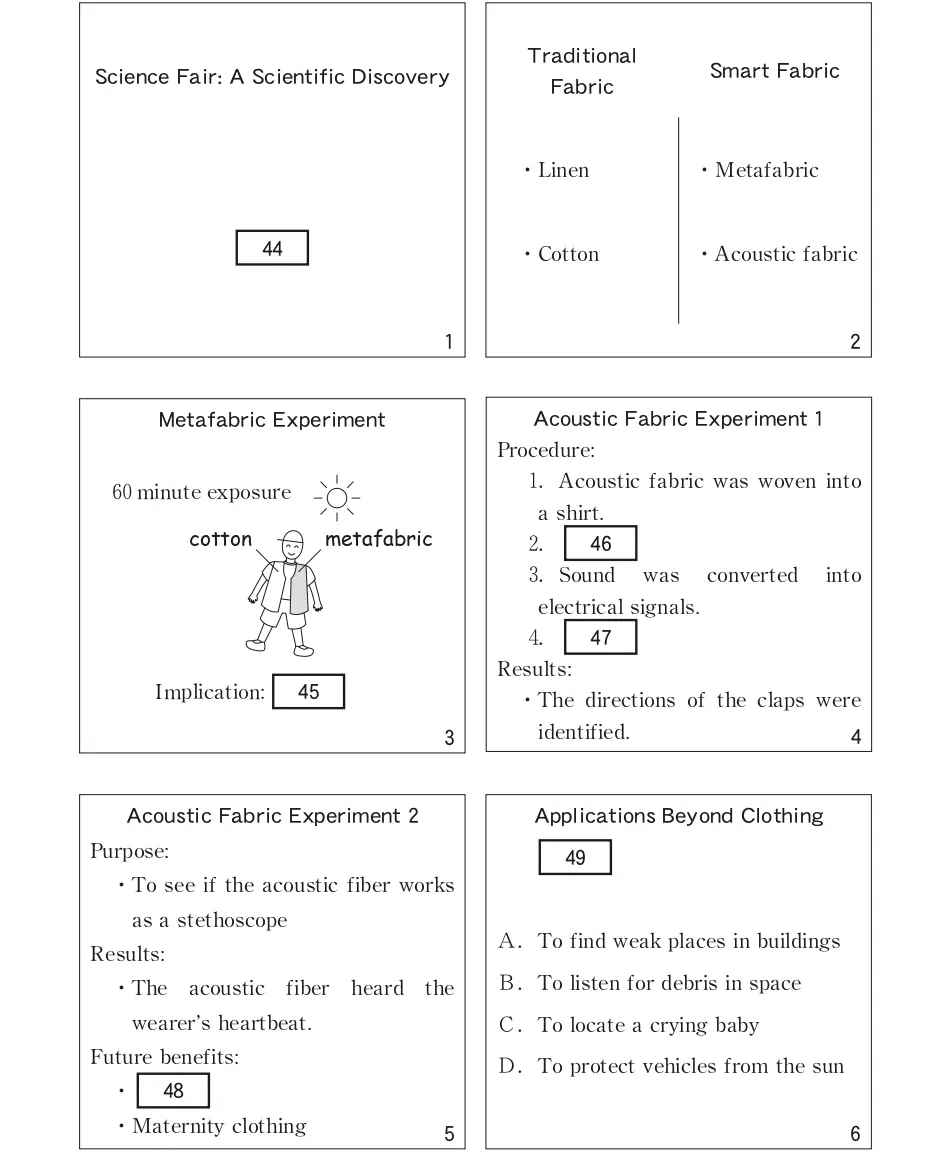
You are preparing for a science fair presentation on a scientific discovery, using the following magazine article.
”Smart” Fabrics
Through the years, the fabrics we use have evolved to suit our changing lifestyles and needs. Linen, made from the fibers of a plant called flax, is one of the oldest textiles in the world. It naturally reflects away the sun and its intense heat, and allows better airflow than other types of fabric. Light and airy, linen has long been the ideal fabric for warm climates. With industrialization and population growth, however, cotton became more commonly used since it was suitable for mass production. Cloth made from cotton can be heavy and can trap body heat though, which may make people feel uncomfortable in very hot and humid weather.
Newer materials are always being developed as technology progresses, and ”smart” fabrics are a recent scientific breakthrough in the textile industry. Weaving flexible synthetic fibers into cloth can provide additional functions for the fabric. For example, scientists at the Huazhong University of Science and Technology made a new fabric called ”metafabric” that deflects heat to keep people cooler. Such fabric can be used to create clothes that ease the discomfort people suffer when the temperature rises. In their experiment, a participant wore a vest consisting of two halves―one half cotton and the other half metafabric―and was exposed to direct sunlight for an hour. Underneath the cotton, the skin temperature soared to 37℃. In contrast, underneath the metafabric, the temperature rose by just one degree, from 31℃ to 32℃.
Another interesting example is a fabric that can detect sounds. The human ear picks up sound pressures, and the inner organs convert sound waves into mechanical vibrations and then into electrical signals. Similarly, ”piezoelectric materials,” which are typically used for microphones or speakers,produce an electrical signal when mechanically bent.
Using this knowledge, a team of researchers at the Massachusetts Institute of Technology and the Rhode Island School of Design came up with a so−called ”acoustic fabric.” The researchers wove a piezoelectric fiber into fabric and conducted a series of experiments. One experiment examined the fabric’s sensitivity to sound directions. They sewed two pieces of acoustic fabric onto the back of a shirt. Then, they clapped their hands at various angles away from the shirt. The fiber converted the sound first into mechanical vibrations, then into electrical signals that were stored on a device. The fabric was successfully able to pinpoint the angle of the sounds. This could lead to a useful application for individuals with hearing aids to identify the direction of a specific sound even in noisy surroundings.
In addition to functioning as wearable hearing aids, acoustic fabric can be used for other purposes such as tracking respiratory(lung), pulse, and cardiac(heart)conditions. Another experiment tested whether clothes with acoustic fibers could act as fabric stethoscopes to monitor a person’s subtle cardiac features. The research group attached a single fiber over the chest region on a shirt and found it accurately detected the wearer’s heart signals. Furthermore, this result indicated the possibility of utilizing the fabric in maternity clothes to check an unborn baby’s heartbeat.
Researchers see applications of smart fabrics beyond clothing. A smart fabric with cooling performance can be applied to various products for different purposes, such as tents, car covers, curtains, and sunshade products. Acoustic fabrics can be integrated with spacecraft coatings to monitor cosmic debris, or be used to help detect cracks or strains in buildings. They can even be woven into a net to check on fish in the sea.
As these examples of textile innovation suggest, new fabrics can enhance our lives in many ways. You may not believe this, but the coolest things about these fabrics are that you can get ”smart” while wearing them and some of them are machine−washable!
You found an error on Slide 6. Which of the following should you remove?( 49 )
Your slides:
このページは閲覧用ページです。
履歴を残すには、 「新しく出題する(ここをクリック)」 をご利用ください。
問題
共通テスト(英語)試験 令和6年度(2024年度)追・再試験 問49(<旧課程>英語リーディング(第6問) 問11) (訂正依頼・報告はこちら)
次の英文や図表を読み、最も適当な選択肢を選びなさい。
You are preparing for a science fair presentation on a scientific discovery, using the following magazine article.
”Smart” Fabrics
Through the years, the fabrics we use have evolved to suit our changing lifestyles and needs. Linen, made from the fibers of a plant called flax, is one of the oldest textiles in the world. It naturally reflects away the sun and its intense heat, and allows better airflow than other types of fabric. Light and airy, linen has long been the ideal fabric for warm climates. With industrialization and population growth, however, cotton became more commonly used since it was suitable for mass production. Cloth made from cotton can be heavy and can trap body heat though, which may make people feel uncomfortable in very hot and humid weather.
Newer materials are always being developed as technology progresses, and ”smart” fabrics are a recent scientific breakthrough in the textile industry. Weaving flexible synthetic fibers into cloth can provide additional functions for the fabric. For example, scientists at the Huazhong University of Science and Technology made a new fabric called ”metafabric” that deflects heat to keep people cooler. Such fabric can be used to create clothes that ease the discomfort people suffer when the temperature rises. In their experiment, a participant wore a vest consisting of two halves―one half cotton and the other half metafabric―and was exposed to direct sunlight for an hour. Underneath the cotton, the skin temperature soared to 37℃. In contrast, underneath the metafabric, the temperature rose by just one degree, from 31℃ to 32℃.
Another interesting example is a fabric that can detect sounds. The human ear picks up sound pressures, and the inner organs convert sound waves into mechanical vibrations and then into electrical signals. Similarly, ”piezoelectric materials,” which are typically used for microphones or speakers,produce an electrical signal when mechanically bent.
Using this knowledge, a team of researchers at the Massachusetts Institute of Technology and the Rhode Island School of Design came up with a so−called ”acoustic fabric.” The researchers wove a piezoelectric fiber into fabric and conducted a series of experiments. One experiment examined the fabric’s sensitivity to sound directions. They sewed two pieces of acoustic fabric onto the back of a shirt. Then, they clapped their hands at various angles away from the shirt. The fiber converted the sound first into mechanical vibrations, then into electrical signals that were stored on a device. The fabric was successfully able to pinpoint the angle of the sounds. This could lead to a useful application for individuals with hearing aids to identify the direction of a specific sound even in noisy surroundings.
In addition to functioning as wearable hearing aids, acoustic fabric can be used for other purposes such as tracking respiratory(lung), pulse, and cardiac(heart)conditions. Another experiment tested whether clothes with acoustic fibers could act as fabric stethoscopes to monitor a person’s subtle cardiac features. The research group attached a single fiber over the chest region on a shirt and found it accurately detected the wearer’s heart signals. Furthermore, this result indicated the possibility of utilizing the fabric in maternity clothes to check an unborn baby’s heartbeat.
Researchers see applications of smart fabrics beyond clothing. A smart fabric with cooling performance can be applied to various products for different purposes, such as tents, car covers, curtains, and sunshade products. Acoustic fabrics can be integrated with spacecraft coatings to monitor cosmic debris, or be used to help detect cracks or strains in buildings. They can even be woven into a net to check on fish in the sea.
As these examples of textile innovation suggest, new fabrics can enhance our lives in many ways. You may not believe this, but the coolest things about these fabrics are that you can get ”smart” while wearing them and some of them are machine−washable!
You found an error on Slide 6. Which of the following should you remove?( 49 )
Your slides:
You are preparing for a science fair presentation on a scientific discovery, using the following magazine article.
”Smart” Fabrics
Through the years, the fabrics we use have evolved to suit our changing lifestyles and needs. Linen, made from the fibers of a plant called flax, is one of the oldest textiles in the world. It naturally reflects away the sun and its intense heat, and allows better airflow than other types of fabric. Light and airy, linen has long been the ideal fabric for warm climates. With industrialization and population growth, however, cotton became more commonly used since it was suitable for mass production. Cloth made from cotton can be heavy and can trap body heat though, which may make people feel uncomfortable in very hot and humid weather.
Newer materials are always being developed as technology progresses, and ”smart” fabrics are a recent scientific breakthrough in the textile industry. Weaving flexible synthetic fibers into cloth can provide additional functions for the fabric. For example, scientists at the Huazhong University of Science and Technology made a new fabric called ”metafabric” that deflects heat to keep people cooler. Such fabric can be used to create clothes that ease the discomfort people suffer when the temperature rises. In their experiment, a participant wore a vest consisting of two halves―one half cotton and the other half metafabric―and was exposed to direct sunlight for an hour. Underneath the cotton, the skin temperature soared to 37℃. In contrast, underneath the metafabric, the temperature rose by just one degree, from 31℃ to 32℃.
Another interesting example is a fabric that can detect sounds. The human ear picks up sound pressures, and the inner organs convert sound waves into mechanical vibrations and then into electrical signals. Similarly, ”piezoelectric materials,” which are typically used for microphones or speakers,produce an electrical signal when mechanically bent.
Using this knowledge, a team of researchers at the Massachusetts Institute of Technology and the Rhode Island School of Design came up with a so−called ”acoustic fabric.” The researchers wove a piezoelectric fiber into fabric and conducted a series of experiments. One experiment examined the fabric’s sensitivity to sound directions. They sewed two pieces of acoustic fabric onto the back of a shirt. Then, they clapped their hands at various angles away from the shirt. The fiber converted the sound first into mechanical vibrations, then into electrical signals that were stored on a device. The fabric was successfully able to pinpoint the angle of the sounds. This could lead to a useful application for individuals with hearing aids to identify the direction of a specific sound even in noisy surroundings.
In addition to functioning as wearable hearing aids, acoustic fabric can be used for other purposes such as tracking respiratory(lung), pulse, and cardiac(heart)conditions. Another experiment tested whether clothes with acoustic fibers could act as fabric stethoscopes to monitor a person’s subtle cardiac features. The research group attached a single fiber over the chest region on a shirt and found it accurately detected the wearer’s heart signals. Furthermore, this result indicated the possibility of utilizing the fabric in maternity clothes to check an unborn baby’s heartbeat.
Researchers see applications of smart fabrics beyond clothing. A smart fabric with cooling performance can be applied to various products for different purposes, such as tents, car covers, curtains, and sunshade products. Acoustic fabrics can be integrated with spacecraft coatings to monitor cosmic debris, or be used to help detect cracks or strains in buildings. They can even be woven into a net to check on fish in the sea.
As these examples of textile innovation suggest, new fabrics can enhance our lives in many ways. You may not believe this, but the coolest things about these fabrics are that you can get ”smart” while wearing them and some of them are machine−washable!
You found an error on Slide 6. Which of the following should you remove?( 49 )
Your slides:
- A
- B
- C
- D
正解!素晴らしいです
残念...
画像拡大
この過去問の解説 (3件)
01
beyond clothingの利用方法で間違っている選択肢を選びます。
利用方法については、6段落目に説明があります。
A建物の弱い場所を見つけること
不正解です。
Acoustic fabrics can(中略)be used to help detect cracks or strains in buildings
建物のひびや負担を見つけるのに使えるとあるため、利用方法として正しいです。
B宇宙で破片の音を聞くこと
不正解です。
Acoustic fabrics can be integrated with spacecraft coatings to monitor cosmic debris
宇宙船のコーティングと統合されて宇宙ゴミを観察することができるとあるため、利用方法として正しいです。
C泣いている赤ちゃんの場所を突き止める
正解です。
本文に記載がありません。
D自動車を太陽光から守る
不正解です。
A smart fabric with cooling performance can be applied to(中略) such as tents, car covers, curtains, and sunshade products.
サンシェードとして使えるとあるため、利用方法として正しいです。
参考になった数0
この解説の修正を提案する
02
問の訳は以下の通りです。
スライド6に誤りが見つかりました。次のうちどれを削除すればよいですか?(49)
衣服以外の用途
49
A. 建物の脆弱な部分を見つける
B. 宇宙空間のゴミを音で検知する
C. 泣いている赤ちゃんを見つける
D. 車を太陽光から守る
選択肢を確認する前に、本文の最終の6,7段落を確認しましょう。
研究者たちは、スマートファブリックの用途を衣類以外にも広げようとしています。冷却性能を備えたスマートファブリックは、テント、車のカバー、カーテン、サンシェードなど、様々な用途の製品に応用できます。アコースティックファブリックは、宇宙船のコーティングに組み込むことで宇宙ゴミを監視したり、建物の亀裂やひび割れの検出に役立てたりすることができます。さらには、網に織り込んで海の魚の様子を確認することも可能です。
これらの繊維の革新の例が示すように、新しいファブリックは私たちの生活を様々な方法で豊かにすることができます。信じられないかもしれませんが、これらのファブリックの最も素晴らしい点は、着用しながら「スマート」になれること、そして洗濯機で洗えるものがあることです。
これを踏まえ、各選択肢を確認しましょう。
A. 建物の脆弱な部分を見つける
be used to help detect cracks or strains in buildings.(建物の亀裂やひび割れの検出)に役立てられると記載があるため、正解です。
B. 宇宙空間のゴミを音で検知する
Acoustic fabrics can be integrated with spacecraft coatings to monitor cosmic debris(アコースティックファブリックは、宇宙船のコーティングに組み込むことで宇宙ゴミを監視)できるので、正解です。
C. 泣いている赤ちゃんを見つける
第5段落にcheck an unborn baby’s heartbeat.(胎児の心拍を確認する)ことに活用できることはは分かりますが、泣いている赤ちゃんへの使用は言及されていないため、不正解です。
D. 車を太陽光から守る
A smart fabric with cooling performance can be applied to various products for different purposes, such as tents, car covers, curtains, and sunshade products.
冷却性能を備えたスマートファブリックは、テント、車のカバー、カーテン、サンシェード製品など、さまざまな目的の製品に応用できます。
と記載があり、車を守る冷却機能としても応用が利くことがわかります。よって正解です。
この問題では、当てはまらないものを選ばなければいけないので、正解はCとなります。
参考になった数0
この解説の修正を提案する
03
設問では、
スライド6にある衣服以外の応用例の中で、本文の内容と一致しないものを選ぶ問題です。
To find weak places in buildings
→正しい
「建物のひび割れや歪みを検知する(detect cracks or strains in buildings)」と書かれています。
To listen for debris in space
→正しい
本文には「宇宙ゴミ(cosmic debris)を監視するために宇宙船のコーティングと統合できる」と書かれています。
To locate a crying baby
→間違い
本文には、音響効果を持つ生地を「赤ちゃんの心拍(unborn baby's heartbeat)を確認するマタニティウェア」に利用できる可能性については触れられているものの、「泣いている赤ちゃんの場所を特定する」とは書かれていません。
To protect vehicles from the sun
→正しい
本文には「冷却性能を持つ布は、カーカバー(car covers)などの製品に応用できる」と書かれています。
参考になった数0
この解説の修正を提案する
前の問題(問48)へ
令和6年度(2024年度)追・再試験 問題一覧
次の問題(問50)へ