
共通テスト(英語) 過去問
令和6年度(2024年度)追・再試験
問77 (<旧課程>英語リスニング(第5問) 問2)
問題文
次の講義を読み、問に答えなさい。
<状況>
あなたは大学で、農業用ロボットに関する講義を、ワークシートにメモを取りながら聞いています。
Today, we will learn about robots in agriculture. Robots are already used for planting, harvesting, and other jobs. Now, farm workers are retiring and there are not enough workers to take their place. Robots have the potential to help with this labor shortage and improve agricultural production. Let’s look at the apple industry and consider how robots can help with manual work and decision− making.
On apple farms in the U.S., both robots and humans do manual work. Now, robots are slower than humans at picking apples. However, in the future, advanced robots will be more effective because they will be able to keep working without a break, unlike humans. As technology improves, robots will better assist people in doing routine manual work like picking apples.
Currently, humans rather than robots make decisions. For example, farmers do an amazing job of anticipating how many apples they can harvest each year. However, even growers with a lot of experience are not always accurate and this can cause financial loss. In the future, data−collecting robots and AI are expected to work together to make more precise predictions about apple harvesting.
Does this mean all work, including non−routine work, will be done by robots? No, not at all. Some non−routine decision−making work and some manual work will still be done by humans. For example, robots have difficulty picking apples from trees of different shapes and sizes. Humans will still need to manage the trees by deciding the best shapes for harvesting, and cut the trees by hand.
Our first team will talk about the connection between robots and different types of agricultural work. Team 1, please start.
ワークシートの空欄( 28 )に入れるのに最も適切なものを、六つの選択肢のうちから一つ選びなさい。
ワークシート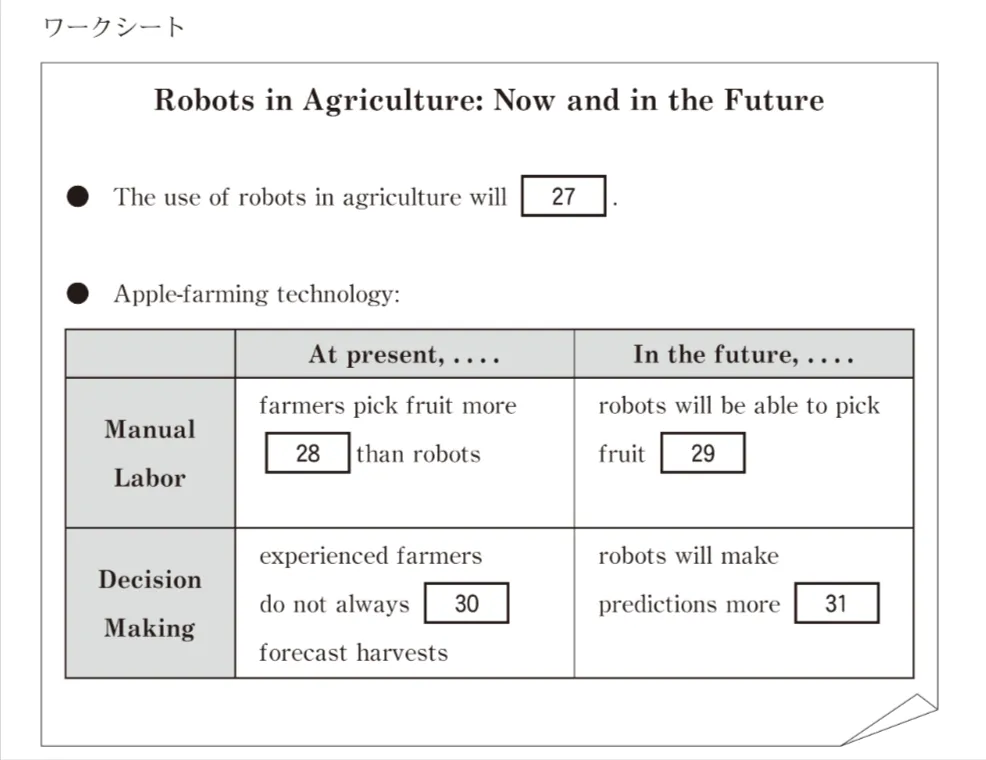
<状況>
あなたは大学で、農業用ロボットに関する講義を、ワークシートにメモを取りながら聞いています。
Today, we will learn about robots in agriculture. Robots are already used for planting, harvesting, and other jobs. Now, farm workers are retiring and there are not enough workers to take their place. Robots have the potential to help with this labor shortage and improve agricultural production. Let’s look at the apple industry and consider how robots can help with manual work and decision− making.
On apple farms in the U.S., both robots and humans do manual work. Now, robots are slower than humans at picking apples. However, in the future, advanced robots will be more effective because they will be able to keep working without a break, unlike humans. As technology improves, robots will better assist people in doing routine manual work like picking apples.
Currently, humans rather than robots make decisions. For example, farmers do an amazing job of anticipating how many apples they can harvest each year. However, even growers with a lot of experience are not always accurate and this can cause financial loss. In the future, data−collecting robots and AI are expected to work together to make more precise predictions about apple harvesting.
Does this mean all work, including non−routine work, will be done by robots? No, not at all. Some non−routine decision−making work and some manual work will still be done by humans. For example, robots have difficulty picking apples from trees of different shapes and sizes. Humans will still need to manage the trees by deciding the best shapes for harvesting, and cut the trees by hand.
Our first team will talk about the connection between robots and different types of agricultural work. Team 1, please start.
ワークシートの空欄( 28 )に入れるのに最も適切なものを、六つの選択肢のうちから一つ選びなさい。
ワークシート
このページは閲覧用ページです。
履歴を残すには、 「新しく出題する(ここをクリック)」 をご利用ください。
問題
共通テスト(英語)試験 令和6年度(2024年度)追・再試験 問77(<旧課程>英語リスニング(第5問) 問2) (訂正依頼・報告はこちら)
次の講義を読み、問に答えなさい。
<状況>
あなたは大学で、農業用ロボットに関する講義を、ワークシートにメモを取りながら聞いています。
Today, we will learn about robots in agriculture. Robots are already used for planting, harvesting, and other jobs. Now, farm workers are retiring and there are not enough workers to take their place. Robots have the potential to help with this labor shortage and improve agricultural production. Let’s look at the apple industry and consider how robots can help with manual work and decision− making.
On apple farms in the U.S., both robots and humans do manual work. Now, robots are slower than humans at picking apples. However, in the future, advanced robots will be more effective because they will be able to keep working without a break, unlike humans. As technology improves, robots will better assist people in doing routine manual work like picking apples.
Currently, humans rather than robots make decisions. For example, farmers do an amazing job of anticipating how many apples they can harvest each year. However, even growers with a lot of experience are not always accurate and this can cause financial loss. In the future, data−collecting robots and AI are expected to work together to make more precise predictions about apple harvesting.
Does this mean all work, including non−routine work, will be done by robots? No, not at all. Some non−routine decision−making work and some manual work will still be done by humans. For example, robots have difficulty picking apples from trees of different shapes and sizes. Humans will still need to manage the trees by deciding the best shapes for harvesting, and cut the trees by hand.
Our first team will talk about the connection between robots and different types of agricultural work. Team 1, please start.
ワークシートの空欄( 28 )に入れるのに最も適切なものを、六つの選択肢のうちから一つ選びなさい。
ワークシート
<状況>
あなたは大学で、農業用ロボットに関する講義を、ワークシートにメモを取りながら聞いています。
Today, we will learn about robots in agriculture. Robots are already used for planting, harvesting, and other jobs. Now, farm workers are retiring and there are not enough workers to take their place. Robots have the potential to help with this labor shortage and improve agricultural production. Let’s look at the apple industry and consider how robots can help with manual work and decision− making.
On apple farms in the U.S., both robots and humans do manual work. Now, robots are slower than humans at picking apples. However, in the future, advanced robots will be more effective because they will be able to keep working without a break, unlike humans. As technology improves, robots will better assist people in doing routine manual work like picking apples.
Currently, humans rather than robots make decisions. For example, farmers do an amazing job of anticipating how many apples they can harvest each year. However, even growers with a lot of experience are not always accurate and this can cause financial loss. In the future, data−collecting robots and AI are expected to work together to make more precise predictions about apple harvesting.
Does this mean all work, including non−routine work, will be done by robots? No, not at all. Some non−routine decision−making work and some manual work will still be done by humans. For example, robots have difficulty picking apples from trees of different shapes and sizes. Humans will still need to manage the trees by deciding the best shapes for harvesting, and cut the trees by hand.
Our first team will talk about the connection between robots and different types of agricultural work. Team 1, please start.
ワークシートの空欄( 28 )に入れるのに最も適切なものを、六つの選択肢のうちから一つ選びなさい。
ワークシート
- accurately
- actively
- continuously
- expectedly
- quickly
- slowly
正解!素晴らしいです
残念...
画像拡大
この過去問の解説 (3件)
01
正しい選択肢は、quicklyです。
空欄(28)は、現在のリンゴ収穫において、人間がロボットよりどのようにリンゴを摘むかを表す語を入れる問題です。講義では、robots are slower than humans at picking apples「ロボットはリンゴを摘むのが人間より遅い」と説明されています。つまり、人間はロボットより速くリンゴを摘むということです。
これは講義の内容と合いません。
accuratelyは「正確に」という意味です。講義では、収穫量の予測をより正確にする話は出ていますが、空欄(28)で問われているのは、リンゴを摘む作業の速さです。そのため、この語は合いません。
これは講義の内容と合いません。
activelyは「活発に」という意味です。講義では、人間がロボットより活発にリンゴを摘むとは言っていません。比べられているのは、活発さではなく、摘む速さです。
これは講義の内容と合いません。
continuouslyは「続けて、絶え間なく」という意味です。講義では、将来の高度なロボットは休憩なしで働き続けられると説明されています。しかし、空欄(28)は現在の人間とロボットの比較なので、人間が休まず続けて働くという意味ではありません。
これは講義の内容と合いません。
expectedlyは「予想どおりに」という意味です。講義では、予測の正確さについての話はありますが、空欄(28)では、リンゴを摘む作業の速さが問われています。そのため、この語は合いません。
これは講義の内容に合っています。
講義では、現在、ロボットはリンゴを摘むのが人間より遅いと説明されています。言いかえると、人間はロボットより速くリンゴを摘むということです。
そのため、空欄(28)にはquicklyが入ります。
これは講義の内容と合いません。
slowlyは「ゆっくりと」という意味です。講義では、遅いのはロボットのほうだと説明されています。人間のほうが遅いわけではないので、この語は合いません。
この問題では、robots are slower than humans at picking applesという文が大きな手がかりです。
これは「ロボットはリンゴを摘むのが人間より遅い」という意味です。つまり、現在は人間のほうがロボットより速くリンゴを摘むことができます。
したがって、空欄(28)に入る最も適切な選択肢は、quicklyです。
参考になった数0
この解説の修正を提案する
02
日本語訳第2段落
アメリカのリンゴ農場では、ロボットと人間の両方が手作業を行っています。現時点では、リンゴを収穫する速度において、ロボットは人間よりも遅いです。しかし将来、高度なロボットは、人間とは異なり休憩なしで働き続けることができるため、より効果的になるでしょう。技術が向上するにつれて、ロボットはリンゴの収穫のような日常的な手作業において、より良く人々を支援するようになります。
訳)正確に
→間違い
意思決定のセクションで「収穫予測の正確さ」については触れていますが、
収穫作業そのものの速度の比較には合いません。
訳)活発に
→間違い
作業の熱心さではなく、能力や速度の比較がこの設問で問われていることです。
訳)絶え間なく
→間違い
将来のロボットの特徴として「休憩なしで(without a break)」と書かれていますが、現在の人間側の特徴ではありません。
訳)期待通りに
→間違い
能力や速度の比較がこの設問で問われていることです。
訳)速く
→正しい
「ロボットは人間より遅い」ということは、
言い換えれば「人間(農家)はロボットよりも速く(quickly)収穫する」
ということになります。
よって、quickly が正解です。
訳)ゆっくりと
→間違い
人間の方が早いため間違いです。
参考になった数0
この解説の修正を提案する
03
まず表をしっかりと見ておきましょう。
この問題のポイントは
①現在(At present)
②手作業(Manual labor)
そして、「農業者はロボットより( 28 )果物を摘む」という内容です。
以上の点を意識しながら聴くと、
both robots and humans do manual work.(ロボットと人間の両方とも手作業をします)
という1文が読まれます。
manual work=manual labor であるため、解答に関連がありそうだと予測できます。
その次の文に、
Now, robots are slower than humans at picking apples.
(今、ロボットはリンゴを摘むのが人間より遅い)
とあります。
この「now」も大きなヒントとなり、解答を導くことができます。
「正確に」
Now, robots are slower than humans at picking apples.
(今、ロボットはリンゴを摘むのが人間より遅い)
から不正解
「活発に」
Now, robots are slower than humans at picking apples.
(今、ロボットはリンゴを摘むのが人間より遅い)
から不正解
「継続的に」
Now, robots are slower than humans at picking apples.
(今、ロボットはリンゴを摘むのが人間より遅い)
から不正解
「期待通りに」
Now, robots are slower than humans at picking apples.
(今、ロボットはリンゴを摘むのが人間より遅い)
から不正解
正解 「素早く」
Now, robots are slower than humans at picking apples.
(今、ロボットはリンゴを摘むのが人間より遅い)
ということは、問題文のfarmersは「より素速く」摘むことができるということになります。
「ゆっくりと」
Now, robots are slower than humans at picking apples.
(今、ロボットはリンゴを摘むのが人間より遅い)
から不正解です。
主語の違いに注意しましょう。
表のキーワードに反応できるように意識しましょう。
参考になった数0
この解説の修正を提案する
前の問題(問76)へ
令和6年度(2024年度)追・再試験 問題一覧
次の問題(問78)へ