
共通テスト(英語) 過去問
令和7年度(2025年度)追・再試験
問71 (英語リスニング(第5問) 問1)
問題文
最初に講義を聞き、問いに答えなさい。
<状況>
あなたは、大学で都市計画に関する科目を履修していて、一連の活動(活動1,2,3)に取り組んでいます。
<活動1>
あなたは、ワークシートにメモを取りながら、講義を聞いています。
In our last class, we looked at how climate change is presenting challenges for cities across the globe. Today we will focus on what city planners are doing to deal with extreme heat in cities. To reduce temperatures, urban designers are adding “passive cooling” elements. This means designing and redeveloping greenery, streets, and buildings in specific ways to reduce heat in the city.
Greenery, or “green coverage,” includes parks, gardens, trees, and other types of vegetation that provide shade. A study conducted in Melbourne, Australia, suggests a 10 percent increase in green coverage could reduce daytime temperatures by 1 degree Celsius. Other advantages are better psychological health for residents and a richer variety of wildlife.
The layout of streets can play an important role in passive cooling. By placing streets in line with local wind patterns, air can flow easily through a city, lowering the temperature. One study shows that tropical cities like Singapore could benefit from having streets arranged so that ocean winds move through them, cooling the city off. Additionally, good wind flow decreases air pollution, improving residents’ health.
Building design can also affect city temperatures. Many studies recommend the use of buildings of various heights. High−rise buildings create shade and low−rise buildings allow wind to blow hot air away. In tropical cities near the ocean, like Manila in the Philippines, low−rise buildings should be built near the shore so breezes reach the inside of the city. As an added benefit, buildings of various sizes make the city visually attractive.
These are some ways that good use of urban design can help cool our cities and make them better places to live.
ワークシートの空欄( 27 )に入れるのに最も適切なものを、四つの選択肢のうちから一つ選びなさい。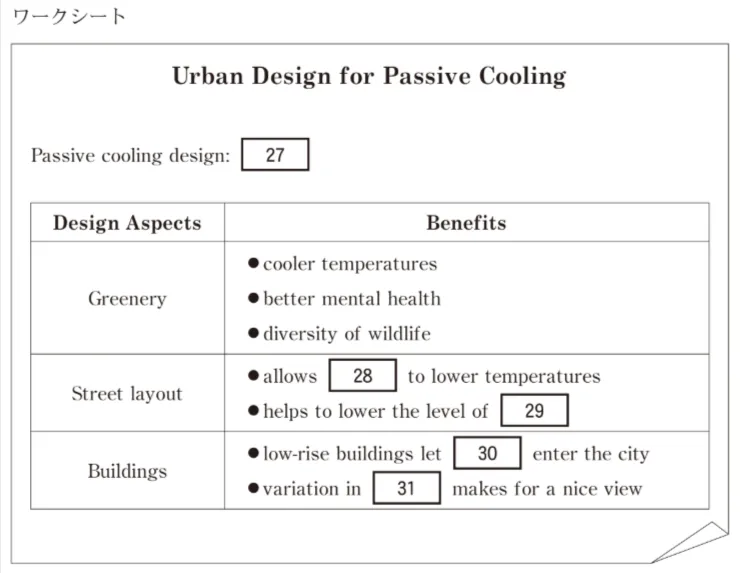
<状況>
あなたは、大学で都市計画に関する科目を履修していて、一連の活動(活動1,2,3)に取り組んでいます。
<活動1>
あなたは、ワークシートにメモを取りながら、講義を聞いています。
In our last class, we looked at how climate change is presenting challenges for cities across the globe. Today we will focus on what city planners are doing to deal with extreme heat in cities. To reduce temperatures, urban designers are adding “passive cooling” elements. This means designing and redeveloping greenery, streets, and buildings in specific ways to reduce heat in the city.
Greenery, or “green coverage,” includes parks, gardens, trees, and other types of vegetation that provide shade. A study conducted in Melbourne, Australia, suggests a 10 percent increase in green coverage could reduce daytime temperatures by 1 degree Celsius. Other advantages are better psychological health for residents and a richer variety of wildlife.
The layout of streets can play an important role in passive cooling. By placing streets in line with local wind patterns, air can flow easily through a city, lowering the temperature. One study shows that tropical cities like Singapore could benefit from having streets arranged so that ocean winds move through them, cooling the city off. Additionally, good wind flow decreases air pollution, improving residents’ health.
Building design can also affect city temperatures. Many studies recommend the use of buildings of various heights. High−rise buildings create shade and low−rise buildings allow wind to blow hot air away. In tropical cities near the ocean, like Manila in the Philippines, low−rise buildings should be built near the shore so breezes reach the inside of the city. As an added benefit, buildings of various sizes make the city visually attractive.
These are some ways that good use of urban design can help cool our cities and make them better places to live.
ワークシートの空欄( 27 )に入れるのに最も適切なものを、四つの選択肢のうちから一つ選びなさい。
このページは閲覧用ページです。
履歴を残すには、 「新しく出題する(ここをクリック)」 をご利用ください。
問題
反映中…
共通テスト(英語)試験 令和7年度(2025年度)追・再試験 問71(英語リスニング(第5問) 問1) (訂正依頼・報告はこちら)
最初に講義を聞き、問いに答えなさい。
<状況>
あなたは、大学で都市計画に関する科目を履修していて、一連の活動(活動1,2,3)に取り組んでいます。
<活動1>
あなたは、ワークシートにメモを取りながら、講義を聞いています。
In our last class, we looked at how climate change is presenting challenges for cities across the globe. Today we will focus on what city planners are doing to deal with extreme heat in cities. To reduce temperatures, urban designers are adding “passive cooling” elements. This means designing and redeveloping greenery, streets, and buildings in specific ways to reduce heat in the city.
Greenery, or “green coverage,” includes parks, gardens, trees, and other types of vegetation that provide shade. A study conducted in Melbourne, Australia, suggests a 10 percent increase in green coverage could reduce daytime temperatures by 1 degree Celsius. Other advantages are better psychological health for residents and a richer variety of wildlife.
The layout of streets can play an important role in passive cooling. By placing streets in line with local wind patterns, air can flow easily through a city, lowering the temperature. One study shows that tropical cities like Singapore could benefit from having streets arranged so that ocean winds move through them, cooling the city off. Additionally, good wind flow decreases air pollution, improving residents’ health.
Building design can also affect city temperatures. Many studies recommend the use of buildings of various heights. High−rise buildings create shade and low−rise buildings allow wind to blow hot air away. In tropical cities near the ocean, like Manila in the Philippines, low−rise buildings should be built near the shore so breezes reach the inside of the city. As an added benefit, buildings of various sizes make the city visually attractive.
These are some ways that good use of urban design can help cool our cities and make them better places to live.
ワークシートの空欄( 27 )に入れるのに最も適切なものを、四つの選択肢のうちから一つ選びなさい。
<状況>
あなたは、大学で都市計画に関する科目を履修していて、一連の活動(活動1,2,3)に取り組んでいます。
<活動1>
あなたは、ワークシートにメモを取りながら、講義を聞いています。
In our last class, we looked at how climate change is presenting challenges for cities across the globe. Today we will focus on what city planners are doing to deal with extreme heat in cities. To reduce temperatures, urban designers are adding “passive cooling” elements. This means designing and redeveloping greenery, streets, and buildings in specific ways to reduce heat in the city.
Greenery, or “green coverage,” includes parks, gardens, trees, and other types of vegetation that provide shade. A study conducted in Melbourne, Australia, suggests a 10 percent increase in green coverage could reduce daytime temperatures by 1 degree Celsius. Other advantages are better psychological health for residents and a richer variety of wildlife.
The layout of streets can play an important role in passive cooling. By placing streets in line with local wind patterns, air can flow easily through a city, lowering the temperature. One study shows that tropical cities like Singapore could benefit from having streets arranged so that ocean winds move through them, cooling the city off. Additionally, good wind flow decreases air pollution, improving residents’ health.
Building design can also affect city temperatures. Many studies recommend the use of buildings of various heights. High−rise buildings create shade and low−rise buildings allow wind to blow hot air away. In tropical cities near the ocean, like Manila in the Philippines, low−rise buildings should be built near the shore so breezes reach the inside of the city. As an added benefit, buildings of various sizes make the city visually attractive.
These are some ways that good use of urban design can help cool our cities and make them better places to live.
ワークシートの空欄( 27 )に入れるのに最も適切なものを、四つの選択肢のうちから一つ選びなさい。
- an effort to save energy by developing cool buildings and streets
- new types of temperature−control systems for buildings
- the design of transportation technology to avoid extreme heat
- the use of nature along with city planning to decrease temperatures
正解!素晴らしいです
残念...
画像拡大
この過去問の解説 (3件)
01
リスニングの問題である事を踏まえて解答を作成していきます。
少し長めの英文を聴いて各空欄を埋める形式になっています。
空欄(27)は “passive cooling” の概略を述べるものです。
This means designing and redeveloping greenery, streets, and buildings in specific ways to reduce heat in the city. の部分が最大のヒントになります。
mean:意味する
redevelop:re(再)+ develop(発展させる、開発する)
reduce:減らす
greenery は聞き慣れない語かと思われます。
何となく予想は付くかもしれませんが、次に説明があります。
Greenery, or “green coverage, ” includes parks, gardens, trees, and other types of vegetation that provide shade.
つまり影を作る(provide:提供する)木などやその他の植生・植物(vegetation)の事を指しています。
選択肢を素早く見ていくと、
"the use of nature along with city planning to decrease temperatures"
が正しい選択肢だと判定できます。nature の部分が "greenery" に相当する事になります。
an effort to save energy by developing cool buildings and streets
"developing cool buildings and streets" の部分が説明の英文になく、
"cool buildings and streets" の具体性も不明瞭です。
この選択肢は不適切です。
new types of temperature−control systems for buildings
この選択肢の文章の中には "greenery" の内容が含まれていません。
また説明の英文を後半部分まで聴くと影や風通しの話が中心であり、
その内容に合わない事になります。
temperature:温度
この選択肢は不適切です。
the design of transportation technology to avoid extreme heat
この文章の中には "greenery" の内容が含まれておらず。
また説明の英文を後半部分まで聴くと影や風通しの話が中心であり、
"transportation technology" の話はでてきません。
transportation:①交通機関、交通のシステム ②乗り物
この選択肢は不適切です。
the use of nature along with city planning to decrease temperatures
nature:自然
along with:~とともに、~と並行して
decrease:減らす(reduce とほぼ同義で使われています。)
この選択肢の文章には、
"This means designing and redeveloping greenery, streets, and buildings in specific ways to reduce heat in the city." の説明の概略が含まれています。
・the use of nature → designing and redeveloping "greenery"
・city planning → designing and redeveloping … streets, and buildings
これら2つが along with で結ばれたものが選択肢の内容になります。
そのため、この選択肢が空欄(27)に入ります。
本設問で特に知っておきたい語句は、mean, develop, reduce, vegetation, transportation, temperature, nature, decrease, along with などです。
"greenery" については英文で説明がありますので、単語の意味を知っておく事よりも、むしろ英文での説明を聴いて意味を把握する事が重要となります。
誤った選択肢については、内容をひとつひとつ精査するというよりは、
説明の英文になかったものを見て手早く解答の候補から外していく事が望ましいかと思われます。
参考になった数0
この解説の修正を提案する
02
正しい選択肢は、「the use of nature along with city planning to decrease temperatures」です。
この問題は、講義で説明されているpassive coolingの意味を選ぶ問題です。本文では、都市の気温を下げるために、緑、道路、建物を工夫して設計することが説明されています。つまり、自然の力と都市計画を組み合わせて、暑さをやわらげる方法を指しています。
これは適切ではありません。
この選択肢は、「涼しい建物や道路を作ってエネルギーを節約する取り組み」という意味です。
本文では、都市の温度を下げるために建物や道路を工夫する話は出ています。しかし、中心となっている説明はエネルギー節約ではなく、都市の暑さを下げることです。
そのため、本文の内容を正しくまとめた表現としては少しずれています。
これは適切ではありません。
この選択肢は、「建物用の新しい温度調整システム」という意味です。
しかし、本文で説明されているpassive coolingは、エアコンのような機械や新しいシステムの話ではありません。
緑を増やしたり、風が通る道路の配置にしたり、建物の高さを工夫したりする方法です。したがって、この選択肢は本文の内容と合いません。
これは適切ではありません。
この選択肢は、「極端な暑さを避けるための交通技術の設計」という意味です。
本文では、道路の配置については説明されていますが、それは交通技術の話ではありません。風が都市の中を通りやすくなるように、道路の向きや並び方を工夫するという内容です。
そのため、交通技術に注目したこの選択肢は適切ではありません。
これは正しいです。
この選択肢は、「気温を下げるために、自然と都市計画を組み合わせて使うこと」という意味です。
本文では、greenery(緑)、streets(道路)、buildings(建物)を工夫して、都市の暑さを下げると説明されています。
特に、緑による日かげ、風が通りやすい道路、建物の高さの工夫などが出てきます。これは、自然の力を都市計画に取り入れて気温を下げるという内容なので、本文と最もよく合っています。
この問題では、passive coolingが何を指しているかをつかむことが大切です。
passive coolingは、機械で冷やす方法ではなく、緑、風、建物の形や高さなどをうまく使って、都市の気温を下げる考え方です。
したがって、最も適切なのは「the use of nature along with city planning to decrease temperatures」です。
参考になった数0
この解説の修正を提案する
03
空所は、Passive cooling design(受動冷却設計)が何か、を選ぶ問題です。
受動冷却について述べている箇所は
To reduce temperatures, urban designers are adding “passive cooling” elements. This means designing and redeveloping greenery, streets, and buildings in specific ways to reduce heat in the city.
(気温を下げるために、都会の設計士達は、『受動冷却』の要素を追加している。これは、都市の暑さを軽減するための特殊な方法で、緑、道、そして建物を設計し再開発することを意味している。)
です。
この内容に適するものを選びます。
「涼しい建物や道を開発することにより、エネルギーを節約するための努力」
エネルギー節約が目的ではなく、都市の暑さの軽減が目的です。
「新しいタイプの建物の温度調整システム」
建物だけでなく、都市の暑さ軽減ためのものです。
「極端な暑さを避けるための交通技術の設計」
交通機関の暑さのことではありません。
正解「気温を下げることを計画している都市と自然の使用」
「受動冷却設計」緑などを再開発することで、都市の気温を下げようとするものであり、一致します。
参考になった数0
この解説の修正を提案する
前の問題(問70)へ
令和7年度(2025年度)追・再試験 問題一覧
次の問題(問72)へ