
共通テスト(英語) 過去問
令和7年度(2025年度)追・再試験
問72 (英語リスニング(第5問) 問2)
問題文
最初に講義を聞き、問いに答えなさい。
<状況>
あなたは、大学で都市計画に関する科目を履修していて、一連の活動(活動1,2,3)に取り組んでいます。
<活動1>
あなたは、ワークシートにメモを取りながら、講義を聞いています。
In our last class, we looked at how climate change is presenting challenges for cities across the globe. Today we will focus on what city planners are doing to deal with extreme heat in cities. To reduce temperatures, urban designers are adding “passive cooling” elements. This means designing and redeveloping greenery, streets, and buildings in specific ways to reduce heat in the city.
Greenery, or “green coverage,” includes parks, gardens, trees, and other types of vegetation that provide shade. A study conducted in Melbourne, Australia, suggests a 10 percent increase in green coverage could reduce daytime temperatures by 1 degree Celsius. Other advantages are better psychological health for residents and a richer variety of wildlife.
The layout of streets can play an important role in passive cooling. By placing streets in line with local wind patterns, air can flow easily through a city, lowering the temperature. One study shows that tropical cities like Singapore could benefit from having streets arranged so that ocean winds move through them, cooling the city off. Additionally, good wind flow decreases air pollution, improving residents’ health.
Building design can also affect city temperatures. Many studies recommend the use of buildings of various heights. High−rise buildings create shade and low−rise buildings allow wind to blow hot air away. In tropical cities near the ocean, like Manila in the Philippines, low−rise buildings should be built near the shore so breezes reach the inside of the city. As an added benefit, buildings of various sizes make the city visually attractive.
These are some ways that good use of urban design can help cool our cities and make them better places to live.
ワークシートの空欄( 28 )・( 29 )に入れるのに最も適切なものを、選択肢のうちから一つ選びなさい。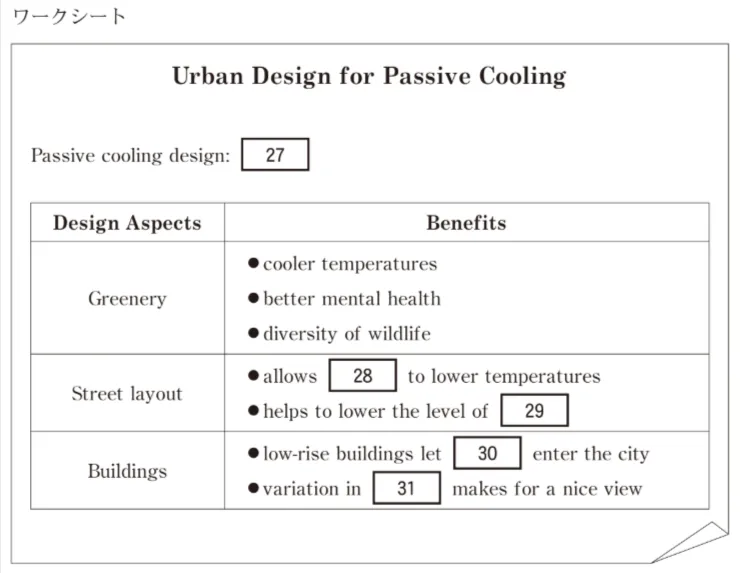
<状況>
あなたは、大学で都市計画に関する科目を履修していて、一連の活動(活動1,2,3)に取り組んでいます。
<活動1>
あなたは、ワークシートにメモを取りながら、講義を聞いています。
In our last class, we looked at how climate change is presenting challenges for cities across the globe. Today we will focus on what city planners are doing to deal with extreme heat in cities. To reduce temperatures, urban designers are adding “passive cooling” elements. This means designing and redeveloping greenery, streets, and buildings in specific ways to reduce heat in the city.
Greenery, or “green coverage,” includes parks, gardens, trees, and other types of vegetation that provide shade. A study conducted in Melbourne, Australia, suggests a 10 percent increase in green coverage could reduce daytime temperatures by 1 degree Celsius. Other advantages are better psychological health for residents and a richer variety of wildlife.
The layout of streets can play an important role in passive cooling. By placing streets in line with local wind patterns, air can flow easily through a city, lowering the temperature. One study shows that tropical cities like Singapore could benefit from having streets arranged so that ocean winds move through them, cooling the city off. Additionally, good wind flow decreases air pollution, improving residents’ health.
Building design can also affect city temperatures. Many studies recommend the use of buildings of various heights. High−rise buildings create shade and low−rise buildings allow wind to blow hot air away. In tropical cities near the ocean, like Manila in the Philippines, low−rise buildings should be built near the shore so breezes reach the inside of the city. As an added benefit, buildings of various sizes make the city visually attractive.
These are some ways that good use of urban design can help cool our cities and make them better places to live.
ワークシートの空欄( 28 )・( 29 )に入れるのに最も適切なものを、選択肢のうちから一つ選びなさい。
このページは閲覧用ページです。
履歴を残すには、 「新しく出題する(ここをクリック)」 をご利用ください。
問題
反映中…
共通テスト(英語)試験 令和7年度(2025年度)追・再試験 問72(英語リスニング(第5問) 問2) (訂正依頼・報告はこちら)
最初に講義を聞き、問いに答えなさい。
<状況>
あなたは、大学で都市計画に関する科目を履修していて、一連の活動(活動1,2,3)に取り組んでいます。
<活動1>
あなたは、ワークシートにメモを取りながら、講義を聞いています。
In our last class, we looked at how climate change is presenting challenges for cities across the globe. Today we will focus on what city planners are doing to deal with extreme heat in cities. To reduce temperatures, urban designers are adding “passive cooling” elements. This means designing and redeveloping greenery, streets, and buildings in specific ways to reduce heat in the city.
Greenery, or “green coverage,” includes parks, gardens, trees, and other types of vegetation that provide shade. A study conducted in Melbourne, Australia, suggests a 10 percent increase in green coverage could reduce daytime temperatures by 1 degree Celsius. Other advantages are better psychological health for residents and a richer variety of wildlife.
The layout of streets can play an important role in passive cooling. By placing streets in line with local wind patterns, air can flow easily through a city, lowering the temperature. One study shows that tropical cities like Singapore could benefit from having streets arranged so that ocean winds move through them, cooling the city off. Additionally, good wind flow decreases air pollution, improving residents’ health.
Building design can also affect city temperatures. Many studies recommend the use of buildings of various heights. High−rise buildings create shade and low−rise buildings allow wind to blow hot air away. In tropical cities near the ocean, like Manila in the Philippines, low−rise buildings should be built near the shore so breezes reach the inside of the city. As an added benefit, buildings of various sizes make the city visually attractive.
These are some ways that good use of urban design can help cool our cities and make them better places to live.
ワークシートの空欄( 28 )・( 29 )に入れるのに最も適切なものを、選択肢のうちから一つ選びなさい。
<状況>
あなたは、大学で都市計画に関する科目を履修していて、一連の活動(活動1,2,3)に取り組んでいます。
<活動1>
あなたは、ワークシートにメモを取りながら、講義を聞いています。
In our last class, we looked at how climate change is presenting challenges for cities across the globe. Today we will focus on what city planners are doing to deal with extreme heat in cities. To reduce temperatures, urban designers are adding “passive cooling” elements. This means designing and redeveloping greenery, streets, and buildings in specific ways to reduce heat in the city.
Greenery, or “green coverage,” includes parks, gardens, trees, and other types of vegetation that provide shade. A study conducted in Melbourne, Australia, suggests a 10 percent increase in green coverage could reduce daytime temperatures by 1 degree Celsius. Other advantages are better psychological health for residents and a richer variety of wildlife.
The layout of streets can play an important role in passive cooling. By placing streets in line with local wind patterns, air can flow easily through a city, lowering the temperature. One study shows that tropical cities like Singapore could benefit from having streets arranged so that ocean winds move through them, cooling the city off. Additionally, good wind flow decreases air pollution, improving residents’ health.
Building design can also affect city temperatures. Many studies recommend the use of buildings of various heights. High−rise buildings create shade and low−rise buildings allow wind to blow hot air away. In tropical cities near the ocean, like Manila in the Philippines, low−rise buildings should be built near the shore so breezes reach the inside of the city. As an added benefit, buildings of various sizes make the city visually attractive.
These are some ways that good use of urban design can help cool our cities and make them better places to live.
ワークシートの空欄( 28 )・( 29 )に入れるのに最も適切なものを、選択肢のうちから一つ選びなさい。
- 28:vegetation 29:stress
- 28:vegetation 29:pollution
- 28:wind 29:pollution
- 28:wind 29:stress
正解!素晴らしいです
残念...
画像拡大
この過去問の解説 (3件)
01
リスニングの問題である事を踏まえて解答を作成していきます。
少し長めの英文を聴いて各空欄を埋める形式になっています。
本設問の空欄(28)(29)は “street layout” の概略を述べるものです。
"The layout of streets can play an important role…" 以下の説明文から内容を聴きとります。
重要な部分は次の2文です。
By placing streets in line with local wind patterns, air can flow easily through a city, lowering the temperature.
(続くシンガポールでの具体例はこの文の説明を補足します。)
Additionally, good wind flow decreases air pollution, improving residents’ health.
in line with:(この表現自体を知らなくても line「線」から意味を推測しましょう。)
①~と(線状に)列を作って、~と(線状に)並んで
②~と同じ水準などに、~と一致して
flow:①【動詞】流れる ②【名詞】流れ
decrease:減る、減らす(increase:増える、増やす と合わせて覚えましょう。)
pollution:汚染
resident:住民(reside:住む)
improve:改善する
「ワークシート」では
・allows(28)to lower temperatures
・helps to lower the level of(29)
となっています。
allow ~ to …: ①~が…する事を可能にする ②~が…する事を許可する
説明の英文からは(28)には wind または air が入ると予測できるでしょう。
実際、選択肢には wind があります。
(29)には、"decreases air pollution" の説明から、
pollution またはその類語が入ると予測できます。
実際、選択肢には pollution があります。
28: wind 29:pollution の組み合わせが本設問の解答となります。
vegetation の話は1つ前の "greenery" に関する説明に関連するものです。
そのため、"street layout" には関連しない事になります。
この選択肢は不適切です。
29: pollution については正しいですが、
vegetation の話は1つ前の "greenery" に関する説明に関連するものです。
そのため、"street layout" には関連しない事になります。
この選択肢は不適切です。
"By placing streets in line with local wind patterns, air can flow easily through a city, lowering the temperature."
(続くシンガポールでの具体例では wind の語もあります。)
"Additionally, good wind flow decreases air pollution, improving residents’ health."
"air(空気)" の "flow(流れ)" は wind(風)なので、
(28)に入るのが wind になります。
allows wind to lower temperatures という表現は説明の英文に合致します。
(29)に入るのが pollution となります。
ここでは大気汚染を減らすと述べられています。
helps to lower the level of pollution という表現は説明の英文に合致します。
lower:下げる、低くする(ここでは decrease と同義で使われています。)
この選択肢は適切となります。
選ばないように注意が必要な選択肢です。
まず、28: wind については正しいです。
次に(29)についてですが、
"improving residents’ health" の説明から、
"stress(ストレス)"を下げるという事は何となく正しい感じもしてしまいます。
しかし、"improving residents’ health" は "decreases air pollution" に由来するものであり、「健康の改善」が「ストレスの軽減」に限定されない、あるいはそうであるとは限らない事になります。
したがって、(29)に stress を入れるのは不適切です。
この選択肢は不適切になります。
知っておきたい単語は、line, flow, decrease, increase, pollution, resident, allow, lower, improve などです。
"The layout of streets can play an important role…" 以下の説明文に解答の根拠となる説明がまとめられています。
そのため、使われている単語さえ知っていれば比較的答えやすい設問かと思われます。
ただし一部紛らわしい選択肢もあるので注意も必要です。
参考になった数0
この解説の修正を提案する
02
正しい選択肢は、「28:wind 29:pollution」です。
この問題は、ワークシートのStreet layout(道の配置)に関する空欄を埋める問題です。講義では、道を地域の風の流れに合わせて配置すると、風が都市の中を通りやすくなり、気温を下げると説明されています。また、よい風の流れは空気汚染を減らすとも述べられています。
これは適切ではありません。
vegetationは「植物」という意味です。講義では、植物はgreen coverage、つまり緑の多さの説明で出てきます。
しかし、空欄(28)はStreet layoutの説明にあり、道の配置によって都市の中を通るものを答える場所です。本文では、道を風の流れに合わせることで、wind(風)が気温を下げると説明されています。
また、stressは「ストレス」という意味です。緑には心理的な健康をよくする効果があると説明されていますが、Street layoutの利点として述べられているのは、air pollution(空気汚染)を減らすことです。
これは適切ではありません。
29にpollutionを入れる点は合っています。講義では、よい風の流れが空気汚染を減らすと説明されています。
しかし、28にvegetationを入れる点が合いません。道の配置によって都市の中を流れ、気温を下げるのは植物ではなく、wind(風)です。
これは正しいです。
講義では、「By placing streets in line with local wind patterns, air can flow easily through a city, lowering the temperature.」と説明されています。
これは、「道を地域の風の流れに合わせることで、空気が都市の中を通りやすくなり、気温を下げる」という意味です。したがって、28にはwindが入ります。
また、「good wind flow decreases air pollution」とあります。これは、「よい風の流れは空気汚染を減らす」という意味です。したがって、29にはpollutionが入ります。
これは適切ではありません。
28にwindを入れる点は合っています。道の配置によって都市に流れやすくなり、気温を下げるのは風です。
しかし、29にstressを入れる点が合いません。講義でStreet layoutの利点として説明されているのは、空気汚染を減らして住民の健康をよくすることです。
stressではなく、pollutionが適切です。
この問題では、ワークシートの空欄がどの項目にあるかを確認することが大切です。
空欄(28)と(29)は、緑ではなくStreet layout(道の配置)の説明です。道を地域の風の流れに合わせると、wind(風)が都市の中を通り、気温を下げます。さらに、よい風の流れはpollution(汚染)を減らします。
したがって、正しい組合せは「28:wind 29:pollution」です。
参考になった数0
この解説の修正を提案する
03
空所は、「Street layout(道の配置)」の項目にあり、その利点を選ぶことが求められています。
(28)を含む文は、
allows (28) to lower temperatures ((28)に気温を下げさせる)
(29)を含む文は、
helps to lower the level of (29). ((29)のレベルを下げるのを助ける)
となっています。
該当箇所を本文から探します。
By placing streets in line with local wind patterns, air can flow easily through a city, lowering the temperature.
(道をその地域の風のパターンに沿って配置することで、空気が都市中を簡単に流れることができ、気温を下げます。)
つまり、「風」に気温を下げさせる ということだとわかります。
したがって、(28)には、「wind」が入ります。
さらに、
Additionally, good wind flow decreases air pollution, improving residents’ health.
(さらに、良い風の流れは空気汚染を減らし、住民の健康を改善します。)
ともあり、風の流れは「汚染」のレベルを下げる と言えます。
したがって、(29)には、「pollution」が入ります。
参考になった数0
この解説の修正を提案する
前の問題(問71)へ
令和7年度(2025年度)追・再試験 問題一覧
次の問題(問74)へ