
共通テスト(英語) 過去問
令和8年度(2026年度)追・再試験
問33 (英語リーディング(第7問) 問2)
問題文
各問の英文や図表を読み、最も適当な選択肢を選びなさい。
You are using the following article to prepare for a presentation about mosquitoes in your science class.
Controlling the “World’s Deadliest Animal”
Have you ever had your outdoor event ruined by mosquitoes? Just as you are about to enjoy a lovely summer picnic, some mosquitoes come to crash the party. Although they may be merely an annoyance in Japan, globally, the story is quite different. The mosquito has been classified as the “world’s deadliest animal” by the Centers for Disease Control and Prevention(CDC) in the US. According to the World Health Organization(WHO), more than 600, 000 people are killed every year from mosquito−borne diseases such as malaria and dengue fever. However, out of the nearly 3, 700 species of mosquitoes worldwide, only a small number transmit serious diseases. For example, the Aedes mosquito is responsible for spreading dengue fever, which is common in tropical regions.
What can be done to safeguard the public? There are various strategies that governments can implement to help protect citizens from mosquitoes. Local governments need to keep accurate records about mosquitoes including the variety and the size of the mosquito population. In addition, cities and towns should inform their citizens about how to stay safe around mosquitoes. When people go outside, they should wear long sleeves to prevent bites. Around the home, any standing water where mosquitoes may breed should be removed. Also, when windows are opened, screens are necessary and should be checked for damage. Governments must also take the lead in managing mosquito populations. Traditional methods tend to include the use of industrial chemicals. These chemicals can reduce mosquito populations, but they may negatively impact the ecosystem. In response to this problem, some innovative techniques which are environmentally safer have recently become available.
One promising new discovery in mosquito control makes use of a spray that contains a surfactant. Surfactants, which are often contained in shampoo, reduce the surface tension of a liquid, which allows water and oil to mix. A Japanese company successfully incorporated this idea and produced a new mosquito spray in 2023. Normally, mosquito bodies and wings are protected by a wax−like coating. This coating prevents water from being absorbed by the mosquito. However, the new spray is able to go through this coating and allow water into the mosquito’s body. As a result, its wings get wet and it is unable to fly, making it an easy target for enemies such as ants or spiders. Furthermore, the spray covers the breathing holes on the mosquito’s body, so it is unable to breathe. Additionally, surfactants are safe for humans because they do not contain any harmful chemicals.
Recent studies on reducing the number of mosquitoes through genetic modification also seem to be encouraging. Researchers now have the technology to place a fatal gene into mosquitoes. When mosquitoes with this gene go back into the wild and mate, the newly born mosquitoes inherit it. Because the gene is deadly, the mosquitoes die before becoming adults. This technique has found success in Panama, Brazil, and some Pacific Islands. Given that genetic modification is still a relatively new technology, further research is required to learn about its long−term effects on the environment.
Another recent discovery focuses on the treatment of mosquito eggs. Scientists are making use of a common bacteria called Wolbachia, which is found naturally in approximately 60% of all insects. Researchers first inject the bacteria into mosquito eggs. Mosquitoes carrying the bacteria are then born and raised in a factory. After maturing, the male mosquitoes with the bacteria are released into the environment. When the males mate with females that do not possess the bacteria, the eggs that they produce will never hatch. Thus, the bacteria work to reduce the population of mosquitoes. Moreover, Wolbachia is neither a threat to the natural environment nor to humans.
The human race has been in a constant battle against mosquitoes and the diseases they carry. In modern times, humans appear to be making steady and consistent progress. With continued scientific innovation and collaboration, we may be able to more effectively control the mosquito population.
Choose the best option for( 33 ).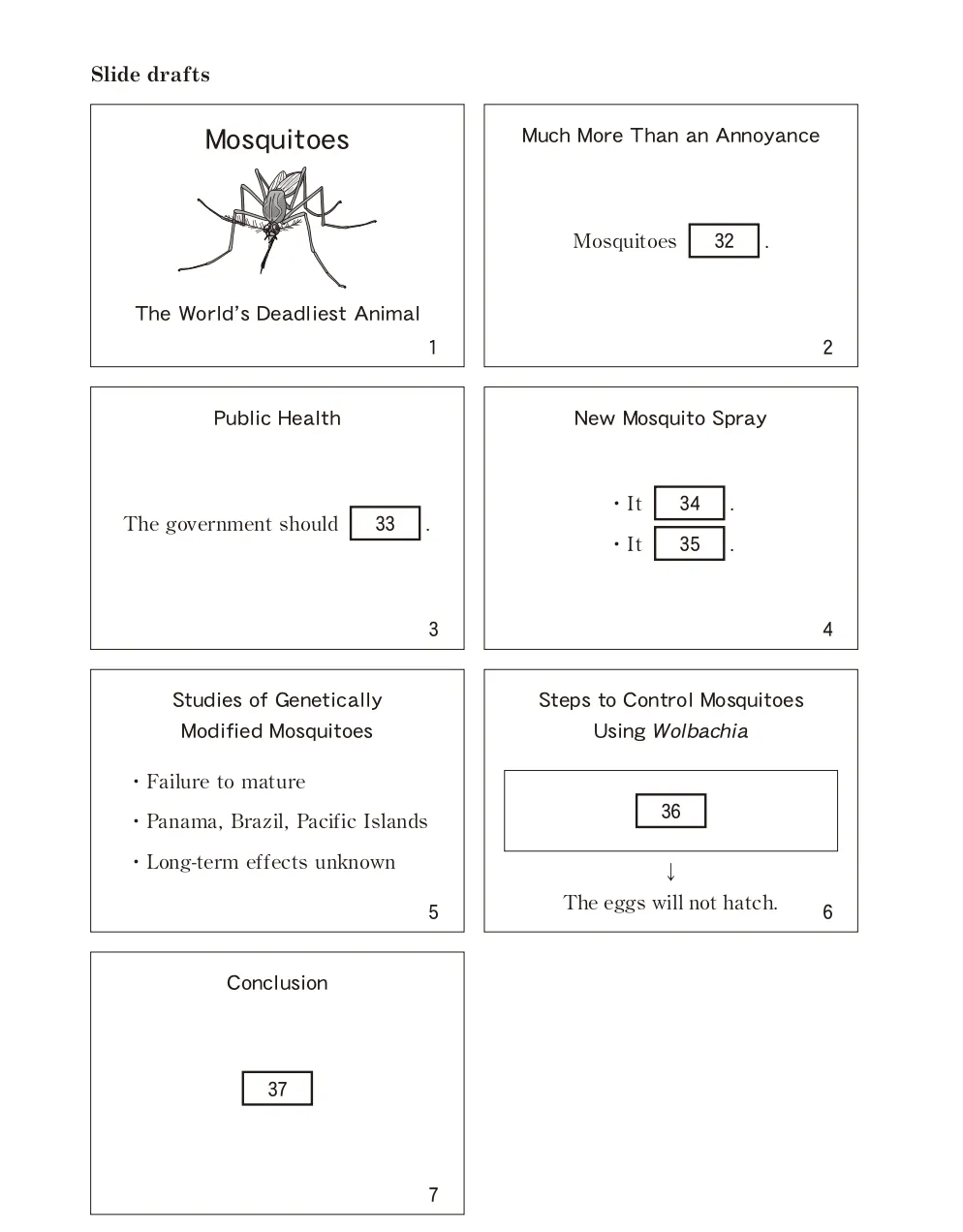
You are using the following article to prepare for a presentation about mosquitoes in your science class.
Controlling the “World’s Deadliest Animal”
Have you ever had your outdoor event ruined by mosquitoes? Just as you are about to enjoy a lovely summer picnic, some mosquitoes come to crash the party. Although they may be merely an annoyance in Japan, globally, the story is quite different. The mosquito has been classified as the “world’s deadliest animal” by the Centers for Disease Control and Prevention(CDC) in the US. According to the World Health Organization(WHO), more than 600, 000 people are killed every year from mosquito−borne diseases such as malaria and dengue fever. However, out of the nearly 3, 700 species of mosquitoes worldwide, only a small number transmit serious diseases. For example, the Aedes mosquito is responsible for spreading dengue fever, which is common in tropical regions.
What can be done to safeguard the public? There are various strategies that governments can implement to help protect citizens from mosquitoes. Local governments need to keep accurate records about mosquitoes including the variety and the size of the mosquito population. In addition, cities and towns should inform their citizens about how to stay safe around mosquitoes. When people go outside, they should wear long sleeves to prevent bites. Around the home, any standing water where mosquitoes may breed should be removed. Also, when windows are opened, screens are necessary and should be checked for damage. Governments must also take the lead in managing mosquito populations. Traditional methods tend to include the use of industrial chemicals. These chemicals can reduce mosquito populations, but they may negatively impact the ecosystem. In response to this problem, some innovative techniques which are environmentally safer have recently become available.
One promising new discovery in mosquito control makes use of a spray that contains a surfactant. Surfactants, which are often contained in shampoo, reduce the surface tension of a liquid, which allows water and oil to mix. A Japanese company successfully incorporated this idea and produced a new mosquito spray in 2023. Normally, mosquito bodies and wings are protected by a wax−like coating. This coating prevents water from being absorbed by the mosquito. However, the new spray is able to go through this coating and allow water into the mosquito’s body. As a result, its wings get wet and it is unable to fly, making it an easy target for enemies such as ants or spiders. Furthermore, the spray covers the breathing holes on the mosquito’s body, so it is unable to breathe. Additionally, surfactants are safe for humans because they do not contain any harmful chemicals.
Recent studies on reducing the number of mosquitoes through genetic modification also seem to be encouraging. Researchers now have the technology to place a fatal gene into mosquitoes. When mosquitoes with this gene go back into the wild and mate, the newly born mosquitoes inherit it. Because the gene is deadly, the mosquitoes die before becoming adults. This technique has found success in Panama, Brazil, and some Pacific Islands. Given that genetic modification is still a relatively new technology, further research is required to learn about its long−term effects on the environment.
Another recent discovery focuses on the treatment of mosquito eggs. Scientists are making use of a common bacteria called Wolbachia, which is found naturally in approximately 60% of all insects. Researchers first inject the bacteria into mosquito eggs. Mosquitoes carrying the bacteria are then born and raised in a factory. After maturing, the male mosquitoes with the bacteria are released into the environment. When the males mate with females that do not possess the bacteria, the eggs that they produce will never hatch. Thus, the bacteria work to reduce the population of mosquitoes. Moreover, Wolbachia is neither a threat to the natural environment nor to humans.
The human race has been in a constant battle against mosquitoes and the diseases they carry. In modern times, humans appear to be making steady and consistent progress. With continued scientific innovation and collaboration, we may be able to more effectively control the mosquito population.
Choose the best option for( 33 ).
このページは閲覧用ページです。
履歴を残すには、 「新しく出題する(ここをクリック)」 をご利用ください。
問題
反映中…
共通テスト(英語)試験 令和8年度(2026年度)追・再試験 問33(英語リーディング(第7問) 問2) (訂正依頼・報告はこちら) (新しいタブで開く)
各問の英文や図表を読み、最も適当な選択肢を選びなさい。
You are using the following article to prepare for a presentation about mosquitoes in your science class.
Controlling the “World’s Deadliest Animal”
Have you ever had your outdoor event ruined by mosquitoes? Just as you are about to enjoy a lovely summer picnic, some mosquitoes come to crash the party. Although they may be merely an annoyance in Japan, globally, the story is quite different. The mosquito has been classified as the “world’s deadliest animal” by the Centers for Disease Control and Prevention(CDC) in the US. According to the World Health Organization(WHO), more than 600, 000 people are killed every year from mosquito−borne diseases such as malaria and dengue fever. However, out of the nearly 3, 700 species of mosquitoes worldwide, only a small number transmit serious diseases. For example, the Aedes mosquito is responsible for spreading dengue fever, which is common in tropical regions.
What can be done to safeguard the public? There are various strategies that governments can implement to help protect citizens from mosquitoes. Local governments need to keep accurate records about mosquitoes including the variety and the size of the mosquito population. In addition, cities and towns should inform their citizens about how to stay safe around mosquitoes. When people go outside, they should wear long sleeves to prevent bites. Around the home, any standing water where mosquitoes may breed should be removed. Also, when windows are opened, screens are necessary and should be checked for damage. Governments must also take the lead in managing mosquito populations. Traditional methods tend to include the use of industrial chemicals. These chemicals can reduce mosquito populations, but they may negatively impact the ecosystem. In response to this problem, some innovative techniques which are environmentally safer have recently become available.
One promising new discovery in mosquito control makes use of a spray that contains a surfactant. Surfactants, which are often contained in shampoo, reduce the surface tension of a liquid, which allows water and oil to mix. A Japanese company successfully incorporated this idea and produced a new mosquito spray in 2023. Normally, mosquito bodies and wings are protected by a wax−like coating. This coating prevents water from being absorbed by the mosquito. However, the new spray is able to go through this coating and allow water into the mosquito’s body. As a result, its wings get wet and it is unable to fly, making it an easy target for enemies such as ants or spiders. Furthermore, the spray covers the breathing holes on the mosquito’s body, so it is unable to breathe. Additionally, surfactants are safe for humans because they do not contain any harmful chemicals.
Recent studies on reducing the number of mosquitoes through genetic modification also seem to be encouraging. Researchers now have the technology to place a fatal gene into mosquitoes. When mosquitoes with this gene go back into the wild and mate, the newly born mosquitoes inherit it. Because the gene is deadly, the mosquitoes die before becoming adults. This technique has found success in Panama, Brazil, and some Pacific Islands. Given that genetic modification is still a relatively new technology, further research is required to learn about its long−term effects on the environment.
Another recent discovery focuses on the treatment of mosquito eggs. Scientists are making use of a common bacteria called Wolbachia, which is found naturally in approximately 60% of all insects. Researchers first inject the bacteria into mosquito eggs. Mosquitoes carrying the bacteria are then born and raised in a factory. After maturing, the male mosquitoes with the bacteria are released into the environment. When the males mate with females that do not possess the bacteria, the eggs that they produce will never hatch. Thus, the bacteria work to reduce the population of mosquitoes. Moreover, Wolbachia is neither a threat to the natural environment nor to humans.
The human race has been in a constant battle against mosquitoes and the diseases they carry. In modern times, humans appear to be making steady and consistent progress. With continued scientific innovation and collaboration, we may be able to more effectively control the mosquito population.
Choose the best option for( 33 ).
横にスクロールして続きを読む(本文にフォーカスして左右キー)。
- apply traditional methods of mosquito control, rather than modern ones
- establish new standards and laws to control the mosquito population
- focus on mosquito monitoring and control, as well as public education
- provide private companies with funding for mosquito control research
正解!素晴らしいです
残念...
画像拡大
この過去問の解説 (2件)
01
問題文は
「(33)に当てはまるものを選びなさい。」
です。
(33)は、Public Health(公衆衛生)の項目にあり、The government should (33 )(政府は(33)すべきだ。)となっています。
公衆衛生のために、政府がすべきことを選びます。
本文での該当箇所は
There are various strategies that governments can implement to help protect citizens from mosquitoes. Local governments need to keep accurate records about mosquitoes including the variety and the size of the mosquito population. In addition, cities and towns should inform their citizens about how to stay safe around mosquitoes.
(国民を蚊から守るのを助けるために、政府ができる様々な戦略があります。地域の政府は、蚊の種類と蚊の数の規模について正確な記録をつける必要があります。さらに、都市や町は、蚊の周囲で安全にいる方法を市民に知らせるべきだ。)
です。
この内容に適するものを選びます。
「蚊の管理にの現代的な方法よりも伝統的な方法を適用する」
本文には
Traditional methods tend to include the use of industrial chemicals. These chemicals can reduce mosquito populations, but they may negatively impact the ecosystem. In response to this problem, some innovative techniques which are environmentally safer have recently become available.
(伝統的な方法は、産業用化学品の使用を含む傾向にある。これかの化学物質は、蚊の数を減らすが、生態系に悪影響を与えるかもしれない。この問題への応対として、最近では、環境的により安全な革新的な技術が使われている。)
とあり、不適切です。
「蚊の数をコントロールするための新しい基準や法律を設立する」
このような記述はありません。
正解「公共の教育と同様に蚊の監視と管理に焦点を当てる」
本文
Local governments need to keep accurate records about mosquitoes including the variety and the size of the mosquito population.
→蚊の監視と管理
In addition, cities and towns should inform their citizens about how to stay safe around mosquitoes.
→公共の教育
をそれぞれ指しており、内容が一致しています。
「民間企業に蚊の管理の研究基金を与える」
企業に関して、本文では
A Japanese company successfully incorporated this idea and produced a new mosquito spray in 2023.
(日本の企業は、この考えを取り入れ、2023年に新しい蚊のスプレーを製造した。)
とはありますが、基金援助に関する記述はありません。
政府に関する記述と選択肢を照らし合わせていきましょう。
参考になった数0
この解説の修正を提案する (新しいタブで開く)
02
問題:( 33 )に入る最も適切な選択肢を選びなさい。
問題のポイント:( 33 )のスライドを確認しましょう。スライドには「公衆衛生 政府は( 33 )するべきである」と記載があります。つまり、政府が蚊から市民を守るためにどのような対策を取るべきかをまとめた内容です。
訳)
あなたは、理科のクラスで蚊についてのプレゼンテーションを準備するために、次の記事を使用しています。
“世界で最も危険な生物”を制御する
屋外でのイベントを蚊のせいで台無しにされた経験はありませんか?楽しい夏のピクニックをまさに楽しもうとしているときに、何匹かの蚊が邪魔をしにやって来ます。日本では単に迷惑な存在にすぎないかもしれませんが、世界的に見ると、事情はまったく異なります。アメリカの疾病対策センター(CDC)は、蚊を「世界で最も危険な生物」に分類しています。世界保健機関(WHO)によると、マラリアやデング熱などの蚊が媒介する病気によって、毎年60万人以上が命を落としています。しかし、世界中に約3,700種類いる蚊のうち、深刻な病気を媒介するのはごく一部にすぎません。例えば、ネッタイシマカは、熱帯地域でよく見られるデング熱を広める原因となっています。
・ruin:台無しにする
・crash:邪魔する
・merely:単に
・annoyance:迷惑
・mosquito−borne:蚊が媒体する
一般の人々を守るために、どのようなことができるでしょうか?政府が市民を蚊から守るために実施できる対策はさまざまあります。地方自治体は、蚊の種類や生息数など、蚊に関する正確な記録を保管する必要があります。さらに、市や町は、蚊から身を守る方法について市民に知らせる必要があります。外出するときには、蚊に刺されるのを防ぐために長袖の服を着用しましょう。家庭の周辺では、蚊が繁殖する可能性のある水たまりや溜まった水を取り除く必要があります。また、窓を開けるときには網戸が必要で、破損していないか確認しましょう。政府は蚊の個体数を管理するうえでも、率先して取り組まなければなりません。従来の方法では、工業用化学物質を使用することが一般的です。これらの化学物質は蚊の数を減らすことができますが、生態系に悪影響を及ぼす可能性があります。この問題に対応するため、近年、環境により安全な革新的技術がいくつか利用できるようになっています。
・implement:実施する
・accurate:正確な
・breed:繁殖する、育つ
・screen:網戸
蚊の駆除の新しい発見の1つは、界面活性剤を含むスプレーを利用するものです。界面活性剤はシャンプーによく含まれており、液体の表面張力を弱めることで、水と油が混ざるようになります。日本のある企業は、この考え方をうまく取り入れ、2023年に新しい蚊用スプレーを製造しました。通常、蚊の体や羽は、ロウのような性質を持つ膜によって保護されています。この膜は、蚊の体に水が吸収されるのを防いでいます。
しかし、新しいスプレーはこの膜を通り抜け、蚊の体内に水が入り込むようにすることができます。その結果、蚊の羽が濡れて飛べなくなり、アリやクモなどの天敵に簡単に捕まえられる獲物になります。さらに、このスプレーは蚊の体にある呼吸孔を覆うため、蚊は呼吸できなくなります。加えて、界面活性剤には有害な化学物質が含まれていないため、安全です。
・surfactant:界面活性剤.
・incorporate:取り入れる
遺伝子組み換えによって蚊の数を減らすことに関する最近の研究も、期待できる結果を示しているようです。研究者たちは現在、蚊の体内に致死遺伝子を組み込む技術を習得しています。この遺伝子を持つ蚊が野生に戻り、交尾すると、生まれてくる蚊はその遺伝子を受け継ぎます。
その遺伝子は致死性であるため、蚊は成虫になる前に死んでしまいます。この技術は、パナマ、ブラジル、そしていくつかの太平洋の島々で成功しています。遺伝子組み換えはまだ比較的新しい技術であることを考えると、環境に対する長期的な影響を知るためには、さらなる研究が必要です。
・genetic modification:遺伝子組み換え
・fatal:致死量の
・mate:交尾
・inherit:受け継ぐ
もう1つの最近の発見は、蚊の卵の処理に注目したものです。科学者たちは、ウォルバキアという一般的な細菌を利用しています。この細菌は、すべての昆虫のおよそ60%に自然に存在しています。研究者たちはまず、この細菌を蚊の卵に注入します。その細菌を持つ蚊が生まれ、工場で育てられます。成長した後、細菌を持つオスの蚊が自然環境に放たれます。そのオスが細菌を持っていないメスと交尾すると、産み付けられた卵は孵化しません。このようにして、この細菌は蚊の個体数を減らす働きをします。さらに、ウォルバキアは自然環境にとっても、人間にとっても脅威ではありません。
・inject:注入する
・hatch:孵化
人類は、蚊や蚊が媒介する病気と絶え間ない戦いを続けてきました。現代では、人類は着実かつ継続的に進歩しているように見えます。科学技術の革新と協力を続けることで、私たちは蚊の個体数をより効果的に管理できるようになるかもしれません。
:steady:着実に
・consistent:継続的に
不正解
訳)現代的な方法ではなく、従来の蚊の駆除方法を採用する
本文には、「従来の方法では、工業用化学物質を使用することが一般的です。これらの化学物質は蚊の数を減らすことができますが、生態系に悪影響を及ぼす可能性があります。」と記載があります。しかし、次の段落では環境により安全で新しい技術が紹介されているため不正解です。
不正解
訳)蚊の数を管理するための新しい基準や法律を制定する
本文には、「地方自治体は、蚊の種類や生息数など、蚊に関する正確な記録を保管する必要があります。」と記載がありますが、新しい基準や法律を制定するという記述はないため不正解です。
正解
訳)蚊の監視・管理に加えて、市民への啓発活動にも重点を置く
本文には、Local governments need to keep accurate records about mosquitoes including the variety and the size of the mosquito population. In addition, cities and towns should inform their citizens about how to stay safe around mosquitoes.Governments must also take the lead in managing mosquito populations.(地方自治体は、蚊の種類や生息数など、蚊に関する正確な記録を保管する必要があります。さらに、市や町は、蚊から身を守る方法について市民に知らせる必要があります。政府は蚊の個体数を管理するうえでも、率先して取り組まなければなりません。).と記載があります。
この内容をまとめると、選択肢と一致するため正解です。
不正解
訳)蚊の駆除に関する研究のために、民間企業に資金を提供する
本文には、日本企業が新しい蚊のスプレーを開発したという説明があります。しかし、政府が民間企業に研究資金を提供したということは述べられていません。
政府が取り組むべきことは、次の3つです。
・蚊の種類や個体数を調査・記録する。
・蚊の個体数を管理する。
・市民に蚊から身を守る方法を知らせる。
参考になった数0
この解説の修正を提案する (新しいタブで開く)
前の問題(問32)へ
令和8年度(2026年度)追・再試験 問題一覧
次の問題(問34)へ