
共通テスト(英語) 過去問
令和8年度(2026年度)追・再試験
問34 (英語リーディング(第7問) 問3)
問題文
各問の英文や図表を読み、最も適当な選択肢を選びなさい。
You are using the following article to prepare for a presentation about mosquitoes in your science class.
Controlling the “World’s Deadliest Animal”
Have you ever had your outdoor event ruined by mosquitoes? Just as you are about to enjoy a lovely summer picnic, some mosquitoes come to crash the party. Although they may be merely an annoyance in Japan, globally, the story is quite different. The mosquito has been classified as the “world’s deadliest animal” by the Centers for Disease Control and Prevention(CDC) in the US. According to the World Health Organization(WHO), more than 600, 000 people are killed every year from mosquito−borne diseases such as malaria and dengue fever. However, out of the nearly 3, 700 species of mosquitoes worldwide, only a small number transmit serious diseases. For example, the Aedes mosquito is responsible for spreading dengue fever, which is common in tropical regions.
What can be done to safeguard the public? There are various strategies that governments can implement to help protect citizens from mosquitoes. Local governments need to keep accurate records about mosquitoes including the variety and the size of the mosquito population. In addition, cities and towns should inform their citizens about how to stay safe around mosquitoes. When people go outside, they should wear long sleeves to prevent bites. Around the home, any standing water where mosquitoes may breed should be removed. Also, when windows are opened, screens are necessary and should be checked for damage. Governments must also take the lead in managing mosquito populations. Traditional methods tend to include the use of industrial chemicals. These chemicals can reduce mosquito populations, but they may negatively impact the ecosystem. In response to this problem, some innovative techniques which are environmentally safer have recently become available.
One promising new discovery in mosquito control makes use of a spray that contains a surfactant. Surfactants, which are often contained in shampoo, reduce the surface tension of a liquid, which allows water and oil to mix. A Japanese company successfully incorporated this idea and produced a new mosquito spray in 2023. Normally, mosquito bodies and wings are protected by a wax−like coating. This coating prevents water from being absorbed by the mosquito. However, the new spray is able to go through this coating and allow water into the mosquito’s body. As a result, its wings get wet and it is unable to fly, making it an easy target for enemies such as ants or spiders. Furthermore, the spray covers the breathing holes on the mosquito’s body, so it is unable to breathe. Additionally, surfactants are safe for humans because they do not contain any harmful chemicals.
Recent studies on reducing the number of mosquitoes through genetic modification also seem to be encouraging. Researchers now have the technology to place a fatal gene into mosquitoes. When mosquitoes with this gene go back into the wild and mate, the newly born mosquitoes inherit it. Because the gene is deadly, the mosquitoes die before becoming adults. This technique has found success in Panama, Brazil, and some Pacific Islands. Given that genetic modification is still a relatively new technology, further research is required to learn about its long−term effects on the environment.
Another recent discovery focuses on the treatment of mosquito eggs. Scientists are making use of a common bacteria called Wolbachia, which is found naturally in approximately 60% of all insects. Researchers first inject the bacteria into mosquito eggs. Mosquitoes carrying the bacteria are then born and raised in a factory. After maturing, the male mosquitoes with the bacteria are released into the environment. When the males mate with females that do not possess the bacteria, the eggs that they produce will never hatch. Thus, the bacteria work to reduce the population of mosquitoes. Moreover, Wolbachia is neither a threat to the natural environment nor to humans.
The human race has been in a constant battle against mosquitoes and the diseases they carry. In modern times, humans appear to be making steady and consistent progress. With continued scientific innovation and collaboration, we may be able to more effectively control the mosquito population.
Choose the best options for( 34 )and( 35 ).(The order does not matter.)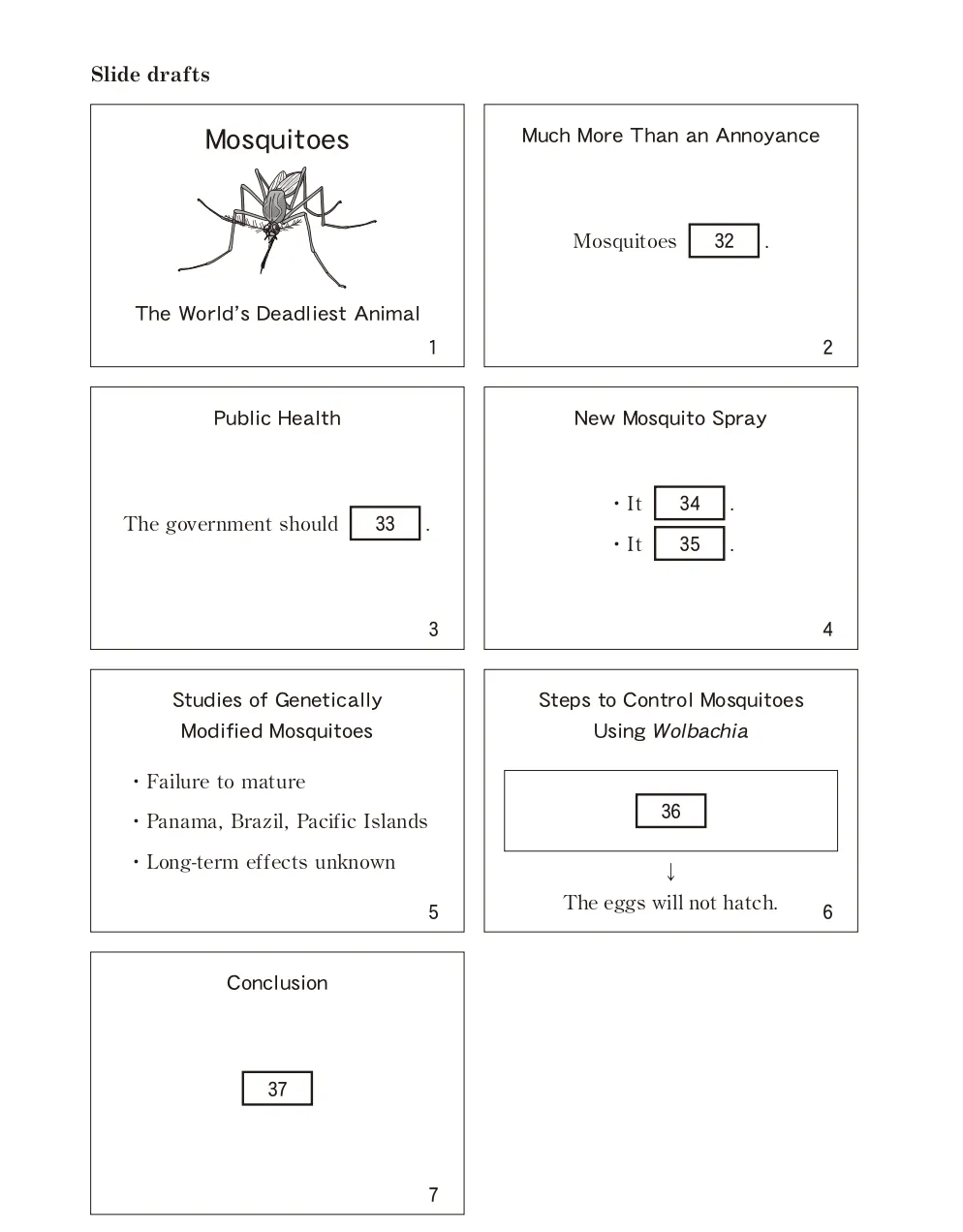
You are using the following article to prepare for a presentation about mosquitoes in your science class.
Controlling the “World’s Deadliest Animal”
Have you ever had your outdoor event ruined by mosquitoes? Just as you are about to enjoy a lovely summer picnic, some mosquitoes come to crash the party. Although they may be merely an annoyance in Japan, globally, the story is quite different. The mosquito has been classified as the “world’s deadliest animal” by the Centers for Disease Control and Prevention(CDC) in the US. According to the World Health Organization(WHO), more than 600, 000 people are killed every year from mosquito−borne diseases such as malaria and dengue fever. However, out of the nearly 3, 700 species of mosquitoes worldwide, only a small number transmit serious diseases. For example, the Aedes mosquito is responsible for spreading dengue fever, which is common in tropical regions.
What can be done to safeguard the public? There are various strategies that governments can implement to help protect citizens from mosquitoes. Local governments need to keep accurate records about mosquitoes including the variety and the size of the mosquito population. In addition, cities and towns should inform their citizens about how to stay safe around mosquitoes. When people go outside, they should wear long sleeves to prevent bites. Around the home, any standing water where mosquitoes may breed should be removed. Also, when windows are opened, screens are necessary and should be checked for damage. Governments must also take the lead in managing mosquito populations. Traditional methods tend to include the use of industrial chemicals. These chemicals can reduce mosquito populations, but they may negatively impact the ecosystem. In response to this problem, some innovative techniques which are environmentally safer have recently become available.
One promising new discovery in mosquito control makes use of a spray that contains a surfactant. Surfactants, which are often contained in shampoo, reduce the surface tension of a liquid, which allows water and oil to mix. A Japanese company successfully incorporated this idea and produced a new mosquito spray in 2023. Normally, mosquito bodies and wings are protected by a wax−like coating. This coating prevents water from being absorbed by the mosquito. However, the new spray is able to go through this coating and allow water into the mosquito’s body. As a result, its wings get wet and it is unable to fly, making it an easy target for enemies such as ants or spiders. Furthermore, the spray covers the breathing holes on the mosquito’s body, so it is unable to breathe. Additionally, surfactants are safe for humans because they do not contain any harmful chemicals.
Recent studies on reducing the number of mosquitoes through genetic modification also seem to be encouraging. Researchers now have the technology to place a fatal gene into mosquitoes. When mosquitoes with this gene go back into the wild and mate, the newly born mosquitoes inherit it. Because the gene is deadly, the mosquitoes die before becoming adults. This technique has found success in Panama, Brazil, and some Pacific Islands. Given that genetic modification is still a relatively new technology, further research is required to learn about its long−term effects on the environment.
Another recent discovery focuses on the treatment of mosquito eggs. Scientists are making use of a common bacteria called Wolbachia, which is found naturally in approximately 60% of all insects. Researchers first inject the bacteria into mosquito eggs. Mosquitoes carrying the bacteria are then born and raised in a factory. After maturing, the male mosquitoes with the bacteria are released into the environment. When the males mate with females that do not possess the bacteria, the eggs that they produce will never hatch. Thus, the bacteria work to reduce the population of mosquitoes. Moreover, Wolbachia is neither a threat to the natural environment nor to humans.
The human race has been in a constant battle against mosquitoes and the diseases they carry. In modern times, humans appear to be making steady and consistent progress. With continued scientific innovation and collaboration, we may be able to more effectively control the mosquito population.
Choose the best options for( 34 )and( 35 ).(The order does not matter.)
このページは閲覧用ページです。
履歴を残すには、 「新しく出題する(ここをクリック)」 をご利用ください。
問題
反映中…
共通テスト(英語)試験 令和8年度(2026年度)追・再試験 問34(英語リーディング(第7問) 問3) (訂正依頼・報告はこちら) (新しいタブで開く)
各問の英文や図表を読み、最も適当な選択肢を選びなさい。
You are using the following article to prepare for a presentation about mosquitoes in your science class.
Controlling the “World’s Deadliest Animal”
Have you ever had your outdoor event ruined by mosquitoes? Just as you are about to enjoy a lovely summer picnic, some mosquitoes come to crash the party. Although they may be merely an annoyance in Japan, globally, the story is quite different. The mosquito has been classified as the “world’s deadliest animal” by the Centers for Disease Control and Prevention(CDC) in the US. According to the World Health Organization(WHO), more than 600, 000 people are killed every year from mosquito−borne diseases such as malaria and dengue fever. However, out of the nearly 3, 700 species of mosquitoes worldwide, only a small number transmit serious diseases. For example, the Aedes mosquito is responsible for spreading dengue fever, which is common in tropical regions.
What can be done to safeguard the public? There are various strategies that governments can implement to help protect citizens from mosquitoes. Local governments need to keep accurate records about mosquitoes including the variety and the size of the mosquito population. In addition, cities and towns should inform their citizens about how to stay safe around mosquitoes. When people go outside, they should wear long sleeves to prevent bites. Around the home, any standing water where mosquitoes may breed should be removed. Also, when windows are opened, screens are necessary and should be checked for damage. Governments must also take the lead in managing mosquito populations. Traditional methods tend to include the use of industrial chemicals. These chemicals can reduce mosquito populations, but they may negatively impact the ecosystem. In response to this problem, some innovative techniques which are environmentally safer have recently become available.
One promising new discovery in mosquito control makes use of a spray that contains a surfactant. Surfactants, which are often contained in shampoo, reduce the surface tension of a liquid, which allows water and oil to mix. A Japanese company successfully incorporated this idea and produced a new mosquito spray in 2023. Normally, mosquito bodies and wings are protected by a wax−like coating. This coating prevents water from being absorbed by the mosquito. However, the new spray is able to go through this coating and allow water into the mosquito’s body. As a result, its wings get wet and it is unable to fly, making it an easy target for enemies such as ants or spiders. Furthermore, the spray covers the breathing holes on the mosquito’s body, so it is unable to breathe. Additionally, surfactants are safe for humans because they do not contain any harmful chemicals.
Recent studies on reducing the number of mosquitoes through genetic modification also seem to be encouraging. Researchers now have the technology to place a fatal gene into mosquitoes. When mosquitoes with this gene go back into the wild and mate, the newly born mosquitoes inherit it. Because the gene is deadly, the mosquitoes die before becoming adults. This technique has found success in Panama, Brazil, and some Pacific Islands. Given that genetic modification is still a relatively new technology, further research is required to learn about its long−term effects on the environment.
Another recent discovery focuses on the treatment of mosquito eggs. Scientists are making use of a common bacteria called Wolbachia, which is found naturally in approximately 60% of all insects. Researchers first inject the bacteria into mosquito eggs. Mosquitoes carrying the bacteria are then born and raised in a factory. After maturing, the male mosquitoes with the bacteria are released into the environment. When the males mate with females that do not possess the bacteria, the eggs that they produce will never hatch. Thus, the bacteria work to reduce the population of mosquitoes. Moreover, Wolbachia is neither a threat to the natural environment nor to humans.
The human race has been in a constant battle against mosquitoes and the diseases they carry. In modern times, humans appear to be making steady and consistent progress. With continued scientific innovation and collaboration, we may be able to more effectively control the mosquito population.
Choose the best options for( 34 )and( 35 ).(The order does not matter.)
横にスクロールして続きを読む(本文にフォーカスして左右キー)。
- covers the mosquito with a wax
- destroys bacteria in the mosquito’s body
- interferes with the mosquito’s breathing
- prevents the mosquito from flying
- stops chemicals from harming the mosquito
正解!素晴らしいです
残念...
画像拡大
この過去問の解説 (2件)
01
問題文は
「(34)と(35)に当てはまるものを選びなさい。(順不同)」
です。
これは、New Mosquito Spray(新しい蚊のスプレー)の項目にあり、
It (34 ). It (35). (それは(34)。それは(35)。)
となっています。
新しい蚊のスプレーに関して正しいものを選びます。
蚊の新しいスプレーに関しての記述は
Normally, mosquito bodies and wings are protected by a wax−like coating. This coating prevents water from being absorbed by the mosquito. However, the new spray is able to go through this coating and allow water into the mosquito’s body. As a result, its wings get wet and it is unable to fly, making it an easy target for enemies such as ants or spiders. Furthermore, the spray covers the breathing holes on the mosquito’s body, so it is unable to breathe.
(普通、蚊の身体と羽は、ワックスのようなコーティングで守られています。このコーティングは、蚊によって、水が吸収されるのを妨げています。しかし、新しいスプレーは、このコーティングを通り抜け、水が蚊の身体に入り込むのを可能にします。結果として、蚊の羽が濡れ、飛べなくなり、蟻や蜘蛛のような敵の標的に簡単になるのです。さらに、そのスプレーは、蚊の身体にある呼吸の穴を塞ぐので、呼吸できなくなります。)
です。
「蚊をワックスで覆う」
本文には
Normally, mosquito bodies and wings are protected by a wax−like coating. This coating prevents water from being absorbed by the mosquito. However, the new spray is able to go through this coating and allow water into the mosquito’s body.
(普通、蚊の身体と羽は、ワックスのようなコーティングで守られています。このコーティングは、蚊によって、水が吸収されるのを妨げています。しかし、新しいスプレーは、このコーティングを通り抜け、水が蚊の身体に入り込むのを可能にします。)
とあり、誤りです。
「蚊の身体のバクテリアを破壊する」
このような記述はありません。
正解「蚊の呼吸を邪魔する」
本文には
the spray covers the breathing holes on the mosquito’s body, so it is unable to breathe.
(そのスプレーは、蚊の身体にある呼吸の穴を塞ぐので、呼吸できなくなります。)
とあり、内容と一致します。
正解 「蚊が飛ぶのを妨げる」
本文には
the new spray is able to go through this coating and allow water into the mosquito’s body. As a result, its wings get wet and it is unable to fly,
(新しいスプレーは、このコーティングを通り抜け、水が蚊の身体に入り込むのを可能にします。結果として、蚊の羽が濡れ、飛べなくなり)
とあり、内容と一致します。
「化学物質が蚊を害するのを止める」
化学物質については、
surfactants are safe for humans because they do not contain any harmful chemicals.
(界面活性剤は人間に安全だ。なぜなら、人間に有害な物質を一切含んでいないからです。)
と述べられていますが、これは蚊ではなく人間の話であるため、誤りです。
スプレーの特徴を正確に捉えましょう。
参考になった数0
この解説の修正を提案する (新しいタブで開く)
02
問題:( 34 )と( 35 )に入る最も適切な選択肢を選びなさい。(順不同)
問題のポイント:( 33 )のスライドを確認しましょう。( 34 )と( 35 )は、新しいスプレーが蚊にどのような影響を与えるのか、2つの効果が説明されています。
訳)
あなたは、理科のクラスで蚊についてのプレゼンテーションを準備するために、次の記事を使用しています。
“世界で最も危険な生物”を制御する
屋外でのイベントを蚊のせいで台無しにされた経験はありませんか?楽しい夏のピクニックをまさに楽しもうとしているときに、何匹かの蚊が邪魔をしにやって来ます。日本では単に迷惑な存在にすぎないかもしれませんが、世界的に見ると、事情はまったく異なります。アメリカの疾病対策センター(CDC)は、蚊を「世界で最も危険な生物」に分類しています。世界保健機関(WHO)によると、マラリアやデング熱などの蚊が媒介する病気によって、毎年60万人以上が命を落としています。しかし、世界中に約3,700種類いる蚊のうち、深刻な病気を媒介するのはごく一部にすぎません。例えば、ネッタイシマカは、熱帯地域でよく見られるデング熱を広める原因となっています。
・ruin:台無しにする
・crash:邪魔する
・merely:単に
・annoyance:迷惑
・mosquito−borne:蚊が媒体する
一般の人々を守るために、どのようなことができるでしょうか?政府が市民を蚊から守るために実施できる対策はさまざまあります。地方自治体は、蚊の種類や生息数など、蚊に関する正確な記録を保管する必要があります。さらに、市や町は、蚊から身を守る方法について市民に知らせる必要があります。外出するときには、蚊に刺されるのを防ぐために長袖の服を着用しましょう。家庭の周辺では、蚊が繁殖する可能性のある水たまりや溜まった水を取り除く必要があります。また、窓を開けるときには網戸が必要で、破損していないか確認しましょう。政府は蚊の個体数を管理するうえでも、率先して取り組まなければなりません。従来の方法では、工業用化学物質を使用することが一般的です。これらの化学物質は蚊の数を減らすことができますが、生態系に悪影響を及ぼす可能性があります。この問題に対応するため、近年、環境により安全な革新的技術がいくつか利用できるようになっています。
・implement:実施する
・accurate:正確な
・breed:繁殖する、育つ
・screen:網戸
蚊の駆除の新しい発見の1つは、界面活性剤を含むスプレーを利用するものです。界面活性剤はシャンプーによく含まれており、液体の表面張力を弱めることで、水と油が混ざるようになります。日本のある企業は、この考え方をうまく取り入れ、2023年に新しい蚊用スプレーを製造しました。通常、蚊の体や羽は、ロウのような性質を持つ膜によって保護されています。この膜は、蚊の体に水が吸収されるのを防いでいます。
しかし、新しいスプレーはこの膜を通り抜け、蚊の体内に水が入り込むようにすることができます。その結果、蚊の羽が濡れて飛べなくなり、アリやクモなどの天敵に簡単に捕まえられる獲物になります。さらに、このスプレーは蚊の体にある呼吸孔を覆うため、蚊は呼吸できなくなります。加えて、界面活性剤には有害な化学物質が含まれていないため、安全です。
・surfactant:界面活性剤.
・incorporate:取り入れる
遺伝子組み換えによって蚊の数を減らすことに関する最近の研究も、期待できる結果を示しているようです。研究者たちは現在、蚊の体内に致死遺伝子を組み込む技術を習得しています。この遺伝子を持つ蚊が野生に戻り、交尾すると、生まれてくる蚊はその遺伝子を受け継ぎます。
その遺伝子は致死性であるため、蚊は成虫になる前に死んでしまいます。この技術は、パナマ、ブラジル、そしていくつかの太平洋の島々で成功しています。遺伝子組み換えはまだ比較的新しい技術であることを考えると、環境に対する長期的な影響を知るためには、さらなる研究が必要です。
・genetic modification:遺伝子組み換え
・fatal:致死量の
・mate:交尾
・inherit:受け継ぐ
もう1つの最近の発見は、蚊の卵の処理に注目したものです。科学者たちは、ウォルバキアという一般的な細菌を利用しています。この細菌は、すべての昆虫のおよそ60%に自然に存在しています。研究者たちはまず、この細菌を蚊の卵に注入します。その細菌を持つ蚊が生まれ、工場で育てられます。成長した後、細菌を持つオスの蚊が自然環境に放たれます。そのオスが細菌を持っていないメスと交尾すると、産み付けられた卵は孵化しません。このようにして、この細菌は蚊の個体数を減らす働きをします。さらに、ウォルバキアは自然環境にとっても、人間にとっても脅威ではありません。
・inject:注入する
・hatch:孵化
人類は、蚊や蚊が媒介する病気と絶え間ない戦いを続けてきました。現代では、人類は着実かつ継続的に進歩しているように見えます。科学技術の革新と協力を続けることで、私たちは蚊の個体数をより効果的に管理できるようになるかもしれません。
:steady:着実に
・consistent:継続的に
不正解
訳)蚊をロウで覆う
本文には、「蚊の体や羽は、ロウのような性質を持つ膜によって保護されています。」と記載があります。これはその膜を利用して蚊を多くのではなく、その膜を通り抜けて水を体内に入り込ませます。したがって不正解です。
不正解
訳)蚊の体内の細菌を破壊する
本文では、界面活性剤を含むスプレーが蚊の羽を濡らし、呼吸を妨げることが説明されています。細菌を破壊するという効果は述べられていません。
正解
訳)蚊の呼吸を妨げる
本文には、 the spray covers the breathing holes on the mosquito’s body, so it is unable to breathe(このスプレーは蚊の体にある呼吸孔を覆うため、蚊は呼吸できなくなります。).と記載があります。
選択肢の内容と一致しているため正解です。
不正解
訳)蚊が飛ぶのを妨げる
its wings get wet and it is unable to fly, making it an easy target for enemies such as ants or spiders(蚊の羽が濡れて飛べなくなり、アリやクモなどの天敵に簡単に捕まえられる獲物になります。). と記載があります。
スプレーは羽を濡らして飛べなくするということなので正解です。
不正解
訳)化学物質が蚊に害を与えるのを防ぐ
本文では、界面活性剤は人間にとって安全であり、有害な化学物質を含まないと説明されています。しかし、化学物質から蚊を守るという効果はありません。
参考になった数0
この解説の修正を提案する (新しいタブで開く)
前の問題(問33)へ
令和8年度(2026年度)追・再試験 問題一覧
次の問題(問36)へ