
共通テスト(英語) 過去問
令和6年度(2024年度)追・再試験
問46 (<旧課程>英語リーディング(第6問) 問8)
問題文
次の英文や図表を読み、最も適当な選択肢を選びなさい。
You are preparing for a science fair presentation on a scientific discovery, using the following magazine article.
”Smart” Fabrics
Through the years, the fabrics we use have evolved to suit our changing lifestyles and needs. Linen, made from the fibers of a plant called flax, is one of the oldest textiles in the world. It naturally reflects away the sun and its intense heat, and allows better airflow than other types of fabric. Light and airy, linen has long been the ideal fabric for warm climates. With industrialization and population growth, however, cotton became more commonly used since it was suitable for mass production. Cloth made from cotton can be heavy and can trap body heat though, which may make people feel uncomfortable in very hot and humid weather.
Newer materials are always being developed as technology progresses, and ”smart” fabrics are a recent scientific breakthrough in the textile industry. Weaving flexible synthetic fibers into cloth can provide additional functions for the fabric. For example, scientists at the Huazhong University of Science and Technology made a new fabric called ”metafabric” that deflects heat to keep people cooler. Such fabric can be used to create clothes that ease the discomfort people suffer when the temperature rises. In their experiment, a participant wore a vest consisting of two halves―one half cotton and the other half metafabric―and was exposed to direct sunlight for an hour. Underneath the cotton, the skin temperature soared to 37℃. In contrast, underneath the metafabric, the temperature rose by just one degree, from 31℃ to 32℃.
Another interesting example is a fabric that can detect sounds. The human ear picks up sound pressures, and the inner organs convert sound waves into mechanical vibrations and then into electrical signals. Similarly, ”piezoelectric materials,” which are typically used for microphones or speakers,produce an electrical signal when mechanically bent.
Using this knowledge, a team of researchers at the Massachusetts Institute of Technology and the Rhode Island School of Design came up with a so−called ”acoustic fabric.” The researchers wove a piezoelectric fiber into fabric and conducted a series of experiments. One experiment examined the fabric’s sensitivity to sound directions. They sewed two pieces of acoustic fabric onto the back of a shirt. Then, they clapped their hands at various angles away from the shirt. The fiber converted the sound first into mechanical vibrations, then into electrical signals that were stored on a device. The fabric was successfully able to pinpoint the angle of the sounds. This could lead to a useful application for individuals with hearing aids to identify the direction of a specific sound even in noisy surroundings.
In addition to functioning as wearable hearing aids, acoustic fabric can be used for other purposes such as tracking respiratory(lung), pulse, and cardiac(heart)conditions. Another experiment tested whether clothes with acoustic fibers could act as fabric stethoscopes to monitor a person’s subtle cardiac features. The research group attached a single fiber over the chest region on a shirt and found it accurately detected the wearer’s heart signals. Furthermore, this result indicated the possibility of utilizing the fabric in maternity clothes to check an unborn baby’s heartbeat.
Researchers see applications of smart fabrics beyond clothing. A smart fabric with cooling performance can be applied to various products for different purposes, such as tents, car covers, curtains, and sunshade products. Acoustic fabrics can be integrated with spacecraft coatings to monitor cosmic debris, or be used to help detect cracks or strains in buildings. They can even be woven into a net to check on fish in the sea.
As these examples of textile innovation suggest, new fabrics can enhance our lives in many ways. You may not believe this, but the coolest things about these fabrics are that you can get ”smart” while wearing them and some of them are machine−washable!
You are summarizing the steps in conducting the acoustic study on the smart shirt on Slide 4. Choose the best option for( 46 ).
Your slides: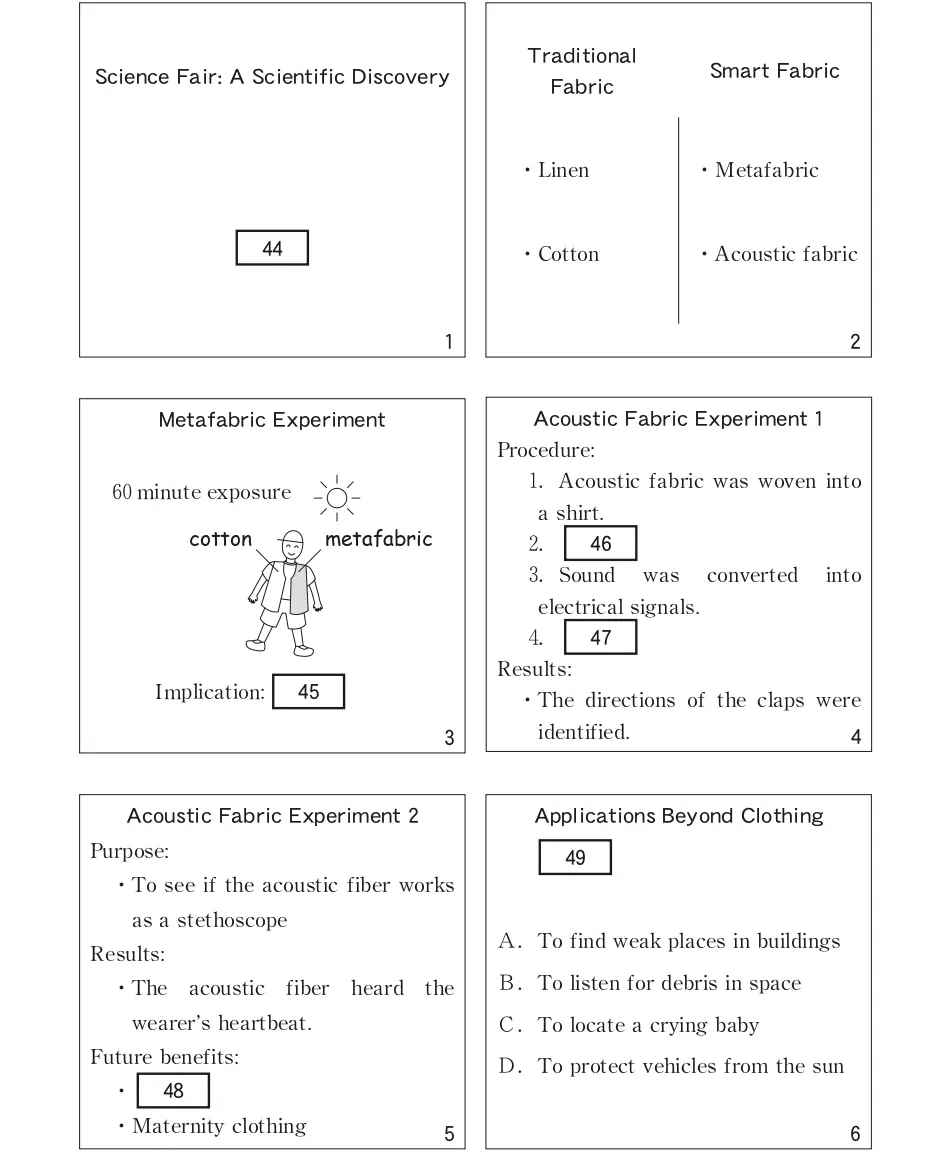
You are preparing for a science fair presentation on a scientific discovery, using the following magazine article.
”Smart” Fabrics
Through the years, the fabrics we use have evolved to suit our changing lifestyles and needs. Linen, made from the fibers of a plant called flax, is one of the oldest textiles in the world. It naturally reflects away the sun and its intense heat, and allows better airflow than other types of fabric. Light and airy, linen has long been the ideal fabric for warm climates. With industrialization and population growth, however, cotton became more commonly used since it was suitable for mass production. Cloth made from cotton can be heavy and can trap body heat though, which may make people feel uncomfortable in very hot and humid weather.
Newer materials are always being developed as technology progresses, and ”smart” fabrics are a recent scientific breakthrough in the textile industry. Weaving flexible synthetic fibers into cloth can provide additional functions for the fabric. For example, scientists at the Huazhong University of Science and Technology made a new fabric called ”metafabric” that deflects heat to keep people cooler. Such fabric can be used to create clothes that ease the discomfort people suffer when the temperature rises. In their experiment, a participant wore a vest consisting of two halves―one half cotton and the other half metafabric―and was exposed to direct sunlight for an hour. Underneath the cotton, the skin temperature soared to 37℃. In contrast, underneath the metafabric, the temperature rose by just one degree, from 31℃ to 32℃.
Another interesting example is a fabric that can detect sounds. The human ear picks up sound pressures, and the inner organs convert sound waves into mechanical vibrations and then into electrical signals. Similarly, ”piezoelectric materials,” which are typically used for microphones or speakers,produce an electrical signal when mechanically bent.
Using this knowledge, a team of researchers at the Massachusetts Institute of Technology and the Rhode Island School of Design came up with a so−called ”acoustic fabric.” The researchers wove a piezoelectric fiber into fabric and conducted a series of experiments. One experiment examined the fabric’s sensitivity to sound directions. They sewed two pieces of acoustic fabric onto the back of a shirt. Then, they clapped their hands at various angles away from the shirt. The fiber converted the sound first into mechanical vibrations, then into electrical signals that were stored on a device. The fabric was successfully able to pinpoint the angle of the sounds. This could lead to a useful application for individuals with hearing aids to identify the direction of a specific sound even in noisy surroundings.
In addition to functioning as wearable hearing aids, acoustic fabric can be used for other purposes such as tracking respiratory(lung), pulse, and cardiac(heart)conditions. Another experiment tested whether clothes with acoustic fibers could act as fabric stethoscopes to monitor a person’s subtle cardiac features. The research group attached a single fiber over the chest region on a shirt and found it accurately detected the wearer’s heart signals. Furthermore, this result indicated the possibility of utilizing the fabric in maternity clothes to check an unborn baby’s heartbeat.
Researchers see applications of smart fabrics beyond clothing. A smart fabric with cooling performance can be applied to various products for different purposes, such as tents, car covers, curtains, and sunshade products. Acoustic fabrics can be integrated with spacecraft coatings to monitor cosmic debris, or be used to help detect cracks or strains in buildings. They can even be woven into a net to check on fish in the sea.
As these examples of textile innovation suggest, new fabrics can enhance our lives in many ways. You may not believe this, but the coolest things about these fabrics are that you can get ”smart” while wearing them and some of them are machine−washable!
You are summarizing the steps in conducting the acoustic study on the smart shirt on Slide 4. Choose the best option for( 46 ).
Your slides:
このページは閲覧用ページです。
履歴を残すには、 「新しく出題する(ここをクリック)」 をご利用ください。
問題
反映中…
共通テスト(英語)試験 令和6年度(2024年度)追・再試験 問46(<旧課程>英語リーディング(第6問) 問8) (訂正依頼・報告はこちら)
次の英文や図表を読み、最も適当な選択肢を選びなさい。
You are preparing for a science fair presentation on a scientific discovery, using the following magazine article.
”Smart” Fabrics
Through the years, the fabrics we use have evolved to suit our changing lifestyles and needs. Linen, made from the fibers of a plant called flax, is one of the oldest textiles in the world. It naturally reflects away the sun and its intense heat, and allows better airflow than other types of fabric. Light and airy, linen has long been the ideal fabric for warm climates. With industrialization and population growth, however, cotton became more commonly used since it was suitable for mass production. Cloth made from cotton can be heavy and can trap body heat though, which may make people feel uncomfortable in very hot and humid weather.
Newer materials are always being developed as technology progresses, and ”smart” fabrics are a recent scientific breakthrough in the textile industry. Weaving flexible synthetic fibers into cloth can provide additional functions for the fabric. For example, scientists at the Huazhong University of Science and Technology made a new fabric called ”metafabric” that deflects heat to keep people cooler. Such fabric can be used to create clothes that ease the discomfort people suffer when the temperature rises. In their experiment, a participant wore a vest consisting of two halves―one half cotton and the other half metafabric―and was exposed to direct sunlight for an hour. Underneath the cotton, the skin temperature soared to 37℃. In contrast, underneath the metafabric, the temperature rose by just one degree, from 31℃ to 32℃.
Another interesting example is a fabric that can detect sounds. The human ear picks up sound pressures, and the inner organs convert sound waves into mechanical vibrations and then into electrical signals. Similarly, ”piezoelectric materials,” which are typically used for microphones or speakers,produce an electrical signal when mechanically bent.
Using this knowledge, a team of researchers at the Massachusetts Institute of Technology and the Rhode Island School of Design came up with a so−called ”acoustic fabric.” The researchers wove a piezoelectric fiber into fabric and conducted a series of experiments. One experiment examined the fabric’s sensitivity to sound directions. They sewed two pieces of acoustic fabric onto the back of a shirt. Then, they clapped their hands at various angles away from the shirt. The fiber converted the sound first into mechanical vibrations, then into electrical signals that were stored on a device. The fabric was successfully able to pinpoint the angle of the sounds. This could lead to a useful application for individuals with hearing aids to identify the direction of a specific sound even in noisy surroundings.
In addition to functioning as wearable hearing aids, acoustic fabric can be used for other purposes such as tracking respiratory(lung), pulse, and cardiac(heart)conditions. Another experiment tested whether clothes with acoustic fibers could act as fabric stethoscopes to monitor a person’s subtle cardiac features. The research group attached a single fiber over the chest region on a shirt and found it accurately detected the wearer’s heart signals. Furthermore, this result indicated the possibility of utilizing the fabric in maternity clothes to check an unborn baby’s heartbeat.
Researchers see applications of smart fabrics beyond clothing. A smart fabric with cooling performance can be applied to various products for different purposes, such as tents, car covers, curtains, and sunshade products. Acoustic fabrics can be integrated with spacecraft coatings to monitor cosmic debris, or be used to help detect cracks or strains in buildings. They can even be woven into a net to check on fish in the sea.
As these examples of textile innovation suggest, new fabrics can enhance our lives in many ways. You may not believe this, but the coolest things about these fabrics are that you can get ”smart” while wearing them and some of them are machine−washable!
You are summarizing the steps in conducting the acoustic study on the smart shirt on Slide 4. Choose the best option for( 46 ).
Your slides:
You are preparing for a science fair presentation on a scientific discovery, using the following magazine article.
”Smart” Fabrics
Through the years, the fabrics we use have evolved to suit our changing lifestyles and needs. Linen, made from the fibers of a plant called flax, is one of the oldest textiles in the world. It naturally reflects away the sun and its intense heat, and allows better airflow than other types of fabric. Light and airy, linen has long been the ideal fabric for warm climates. With industrialization and population growth, however, cotton became more commonly used since it was suitable for mass production. Cloth made from cotton can be heavy and can trap body heat though, which may make people feel uncomfortable in very hot and humid weather.
Newer materials are always being developed as technology progresses, and ”smart” fabrics are a recent scientific breakthrough in the textile industry. Weaving flexible synthetic fibers into cloth can provide additional functions for the fabric. For example, scientists at the Huazhong University of Science and Technology made a new fabric called ”metafabric” that deflects heat to keep people cooler. Such fabric can be used to create clothes that ease the discomfort people suffer when the temperature rises. In their experiment, a participant wore a vest consisting of two halves―one half cotton and the other half metafabric―and was exposed to direct sunlight for an hour. Underneath the cotton, the skin temperature soared to 37℃. In contrast, underneath the metafabric, the temperature rose by just one degree, from 31℃ to 32℃.
Another interesting example is a fabric that can detect sounds. The human ear picks up sound pressures, and the inner organs convert sound waves into mechanical vibrations and then into electrical signals. Similarly, ”piezoelectric materials,” which are typically used for microphones or speakers,produce an electrical signal when mechanically bent.
Using this knowledge, a team of researchers at the Massachusetts Institute of Technology and the Rhode Island School of Design came up with a so−called ”acoustic fabric.” The researchers wove a piezoelectric fiber into fabric and conducted a series of experiments. One experiment examined the fabric’s sensitivity to sound directions. They sewed two pieces of acoustic fabric onto the back of a shirt. Then, they clapped their hands at various angles away from the shirt. The fiber converted the sound first into mechanical vibrations, then into electrical signals that were stored on a device. The fabric was successfully able to pinpoint the angle of the sounds. This could lead to a useful application for individuals with hearing aids to identify the direction of a specific sound even in noisy surroundings.
In addition to functioning as wearable hearing aids, acoustic fabric can be used for other purposes such as tracking respiratory(lung), pulse, and cardiac(heart)conditions. Another experiment tested whether clothes with acoustic fibers could act as fabric stethoscopes to monitor a person’s subtle cardiac features. The research group attached a single fiber over the chest region on a shirt and found it accurately detected the wearer’s heart signals. Furthermore, this result indicated the possibility of utilizing the fabric in maternity clothes to check an unborn baby’s heartbeat.
Researchers see applications of smart fabrics beyond clothing. A smart fabric with cooling performance can be applied to various products for different purposes, such as tents, car covers, curtains, and sunshade products. Acoustic fabrics can be integrated with spacecraft coatings to monitor cosmic debris, or be used to help detect cracks or strains in buildings. They can even be woven into a net to check on fish in the sea.
As these examples of textile innovation suggest, new fabrics can enhance our lives in many ways. You may not believe this, but the coolest things about these fabrics are that you can get ”smart” while wearing them and some of them are machine−washable!
You are summarizing the steps in conducting the acoustic study on the smart shirt on Slide 4. Choose the best option for( 46 ).
Your slides:
- Mechanical vibrations were bent by the fabric.
- Sounds from various directions were made.
- The acoustic fabric recorded the sounds.
- The output from each fiber was saved.
- The researchers moved a shirt to different places.
- Various types of sounds were measured by a shirt.
正解!素晴らしいです
残念...
画像拡大
この過去問の解説 (3件)
01
アコースティックファブリックの実験の手順として、正しいものを選びます。
本文4段落目が該当箇所です。
スライド4枚目 和訳
1.アコースティックファブリックはシャツの中に織り込まれた
2.問46
3.音は電気的な信号に転換された
4.問47
結果
拍手の方向性が識別された
選択肢和訳
・布地によって機械の振動が曲げられた
・様々な方向からの音が作られた
・アコースティックファブリックが音を記録する
・それぞれの繊維からの出力は保存された
・研究者はシャツから異なる場所に移動した
・様々な種類の音がシャツによって測定された
スライドの実験1の内容が、本文中のThey sewed two pieces of acoustic fabric onto the back of a shirt.に当たるため、本問題はその直後の文They clapped their hands at various angles away from the shirt.と内容が合致する選択肢を選びます。
不正解です。
正解です。
不正解です。
不正解です。
不正解です。
不正解です。
参考になった数0
この解説の修正を提案する
02
問の訳は以下の通りです。
アコースティックファブリック実験1
手順:
1. アコースティックファブリックをシャツに織り込んだ。
2. 46
3. 音を電気信号に変換した。
4. 47
結果:
拍手の方向が特定された。
アコースティックファブリックについて書かれているのは第3,4段落です。本文を確認しましょう。
もう一つの興味深い例は、音を検知できる布です。人間の耳は音圧を感知し、内臓が音波を機械的振動に変換し、さらに電気信号に変換します。同様に、マイクやスピーカーに一般的に使用される「圧電材料」は、機械的に曲げられると電気信号を生成します。
この知識を利用して、マサチューセッツ工科大学とロードアイランド・スクール・オブ・デザインの研究チームは、いわゆる「アコースティックファブリック」を考案しました。研究者たちは圧電繊維を布に織り込み、一連の実験を行いました。ある実験では、音の方向に対する布の感度を調べました。彼らはシャツの背中に2枚のアコースティックファブリックを縫い付けました。そして、シャツから離れてさまざまな角度で手を叩きました。繊維は音をまず機械的振動に変換し、次にデバイスに保存される電気信号に変換しました。布は音の角度を正確に特定することに成功しました。これは、補聴器を装着している人が騒がしい環境でも特定の音の方向を識別できるという有用な用途につながる可能性があります。
この内容をもとに実験の内容をまとめると、
アコースティックファブリックをシャツに縫い付ける→少し離れたところから手をたたく→繊維が音を取り込むことによって、機械的振動に変換される→電子信号に変換される→音の角度を特定する
と並べることができます。
これらを踏まえて、各選択肢を確認しましょう。
訳:電子振動は繊維によって折り曲げられました
本文で布を折り曲げたかどうかは言及されていないため、不正解です。
訳:様々な方向から音が発せられました。
they clapped their hands at various angles away from the shirt.とあり、手をたたいて音を発したことがわかります。よってこの選択肢が正解です。
訳:アコースティックファブリックは音を記録しました。
The fiber converted the sound first into mechanical vibrations, then into electrical signals that were stored on a device.(繊維は音をまず機械的振動に変換し、次にデバイスに保存される電気信号に変換しました。)と記載があり、生地ではなく、デバイスに保存されることがわかります。よって不正解です。
訳:それぞれの繊維からの出力は保存されました。
The fiber converted the sound first into mechanical vibrations, then into electrical signals that were stored on a device.(繊維は音をまず機械的振動に変換し、次にデバイスに保存される電気信号に変換しました。)と記載があり内容は正しいですが、この回答は47の回答にあたりますので、不正解です。
訳:研究者たちはシャツを様々な場所に移動させました。
they clapped their hands at various angles away from the shirt.とあり、研究者が場所を変えて手をたたいたことがわかります。よって不正解です。
訳:シャツによって様々な種類の音が測定されました。
they clapped their hands at various angles away from the shirt.とあり、様々な音の種類ではなく角度を変えて手をたたいたため、この回答は不正解です。
参考になった数0
この解説の修正を提案する
03
スライド4の内容は「アコースティック・ファブリック(音響効果を持つ生地)」の実験手順をまとめる問題です。
本文第4段落に設問の答えがあり、実験の具体的な手順が書かれています。
訳)生地によって機械的な振動が曲げられた。
→間違い
繊維が「曲げられると電気信号を出す」という性質の説明は本文で触れられているものの、
手順として振動を曲げたわけではありません。
訳)様々な方向から音が鳴らされた。
→正しい
手順1:シャツの背中に2枚の布を縫い付ける。
手順2:様々な角度で手を叩いた。
下記本文参照
They sewed two pieces of acoustic fabric onto the back of a shirt.
Then, they clapped their hands at various angles away from the shirt.
訳)音響効果を持つ生地が音を記録した。
→間違い
音を記録したのは布自体ではなく「デバイス(device)」です。
訳)各繊維からの出力が保存された。
→間違い
これは手順4(47)の該当部分です。
訳)研究者たちはシャツを別の場所に移動させた。
→間違い
シャツを動かしたのではなく、シャツを着た人に対して、研究者が動いてさまざまな位置から手を叩いています。
訳)さまざまな種類の音がシャツによって測定された。
→間違い
「さまざまな種類」の音ではなく、「さまざまな角度から」の手拍子に焦点を当てた実験です。
参考になった数0
この解説の修正を提案する
前の問題(問45)へ
令和6年度(2024年度)追・再試験 問題一覧
次の問題(問47)へ