
共通テスト(英語) 過去問
令和6年度(2024年度)追・再試験
問81 (<旧課程>英語リスニング(第5問) 問6)
問題文
次の講義を読み、問に答えなさい。
<状況>
あなたは大学で、農業用ロボットに関する講義を、ワークシートにメモを取りながら聞いています。
Today, we will learn about robots in agriculture. Robots are already used for planting, harvesting, and other jobs. Now, farm workers are retiring and there are not enough workers to take their place. Robots have the potential to help with this labor shortage and improve agricultural production. Let’s look at the apple industry and consider how robots can help with manual work and decision− making.
On apple farms in the U.S., both robots and humans do manual work. Now, robots are slower than humans at picking apples. However, in the future, advanced robots will be more effective because they will be able to keep working without a break, unlike humans. As technology improves, robots will better assist people in doing routine manual work like picking apples.
Currently, humans rather than robots make decisions. For example, farmers do an amazing job of anticipating how many apples they can harvest each year. However, even growers with a lot of experience are not always accurate and this can cause financial loss. In the future, data−collecting robots and AI are expected to work together to make more precise predictions about apple harvesting.
Does this mean all work, including non−routine work, will be done by robots? No, not at all. Some non−routine decision−making work and some manual work will still be done by humans. For example, robots have difficulty picking apples from trees of different shapes and sizes. Humans will still need to manage the trees by deciding the best shapes for harvesting, and cut the trees by hand.
Our first team will talk about the connection between robots and different types of agricultural work. Team 1, please start.
講義の内容と一致するものはどれか。最も適切なものを、四つの選択肢のうちから一つ選びなさい。
ワークシート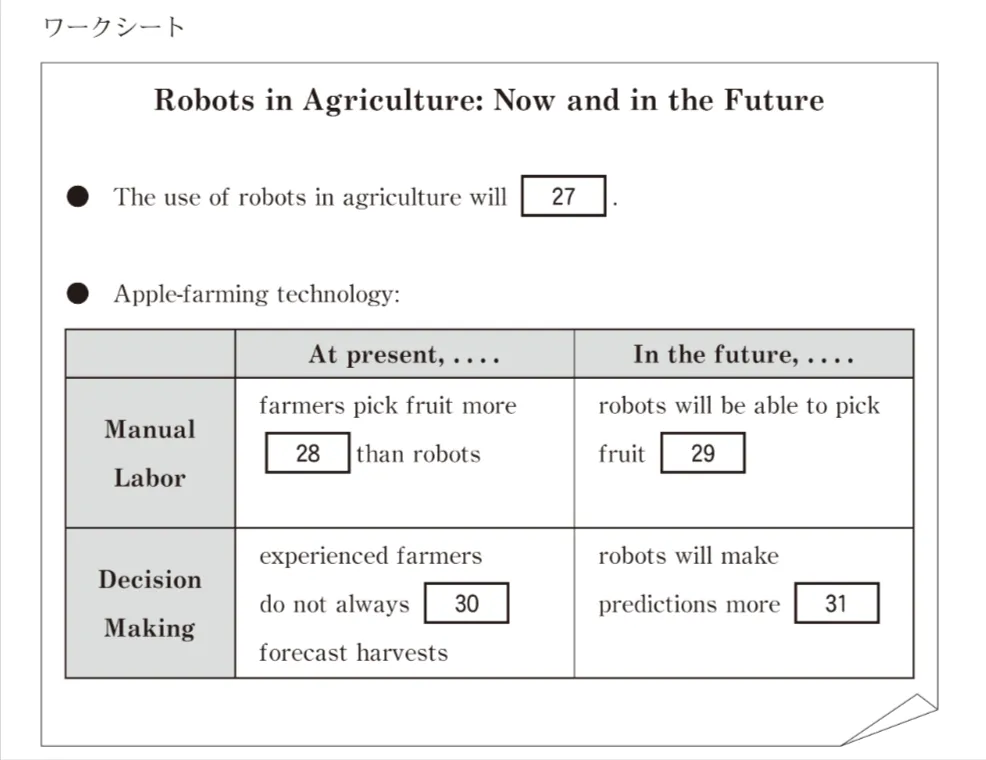
<状況>
あなたは大学で、農業用ロボットに関する講義を、ワークシートにメモを取りながら聞いています。
Today, we will learn about robots in agriculture. Robots are already used for planting, harvesting, and other jobs. Now, farm workers are retiring and there are not enough workers to take their place. Robots have the potential to help with this labor shortage and improve agricultural production. Let’s look at the apple industry and consider how robots can help with manual work and decision− making.
On apple farms in the U.S., both robots and humans do manual work. Now, robots are slower than humans at picking apples. However, in the future, advanced robots will be more effective because they will be able to keep working without a break, unlike humans. As technology improves, robots will better assist people in doing routine manual work like picking apples.
Currently, humans rather than robots make decisions. For example, farmers do an amazing job of anticipating how many apples they can harvest each year. However, even growers with a lot of experience are not always accurate and this can cause financial loss. In the future, data−collecting robots and AI are expected to work together to make more precise predictions about apple harvesting.
Does this mean all work, including non−routine work, will be done by robots? No, not at all. Some non−routine decision−making work and some manual work will still be done by humans. For example, robots have difficulty picking apples from trees of different shapes and sizes. Humans will still need to manage the trees by deciding the best shapes for harvesting, and cut the trees by hand.
Our first team will talk about the connection between robots and different types of agricultural work. Team 1, please start.
講義の内容と一致するものはどれか。最も適切なものを、四つの選択肢のうちから一つ選びなさい。
ワークシート
このページは閲覧用ページです。
履歴を残すには、 「新しく出題する(ここをクリック)」 をご利用ください。
問題
共通テスト(英語)試験 令和6年度(2024年度)追・再試験 問81(<旧課程>英語リスニング(第5問) 問6) (訂正依頼・報告はこちら)
次の講義を読み、問に答えなさい。
<状況>
あなたは大学で、農業用ロボットに関する講義を、ワークシートにメモを取りながら聞いています。
Today, we will learn about robots in agriculture. Robots are already used for planting, harvesting, and other jobs. Now, farm workers are retiring and there are not enough workers to take their place. Robots have the potential to help with this labor shortage and improve agricultural production. Let’s look at the apple industry and consider how robots can help with manual work and decision− making.
On apple farms in the U.S., both robots and humans do manual work. Now, robots are slower than humans at picking apples. However, in the future, advanced robots will be more effective because they will be able to keep working without a break, unlike humans. As technology improves, robots will better assist people in doing routine manual work like picking apples.
Currently, humans rather than robots make decisions. For example, farmers do an amazing job of anticipating how many apples they can harvest each year. However, even growers with a lot of experience are not always accurate and this can cause financial loss. In the future, data−collecting robots and AI are expected to work together to make more precise predictions about apple harvesting.
Does this mean all work, including non−routine work, will be done by robots? No, not at all. Some non−routine decision−making work and some manual work will still be done by humans. For example, robots have difficulty picking apples from trees of different shapes and sizes. Humans will still need to manage the trees by deciding the best shapes for harvesting, and cut the trees by hand.
Our first team will talk about the connection between robots and different types of agricultural work. Team 1, please start.
講義の内容と一致するものはどれか。最も適切なものを、四つの選択肢のうちから一つ選びなさい。
ワークシート
<状況>
あなたは大学で、農業用ロボットに関する講義を、ワークシートにメモを取りながら聞いています。
Today, we will learn about robots in agriculture. Robots are already used for planting, harvesting, and other jobs. Now, farm workers are retiring and there are not enough workers to take their place. Robots have the potential to help with this labor shortage and improve agricultural production. Let’s look at the apple industry and consider how robots can help with manual work and decision− making.
On apple farms in the U.S., both robots and humans do manual work. Now, robots are slower than humans at picking apples. However, in the future, advanced robots will be more effective because they will be able to keep working without a break, unlike humans. As technology improves, robots will better assist people in doing routine manual work like picking apples.
Currently, humans rather than robots make decisions. For example, farmers do an amazing job of anticipating how many apples they can harvest each year. However, even growers with a lot of experience are not always accurate and this can cause financial loss. In the future, data−collecting robots and AI are expected to work together to make more precise predictions about apple harvesting.
Does this mean all work, including non−routine work, will be done by robots? No, not at all. Some non−routine decision−making work and some manual work will still be done by humans. For example, robots have difficulty picking apples from trees of different shapes and sizes. Humans will still need to manage the trees by deciding the best shapes for harvesting, and cut the trees by hand.
Our first team will talk about the connection between robots and different types of agricultural work. Team 1, please start.
講義の内容と一致するものはどれか。最も適切なものを、四つの選択肢のうちから一つ選びなさい。
ワークシート
- Advanced technology could cause problems for fruit farms.
- Agricultural robots could take over farming from humans.
- Future advances in technology will result in job shortages.
- Robots will help humans improve agricultural production.
正解!素晴らしいです
残念...
画像拡大
この過去問の解説 (3件)
01
講義では、農業で働く人が減っているため、ロボットが人手不足を助ける可能性があると説明されています。また、リンゴの収穫や収穫量の予測などで、人間を助け、農業の生産をよくすることが期待されています。つまり、ロボットが人間に代わってすべてを行うのではなく、人間を助けて農業をよりよくするという内容です。
これは講義の内容と合いません。
講義では、ロボットやAIなどの技術が、果樹園に問題を起こすとは述べられていません。むしろ、ロボットは人手不足を助けたり、収穫量の予測をより正確にしたりするものとして説明されています。
これは講義の内容と合いません。
take overは「引き継ぐ」「すべてを代わりに行う」という意味です。しかし講義では、すべての仕事がロボットに置き換わるわけではないと説明されています。
たとえば、形や大きさの違う木からリンゴを取ることはロボットには難しく、人間が木の形を決めたり、手で剪定したりする必要があると述べられています。したがって、ロボットが農業を完全に人間から引き継ぐという内容ではありません。
これは講義の内容と合いません。
講義では、技術の進歩が仕事不足を生むとは言っていません。反対に、農業では働く人が退職し、その代わりになる人が足りないため、ロボットがその人手不足を助ける可能性があると説明されています。
つまり、問題は技術が仕事不足を起こすことではなく、すでに人手が足りないことです。
これは講義の内容に合っています。
講義では、ロボットは人手不足を助け、農業の生産をよくする可能性があると述べられています。また、将来のロボットは休まず働き続けられるため、リンゴの収穫のような決まった作業で人間を助けることが期待されています。
さらに、データを集めるロボットとAIが協力すれば、収穫量の予測もより正確になると説明されています。つまり、ロボットは人間を助けながら、農業の生産を向上させる役割を持つと分かります。
この講義の中心は、農業用ロボットが人間の仕事をすべて奪うという話ではありません。農業では人手が足りなくなっており、ロボットはその問題を助けるものとして紹介されています。
ロボットは、リンゴの収穫のような決まった作業を助けたり、AIとともに収穫量をより正確に予測したりできます。一方で、木の形を決めることや手で剪定することなど、人間が続けて行う仕事もあります。
したがって、講義の内容に最も合うのは、Robots will help humans improve agricultural production.です。
参考になった数0
この解説の修正を提案する
02
内容一致の問題は、全体の内容と、今回であれば表を埋めていったので、
そこをよく読み内容を捉えることが重要です。
訳)高度な技術が果樹園に問題を引き起こす可能性がある
→間違い
講義では技術(ロボット・AI)が労働者不足を補い、予測の精度を高めるというポジティブな内容が強調されており、
問題を引き起こすとは書かれていません。
訳)農業用ロボットが人間から農業を乗っ取る可能性がある
→間違い
講義の後半部分で、
Does this mean all work, including non−routine work, will be done by robots? No, not at all.
すべての作業がロボットによって行われるということでしょうか?いいえ、決してそうではありません。
とあり、人間による管理や手作業の必要性が強調されています。
訳)将来の技術進歩が仕事不足を招くだろう
→間違い
講義では現在すでに労働者不足が発生していることが問題視されており、
ロボットはその不足を補うものとして紹介されています。
訳)ロボットは人間が農業生産を向上させるのを助けるでしょう。
→正しい
Robots have the potential to help with this labor shortage and improve agricultural production.
ロボットには、この労働力不足を助け、農業生産を向上させる可能性があります。とあり、この講義の内容と適しているのはこの選択肢です。
参考になった数0
この解説の修正を提案する
03
この問題は、放送内容を要約した結論を選ぶ問題です。
表中で問われていない箇所が、解答に関わる可能性が非常に高いです。
したがって、Does this mean all work, ~以降を重点的に聴いていきましょう。
大まかな流れや結論が理解できば大丈夫です。
特に重要な箇所は
Does this mean all work, including non−routine work, will be done by robots?
(これはすべての仕事をロボットが担う、ということを意味するのでしょうか)
No, not at all. (いいえ、ちがいます)
Some non−routine decision−making work and some manual work will still be done by humans.
(決定する仕事やいくつかの手作業は、人間によってなされることになるでしょう)
Our first team will talk about the connection between robots and different types of agricultural work.
(我々のチームはロボットと農業を繋ぐことに関して話していきます)
要するに、「人間とロボットの双方が農業をしていく」という趣旨のものを選ぶことになります。
「進歩した科学技術は果実農園に問題を引き起こしている」
ロボットのような技術をマイナスにとらえており、不正解です。
*cause 引き起こす
「農業ロボットは人間から農業を引き継ぐことができる」
人間にしかできないことがあるので不正解です。
*take over 引き継ぐ
「科学技術における未来の進歩は、仕事不足という結果になるであろう」
ロボットが人間に取って代わるわけではないので、不正解です。
正解 「ロボットは人間が農業生産を改善するのを助けるでしょう」
ロボットが人間を助けるという視点の解答になっています。
要点を問われる問題では、細かい英語よりも、大まかな内容をとらえるように意識しましょう。
参考になった数0
この解説の修正を提案する
前の問題(問80)へ
令和6年度(2024年度)追・再試験 問題一覧
次の問題(問82)へ